
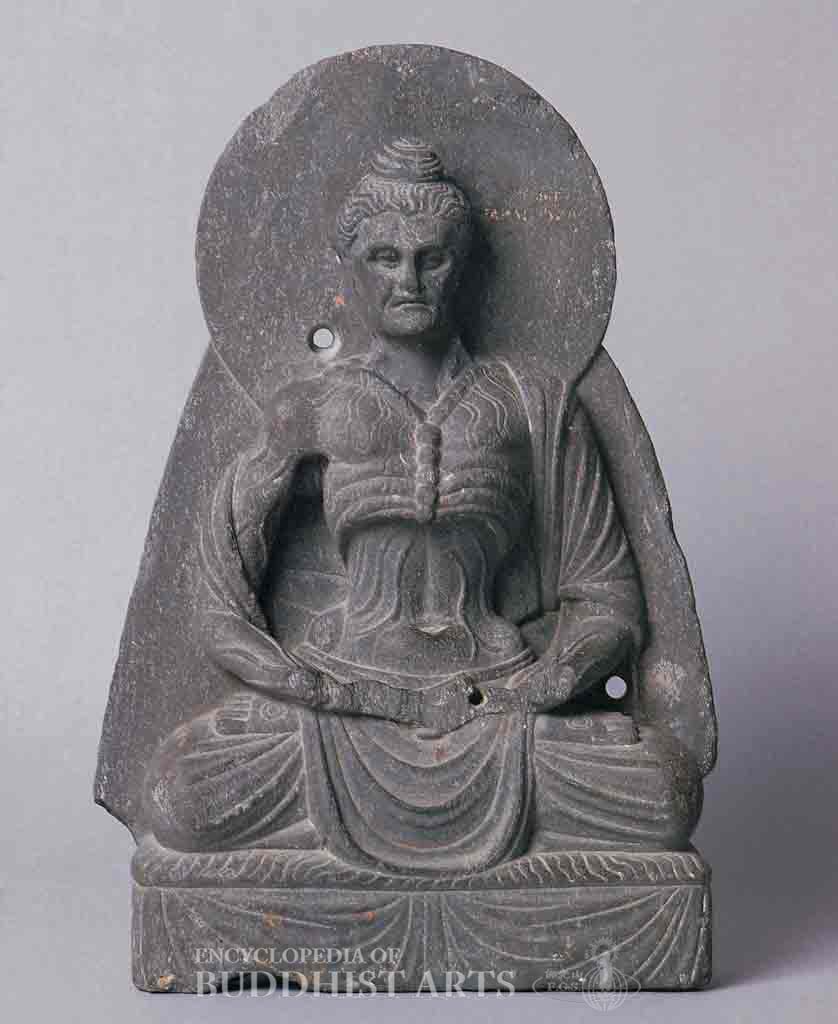
Jamal Garhi: Ascetic Sakyamuni
Schist
Jamal Garhi: Ascetic Sakyamuni
PAKISTAN, Khyber Pakhtunkhwa, Jamal Garhi
Discovered in the 19th century, the site of Jamal Garhi featured a central stupa surrounded by monastic quarters, an assembly hall, many small stupas and more than ten shrines. This statue of Prince Siddhartha during his six years of ascetic life was among the large number of artifacts excavated from the site. According to Buddhist scriptures, he ate only one sesame seed and one grain of rice each day during this time, resulting in his emaciated appearance. The figure sits in the full lotus position with hands in dhyana (meditation) mudra and the mouth turned down in resolution. The nimbus is circular but the intersecting aureole has triangular curves which may not have been its original shape.
For more details, go to the Encyclopedia of Buddhist Arts: Sculpture G-M, page 477.
Cite this article:
author = Hsingyun and Youheng and Lovelock, Yann and Chou, Yuan and Huntington, Susan and Edson, Gary and Neather, Robert,
booktitle = {Encyclopedia of Buddhist Arts: Sculpture G-M},
pages = 477,
title = {{Jamal Garhi: Ascetic Sakyamuni}},
volume = 11,
year = {2016}}