
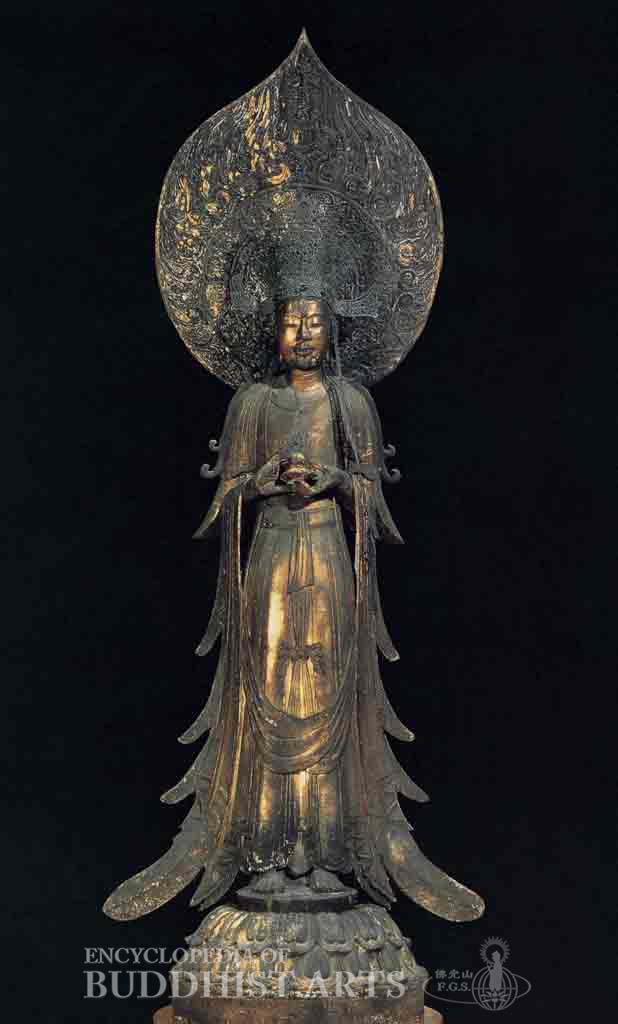
Horyuji Temple Hall of Dreams: Avalokitesvara Bodhisattva
Gilt camphor wood
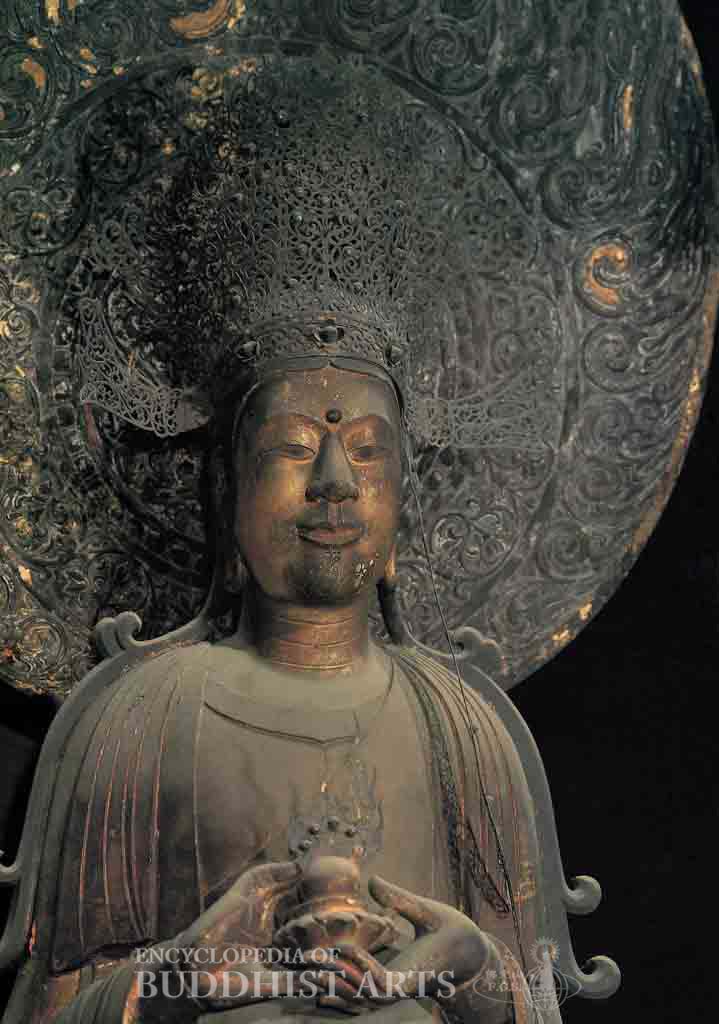
Horyuji Temple Hall of Dreams: Avalokitesvara Bodhisattva (detail)
Horyuji Temple Hall of Dreams: Avalokitesvara Bodhisattva
JAPAN, Nara, Ikoma; Asuka period
The statue resides in the Hall of Dreams. Records state that the statue is the life-size representation of Prince Shotoku, and it was suggested that he served as the model. The statue’s workmanship is characteristic of sculptor Tori and it was listed as a National Treasure in 1951.
The figure is carved from a single piece of wood and is solid inside. A tall bejeweled crown is worn over stylized cascading hair. The crown is created from a copper plate with intricate openwork carving. The petal-shaped nimbus behind the head is carved from wood and decorated with vine-like designs and stylized flames. A flaming jewel is held in both hands. The sleeves of the robe and the stole extend outward in an exaggerated manner from the waist down. The figure’s outline is elegantly sinuous from the side, with the abdomen protruding slightly and the shoulders thrown back, in a style influenced by the Chinese Northern Wei dynasty (386–534) and the Korean Baekje period (18 BCE–663 CE).
The statue was kept hidden from sight within the shrine for centuries, wrapped in layers of white cloth, until it was jointly unveiled by American art researcher Ernest Fenollosa and Japanese art academic Okakura Tenshin in 1884. It is put on display for public veneration during certain times of the year.
For more details, go to the Encyclopedia of Buddhist Arts: Sculpture G-M, page 458.
Cite this article:
author = Hsingyun and Youheng and Lovelock, Yann and Chou, Yuan and Huntington, Susan and Edson, Gary and Neather, Robert,
booktitle = {Encyclopedia of Buddhist Arts: Sculpture G-M},
pages = 458,
title = {{Horyuji Temple Hall of Dreams: Avalokitesvara Bodhisattva}},
volume = 11,
year = {2016}}