
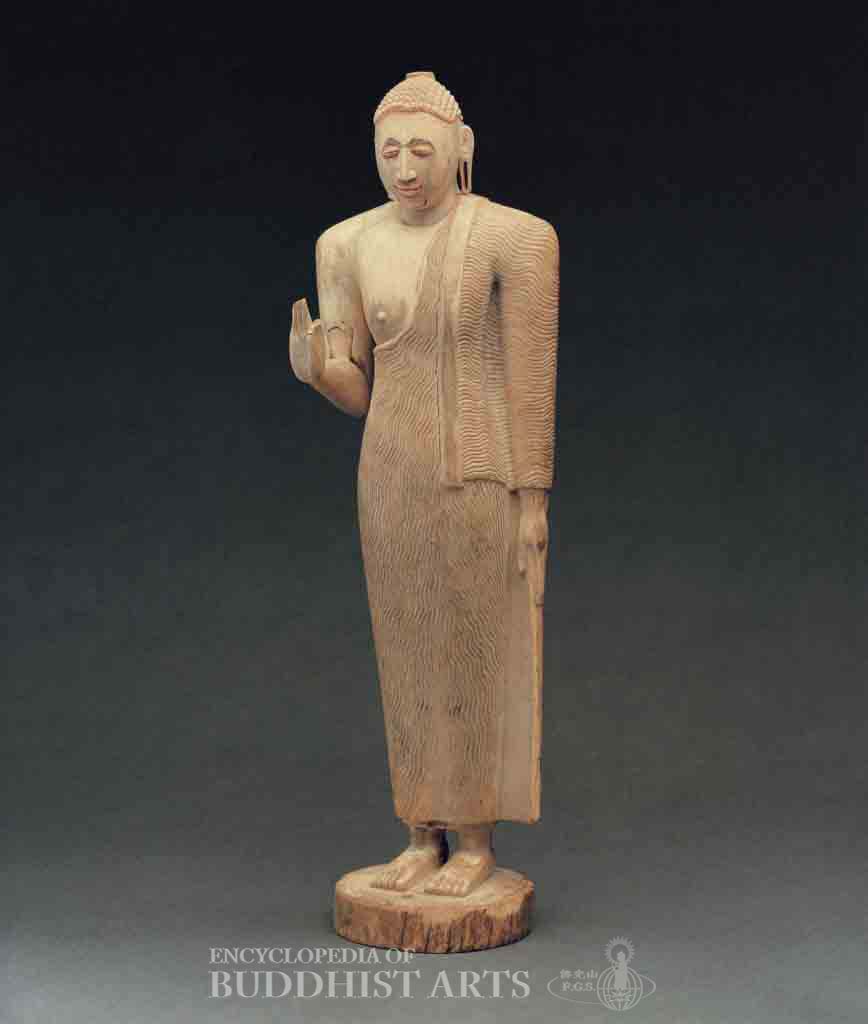
Standing Buddha
Ivory
Standing Buddha
SRI LANKA
The statuette was created during the Kandy Kingdom (circa 1590–1815). The Buddha has tightly curled hair from which the flame at the crown has broken. The round face is portrayed with large, half-closed eyes, a long nose, and thick upturned lips. The hollowed earlobes stretch almost to the shoulders. There are traces of red and black pigment around the eyes, mouth, and chin.
The broad shouldered body appears rather stiff. The right hand is raised in abhaya (fearlessness) mudra and the left hand is held rigidly at the side. The fingers are slender and the toes are of equal length, which are characteristics of the Buddha. The monastic robe leaves the right shoulder bare and hangs to the ankles in a pattern of dense, rippling lines that is a special feature of Kandyan sculptures.
For more details, go to the Encyclopedia of Buddhist Arts: Sculpture St-Z, page 1153.
Cite this article:
author = Hsingyun and Youheng and Lovelock, Yann and Chou, Yuan and Huntington, Susan and Edson, Gary and Neather, Robert,
booktitle = {Encyclopedia of Buddhist Arts: Sculpture St-Z},
pages = 1153,
title = {{Standing Buddha}},
volume = 13,
year = {2016}}