
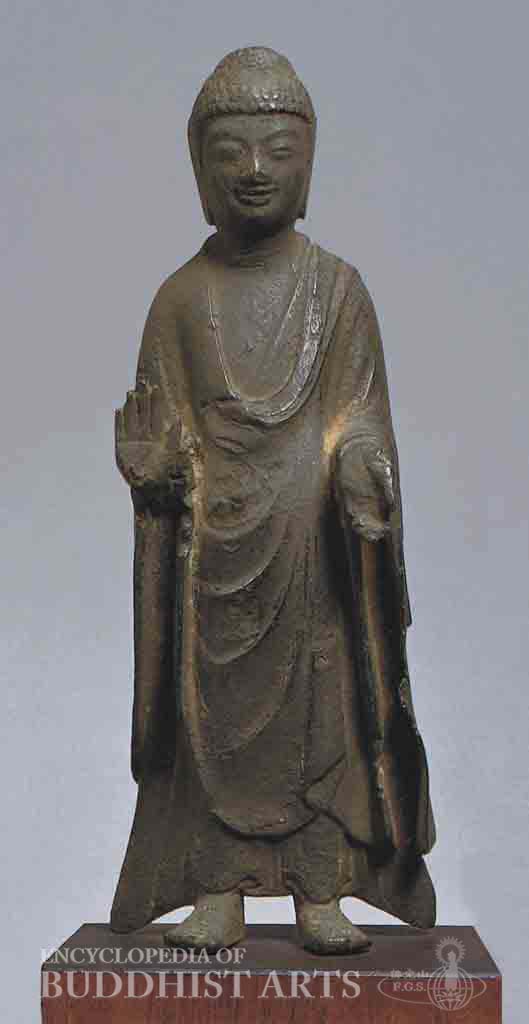
Sakyamuni Buddha
Copper alloy
Sakyamuni Buddha
JAPAN; Asuka period
The statue shows influence from the Tori school of Japanese art. The Buddha’s oval face is distinguished by the narrowed eyes and pronounced lips that part into a broad smile. The figure wears a monastic robe and makes the abhaya (fearlessness) mudra with the right hand and the varada (wish-granting) mudra with the left hand. The hem of the garment extends outward in a fin-like shape, characteristic of the Asuka period (538–645). The statue was originally gilded but was damaged in a fire and required replacement of the arms, although residual damage is still visible.
For more details, go to the Encyclopedia of Buddhist Arts: Sculpture N-Sr, page 919.
Cite this article:
Hsingyun, et al. "Sakyamuni Buddha." Encyclopedia of Buddhist Arts: Sculpture N-Sr, vol. 12, 2016, pp. 919.
Hsingyun, Youheng, Yann Lovelock, Yuan Chou, Susan Huntington, Gary Edson, and Robert Neather. 2016. "Sakyamuni Buddha" In Encyclopedia of Buddhist Arts: Sculpture N-Sr, 12:919.
Hsingyun, Youheng, Lovelock, Y., Chou, Y., Huntington, S., Edson, G., & Neather, R.. (2016). Sakyamuni Buddha. In Encyclopedia of Buddhist Arts: Sculpture N-Sr (Vol. 12, pp. 919).
@misc{Hsingyun2016,
author = Hsingyun and Youheng and Lovelock, Yann and Chou, Yuan and Huntington, Susan and Edson, Gary and Neather, Robert,
booktitle = {Encyclopedia of Buddhist Arts: Sculpture N-Sr},
pages = 919,
title = {{Sakyamuni Buddha}},
volume = 12,
year = {2016}}
author = Hsingyun and Youheng and Lovelock, Yann and Chou, Yuan and Huntington, Susan and Edson, Gary and Neather, Robert,
booktitle = {Encyclopedia of Buddhist Arts: Sculpture N-Sr},
pages = 919,
title = {{Sakyamuni Buddha}},
volume = 12,
year = {2016}}