
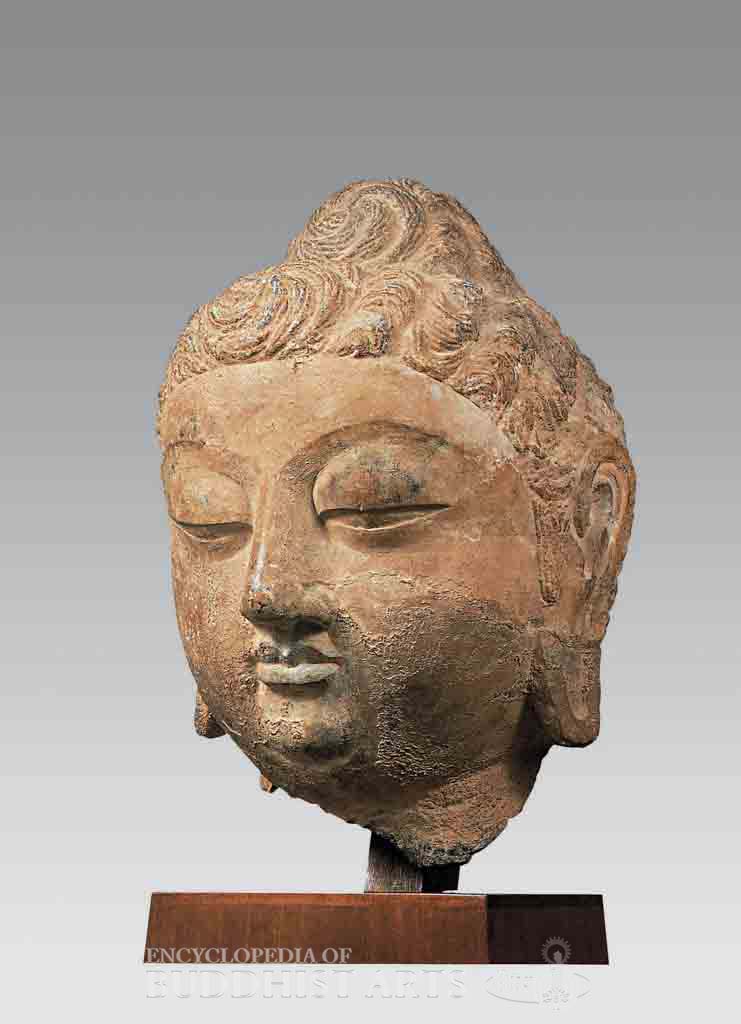
Head of a Buddha
Stone
Head of a Buddha
CHINA; Tang dynasty
The head is believed to have originated from the Longmen Grottoes, where it formed part of the 49 standing figures enshrined in the Buddha niches along the walls. If so, it would have been created around 712 to 756.
Some of the paint is still visible, more so on the curly hair, eyelids and around the mouth. Several whorls along the front of head builds into a usnisa. The face is broad with deep-set eyes beneath the perfect eyebrows and the curved line of the eyebrows is continued to form an aquiline nose. The mouth is small and bow-shaped. The style is reminiscent of the Gupta period (circa 320–550), but simpler and with Chinese characteristics.
For more details, go to the Encyclopedia of Buddhist Arts: Sculpture G-M, page 417.
Cite this article:
Hsingyun, et al. "Head of a Buddha." Encyclopedia of Buddhist Arts: Sculpture G-M, vol. 11, 2016, pp. 417.
Hsingyun, Youheng, Yann Lovelock, Yuan Chou, Susan Huntington, Gary Edson, and Robert Neather. 2016. "Head of a Buddha" In Encyclopedia of Buddhist Arts: Sculpture G-M, 11:417.
Hsingyun, Youheng, Lovelock, Y., Chou, Y., Huntington, S., Edson, G., & Neather, R.. (2016). Head of a Buddha. In Encyclopedia of Buddhist Arts: Sculpture G-M (Vol. 11, pp. 417).
@misc{Hsingyun2016,
author = Hsingyun and Youheng and Lovelock, Yann and Chou, Yuan and Huntington, Susan and Edson, Gary and Neather, Robert,
booktitle = {Encyclopedia of Buddhist Arts: Sculpture G-M},
pages = 417,
title = {{Head of a Buddha}},
volume = 11,
year = {2016}}
author = Hsingyun and Youheng and Lovelock, Yann and Chou, Yuan and Huntington, Susan and Edson, Gary and Neather, Robert,
booktitle = {Encyclopedia of Buddhist Arts: Sculpture G-M},
pages = 417,
title = {{Head of a Buddha}},
volume = 11,
year = {2016}}