
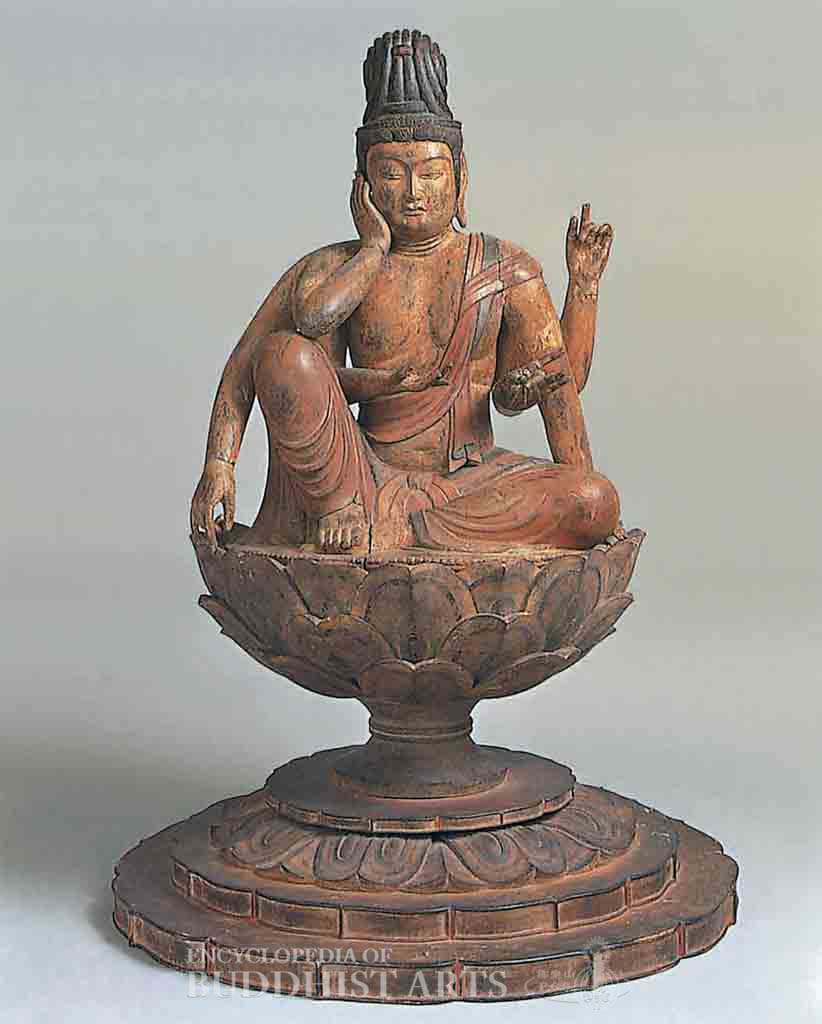
Cintamanicakra Avalokitesvara
Wood
Cintamanicakra Avalokitesvara
JAPAN; Heian period
This six-armed Cintamanicakra Avalokitesvara was created about the turn of the 10th century. Most of the body was carved from a single piece of wood to which the limbs were added later. Traces of the lacquer, paint, and gold leaf with which it was coated remain. The first hand on the left rests on the cheek, the second once held the wish-fulfilling jewel after which this form of the Bodhisattva is named, while the third hand holds some prayer beads. The bottom hand on the right supports the body as it sits in the posture of royal ease, while the second and third hands once held a lotus and a Dharma wheel. A stole crosses the upper body and the skirt clings to the legs. The high head ornaments, the meditative facial expression, the full proportions and the wave-like drapery are all features of 9th and 10th century carving.
For more details, go to the Encyclopedia of Buddhist Arts: Sculpture A-F, page 264.
Cite this article:
author = Hsingyun and Youheng and Lovelock, Yann and Chou, Yuan and Huntington, Susan and Edson, Gary and Neather, Robert,
booktitle = {Encyclopedia of Buddhist Arts: Sculpture A-F},
pages = 264,
title = {{Cintamanicakra Avalokitesvara}},
volume = 10,
year = {2016}}