
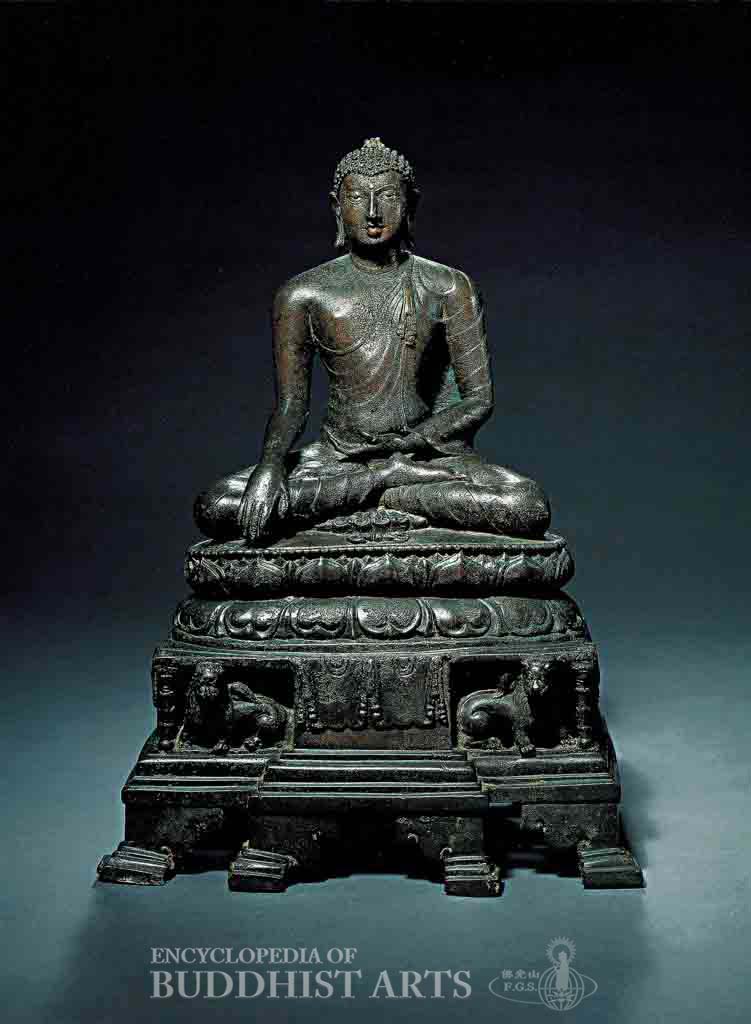
Aksobhya Buddha
Bronze inlaid with silver and copper
Aksobhya Buddha
INDIA, Bihar
The bronze figure was cast during the Pala period (circa 8th–12th century) using the lost-wax technique. This piece is believed to be from Bihar because eastern India was recognized for its rich mineral deposits, and the area is known for producing metal sculptures. The urna and eyes are inlaid with silver, and the lips are overlaid in copper. This style of utilizing different metals to accentuate facial details was popular during the Pala period.
The usnisa on the statue is damaged. The hairline forms a slight widow’s peak. Lining beneath the eyes accentuates them. The figure sits in full lotus position on a double lotus throne with the right hand in the bhumisparsa (earth-touching) mudra and left hand resting in the lap. The monastic robe covers the left shoulder only and hangs down in folds while the hem spreads out on the throne with Aksobhya’s attribute, a vajra, placed before it. Lions crouch at the corners of the base that supports the throne, divided by embroidered cloths.
For more details, go to the Encyclopedia of Buddhist Arts: Sculpture A-F, page 11.
Cite this article:
author = Hsingyun and Youheng and Lovelock, Yann and Chou, Yuan and Huntington, Susan and Edson, Gary and Neather, Robert,
booktitle = {Encyclopedia of Buddhist Arts: Sculpture A-F},
pages = 11,
title = {{Aksobhya Buddha}},
volume = 10,
year = {2016}}