
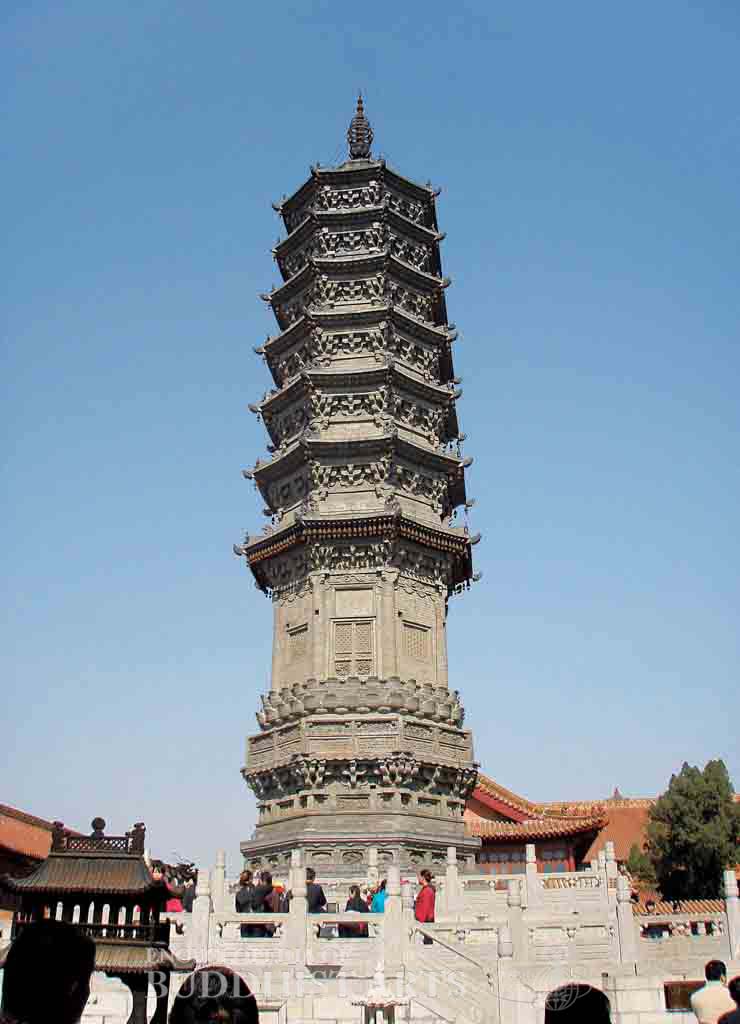
Bolin Chan Monastery Pagoda
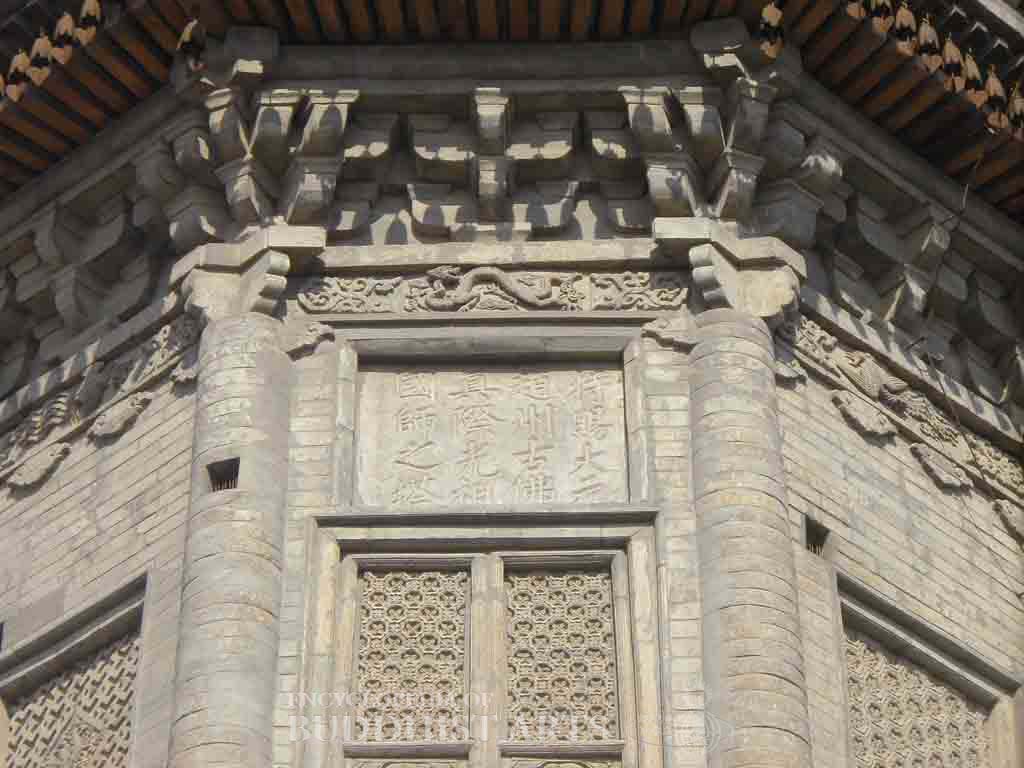
Bolin Chan Monastery Pagoda (detail)
Bolin Chan Monastery Pagoda
CHINA, Hebei, Shijiazhuang
The pagoda is also called the Pagoda of Chan Master Zhenji. The pagoda was built in 1330 during the Yuan dynasty in memory of Chan Master Zhaozhou Congshen, also known as Zhenji, of the Tang dynasty (618–907). It was listed as a National Cultural Heritage Site in 2006.
The seven-tier, octagonal, brick pagoda is 39.5 m high. It stands on a double-tier stone base platform with a brick double Sumeru base above. Carvings of apsaras and warriors can be found on the concave part of the Sumeru base. At the top of the base there are brick bracket sets which support a flat base with balustrades. Above that there is a four-tier upturned lotus around the body of the pagoda. False lattice doors face the four cardinal directions on the first tier, while the remaining walls have false lattice windows. On the rest of the pagoda the eaves are close together with bracket sets supporting them. The iron spire consists of an inverted bowl, an upright lotus, stacked rings, and jewels.
For more details, go to the Encyclopedia of Buddhist Arts: Architecture A-F, page 86.
Cite this article:
author = Hsingyun and Youheng and Johnson, Peter and Mankuang and Lancaster, Lewis,
booktitle = {Encyclopedia of Buddhist Arts: Architecture A-F},
pages = 86,
title = {{Bolin Chan Monastery Pagoda}},
volume = 1,
year = {2016}}