
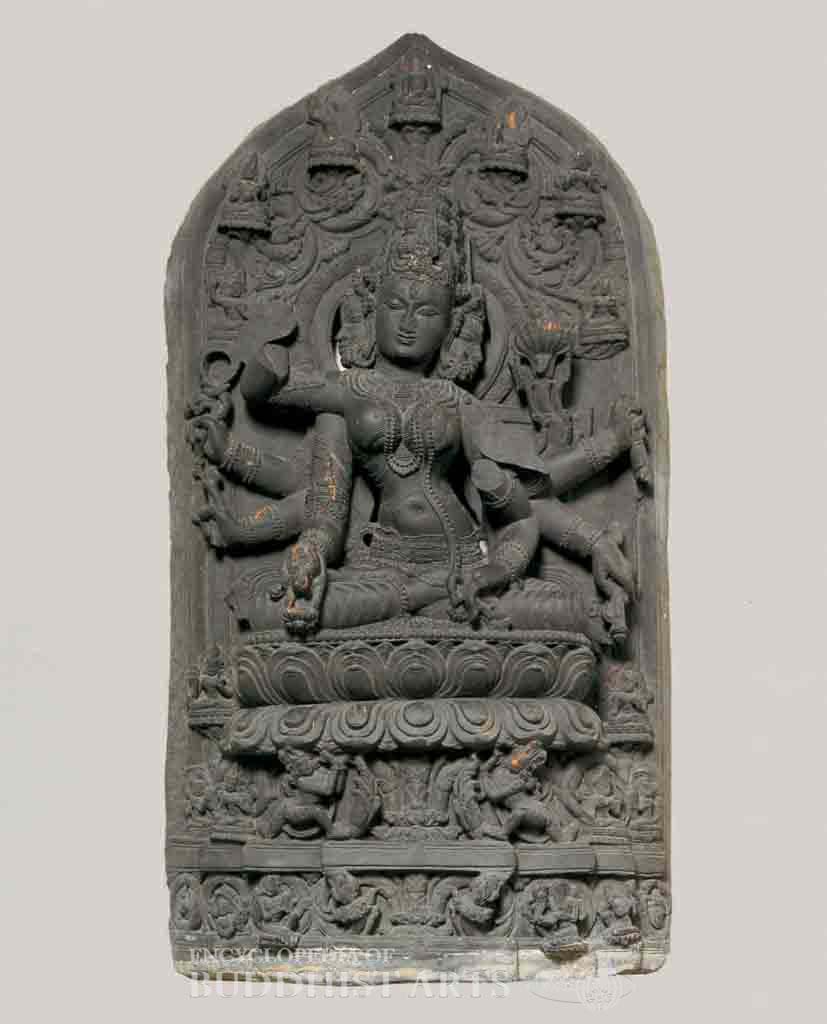
Four-Headed, Eight-Armed Vajra Tara
Stone
Four-Headed, Eight-Armed Vajra Tara
INDIA
The relief was created during the late Pala period (circa 8th–12th century) and illustrates the Vajra Tara described in the Vajrayana Sadhanamala. The sculpture may also have been from Bangladesh.
Although the Bodhisattva is described as having four heads, only three are visible. The figure sits in full lotus position with the body sinuously posed. The upper body is richly adorned with jewelry, while the lower body is clad in a thin skirt. The topmost right arm is broken but is assumed to have held a vajra; the other three right hands hold a noose, an arrow and a conch. The top left arm is also broken and may have formed the karana (warding off evil) mudra. The three left hands hold a lotus, a bow and an elephant goad. The figure sits on an intricate double lotus throne supported by Dharma protectors.
There are seven seated figures at the top of the mandorla, six of which are other forms of Tara with Aksobhya Buddha at the apex. Another pair of Taras is found on either side of the lotus throne, while two more are located immediately below, making a total of ten such figures. Together they form the Vajra Tara mandala.
For more details, go to the Encyclopedia of Buddhist Arts: Sculpture A-F, page 353.
Cite this article:
author = Hsingyun and Youheng and Lovelock, Yann and Chou, Yuan and Huntington, Susan and Edson, Gary and Neather, Robert,
booktitle = {Encyclopedia of Buddhist Arts: Sculpture A-F},
pages = 353,
title = {{Four-Headed, Eight-Armed Vajra Tara}},
volume = 10,
year = {2016}}