
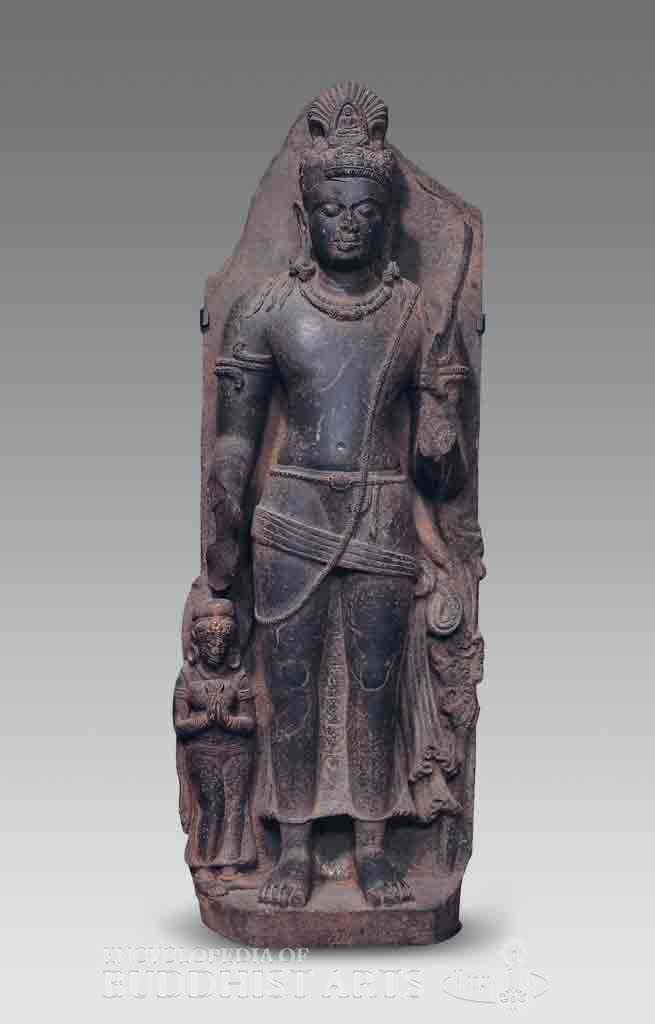
Bihar: Avalokitesvara Bodhisattva
Schist
Bihar: Avalokitesvara Bodhisattva
INDIA, Bihar
This statue was discovered in Bihar and dates to the late 7th or early 8th century. The facial expression on the statue and its clothing are characteristic of Buddhist figures. Its robustness and the slightly rigid posture, as well as the square face and the jewelry reflect the early Pala period (circa 8th–12th century).
Avalokitesvara Bodhisattva’s hair is tied in an elaborate topknot that fans out above the headdress, which has an Amitabha Buddha at the center. A few locks of hair drape down the shoulders. Avalokitesvara wears jewelry, including large earrings, a necklace, armlets, and a belt. A sacred thread hangs diagonally from the left shoulder and reaches down to the thighs. A sash tied at one side hangs precariously around the hips. The figure wears a diaphanous dhoti. Although the hands are missing, the long stem passing over the upper left arm suggests that the left hand was holding a lotus by the stem. A female offering figure, with palms joined, stands on the Bodhisattva’s right.
For more details, go to the Encyclopedia of Buddhist Arts: Sculpture A-F, page 144.
Cite this article:
author = Hsingyun and Youheng and Lovelock, Yann and Chou, Yuan and Huntington, Susan and Edson, Gary and Neather, Robert,
booktitle = {Encyclopedia of Buddhist Arts: Sculpture A-F},
pages = 144,
title = {{Bihar: Avalokitesvara Bodhisattva}},
volume = 10,
year = {2016}}