
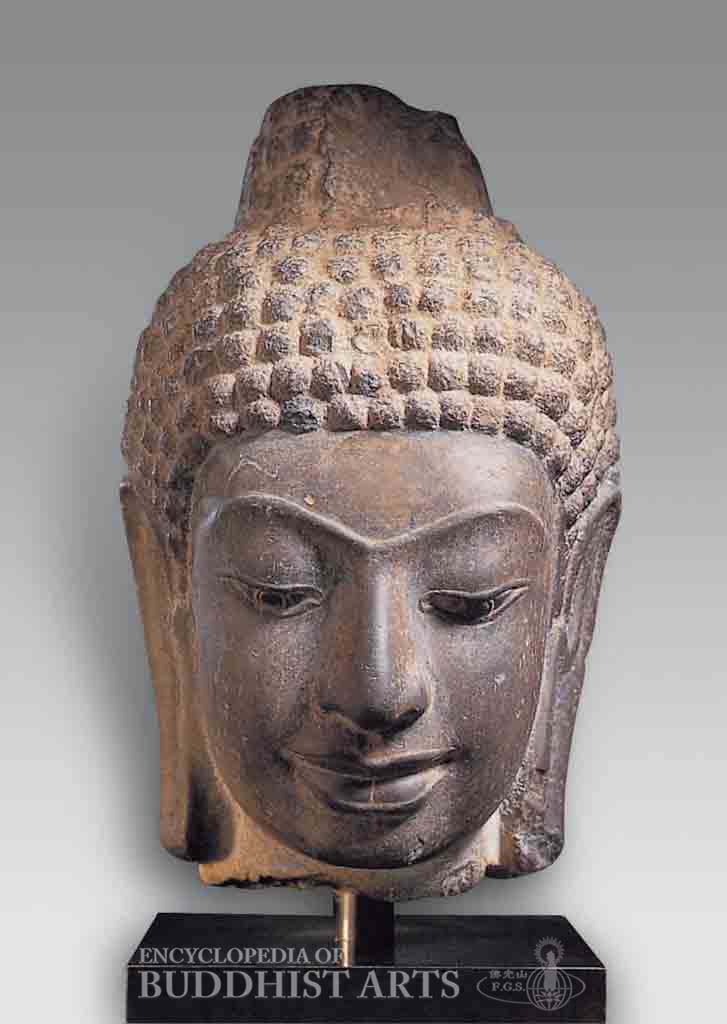
Head of Sakyamuni Buddha
Limestone
Head of Sakyamuni Buddha
THAILAND; Dvaravati Kingdom
This Dvaravati (circa 6th–13th century) sculpture shows many traits commonly found on statues of that era, despite some subtle variations. The similarities include a tall, curled usnisa, joined eyebrows, a broad nose, a wide mouth, and a thick lower lip.
The upward-rising curve of the eyebrows frames the lower face, where the nasal bridge is higher than usual. The half-closed eyes and the lips are enhanced by an outline that gives the facial features more distinction. The curls on the head are simply depicted, perhaps to direct the attention downward. The work shows the creativity of the sculptor, who added embellishments, but at the same time kept them within the artistic boundaries of the era.
For more details, go to the Encyclopedia of Buddhist Arts: Sculpture G-M, page 421.
Cite this article:
author = Hsingyun and Youheng and Lovelock, Yann and Chou, Yuan and Huntington, Susan and Edson, Gary and Neather, Robert,
booktitle = {Encyclopedia of Buddhist Arts: Sculpture G-M},
pages = 421,
title = {{Head of Sakyamuni Buddha}},
volume = 11,
year = {2016}}