
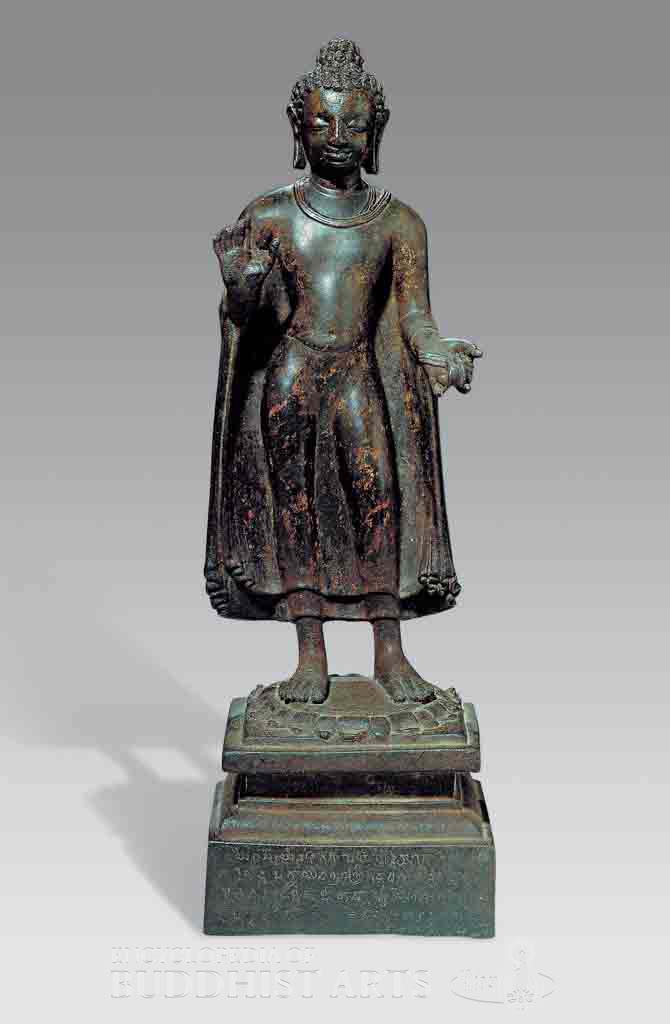
Standing Buddha
Bronze
Standing Buddha
INDIA
The Buddha’s tightly curled hair builds to a high usnisa. Other signs of his status include extended earlobes, three lines on the neck, and even length of fingers and toes with webbing between. The facial features are Indian, with hooded eyes, broad nose, and a thickened lower lip. The monastic robe covers both shoulders, the robe material so sheer that the body is fully apparent beneath. The right hand is raised in abhaya (fearlessness) mudra, while the left hand tightens the fold of the robe around that arm. The figure is standing on a flattened lotus.
The clothing and posture are reminiscent of the Sarnath images dated from the Gupta period (circa 320–550), but the well-fleshed cheeks are not typical. The inscription along the base implies that the sculpture may be from Nepal. Another theory is that the figure was first sculpted in India then taken to Nepal where the inscription was added.
For more details, go to the Encyclopedia of Buddhist Arts: Sculpture St-Z, page 1138.
Cite this article:
author = Hsingyun and Youheng and Lovelock, Yann and Chou, Yuan and Huntington, Susan and Edson, Gary and Neather, Robert,
booktitle = {Encyclopedia of Buddhist Arts: Sculpture St-Z},
pages = 1138,
title = {{Standing Buddha}},
volume = 13,
year = {2016}}