
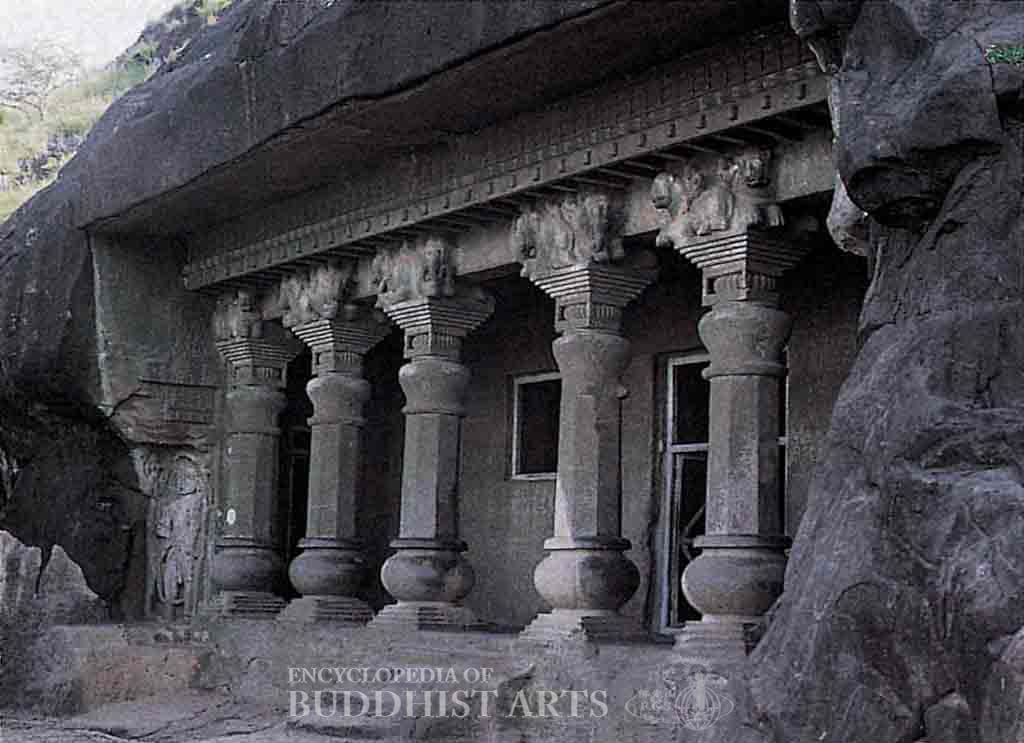
Nasik Cave 10
Nasik Cave 10
INDIA, Maharashtra, Aurangabad
This vihara cave was built in the late 1st to early 2nd century. Inscriptions within the portico and main hall name the Ksaharata family as the donors. The family would have financed the construction of the cave as an offering to the monastic community and for the accumulation of merit.
The portico is 11.4 m wide, 3.6 m high, and 2.9 m deep, with two cells situated on each end. A row of six columns is located in front of the portico. The column bases are round and supported by stepped, square plinths. The column shafts are octagonal. Tamarind trees, human figures, and mythical creatures are carved above the column capitals.
Sixteen cells are cut into the walls of the main hall, five on each side, and six along the back. Stone beds are hewn into the walls of each cell. A relief on the back wall of the main hall depicts a stupa with attendants on each side. There are no other decorative works within the cave.
For more details, go to the Encyclopedia of Buddhist Arts: Caves Mo-S, page 1264.
Cite this article:
author = Hsingyun and Youheng and Johnson, Peter and Mankuang and Huntington, Susan and Edson, Gary and Neather, Robert,
booktitle = {Encyclopedia of Buddhist Arts: Caves Mo-S},
pages = 1264,
title = {{Nasik Cave 10}},
volume = 8,
year = {2016}}