
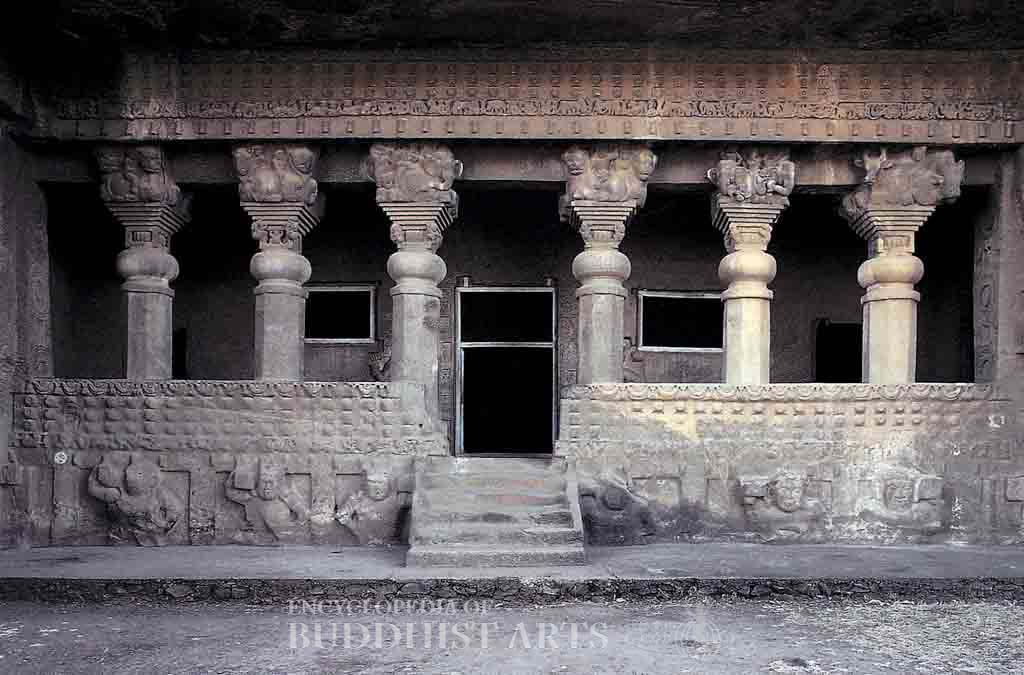
Nasik Cave 3

Nasik Cave 3: Main Hall

Nasik Cave 3: Main Hall - Stupa Relief
Nasik Cave 3
INDIA, Maharashtra, Aurangabad
This vihara cave was created in the 2nd century during the Satavahana period (circa 200 BCE–250 CE), and was funded by the mother of King Gautamiputra Satakarni (reigned circa 78–102).
The balustrades at the front of the portico are supported by reliefs of yaksas, each with an arm raised to support the structure above. This signifies that the building is supported by the power of the earth. The balustrades are embellished with lattice-like patterns and a row of lotus flowers. There are six octagonal columns, each with a rounded upper section. The capitals are carved with an elephant, lion, bull, or human figure. The engravings on the frieze imitate wooden structures and are decorated with images of lotuses, elephants, bulls, and swans. An inscription on the right wall states that the land was donated and cannot be taxed or interfered with by government.
The interior of the cave contains cells with stone beds along the three walls, and a relief of a stupa on the back wall. The base of the stupa is embellished with lotuses followed by some balustrades. The unadorned stupa body is in the shape of an inverted bowl, above which is a harmika and corbeling, followed by five canopies. Two apsaras fly above the stupa, and an attendant stands on each side. This stupa relief is the main object of veneration within the vihara cave, and is considered its distinguishing feature.
For more details, go to the Encyclopedia of Buddhist Arts: Caves Mo-S, page 1263.
Cite this article:
author = Hsingyun and Youheng and Johnson, Peter and Mankuang and Huntington, Susan and Edson, Gary and Neather, Robert,
booktitle = {Encyclopedia of Buddhist Arts: Caves Mo-S},
pages = 1263,
title = {{Nasik Cave 3}},
volume = 8,
year = {2016}}