

Qingxiu Yuan Temple
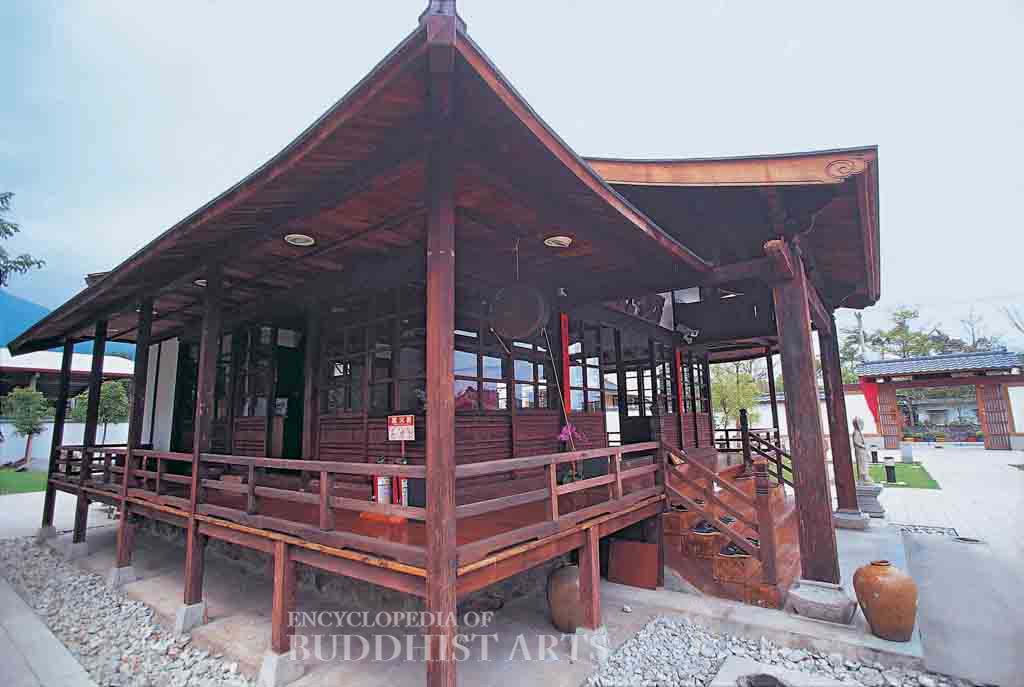
Qingxiu Yuan Temple
Qingxiu Yuan Temple
TAIWAN, Hualien
This is the only remaining Japanese temple of the Shingon school in Taiwan. It was built in 1917 as a religious hall of the Shingon school by immigrants from a village in Shikoku. In 1945 it was renamed Qingxiu Yuan Temple and restored in 2002. A year later it was opened to public. The temple was listed as a Municipal Historic Monument.
The temple is built in the Japanese Koyasan Shingon tradition. The wooden main hall has a pyramidal roof covered with metal roofing. The portico below the extended eaves is built in the style of the Edo period (1615–1868) and consists of components such as architraves, bracket sets, and protruding beam heads. The hall is raised off the ground and has a veranda on three sides. It is a three-by-four bay structure with the middle bay projecting at the rear forming the sanctuary. A statue of Sakyamuni Buddha is enshrined within the hall. On the outside there is a statue of Acala on the right side. The temple also houses stone statues of the Eighty-Eight Buddhas.
For more details, go to the Encyclopedia of Buddhist Arts: Architecture M-S, page 880.
Cite this article:
author = Hsingyun and Youheng and Johnson, Peter and Mankuang and Lancaster, Lewis,
booktitle = {Encyclopedia of Buddhist Arts: Architecture M-S},
pages = 880,
title = {{Qingxiu Yuan Temple}},
volume = 3,
year = {2016}}