
Guangyuan Thousand Buddha Cliff Rock Carvings Cave 806
Guangyuan Thousand Buddha Cliff Rock Carvings Cave 806
CHINA, Sichuan, Guangyuan
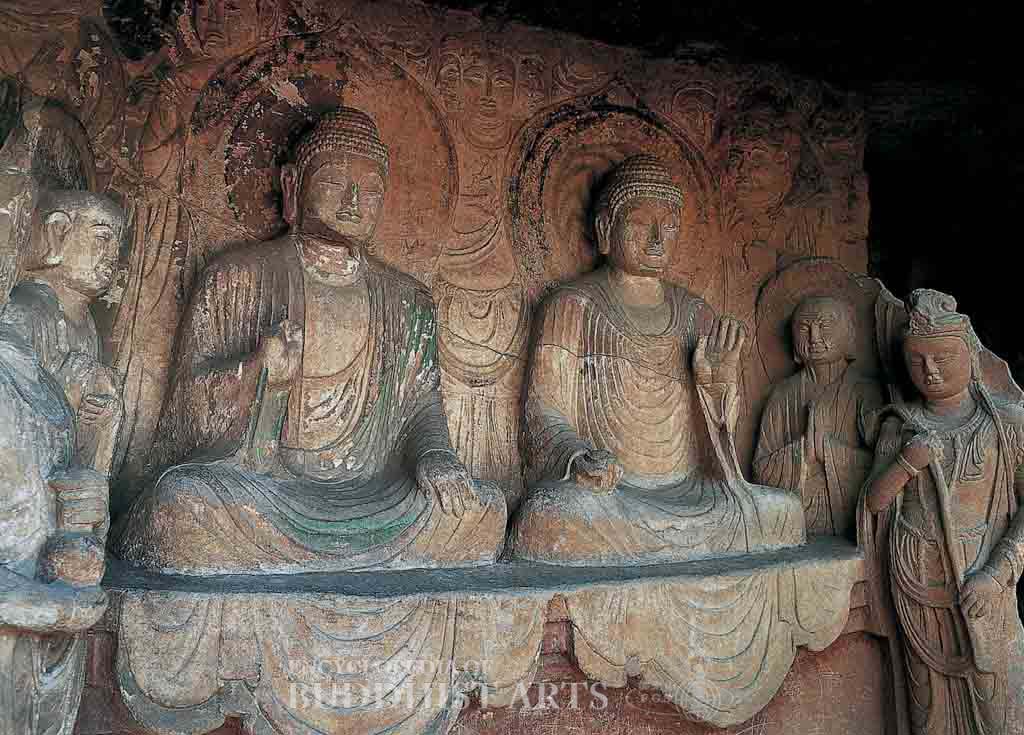
Located in the middle tier of the northern section of the site, Cave 806 measures 3 m in width, 2.2 m in height, and 3.6 m in depth. There are a total of 94 sculptures in the cave, carved in a style typical of the High Tang period (712–756). These carvings are believed to be among the first to depict the “Chapter on the Emergence of the Prabhutaratna Pagoda” from the Lotus Sutra.
The central carvings in the cave, located on the back wall, are Sakyamuni and Prabhutaratna Buddhas seated on a central platform, flanked by two disciples and two Bodhisattvas. The left wall features Sakyamuni Buddha flanked by two attendant Bodhisattvas. On the right wall, there are three standing Avalokitesvara Bodhisattvas. These side walls also contain inscriptions. All three walls are carved with small niches containing images of Avalokitesvara, Ksitigarbha Bodhisattva, and the Ten Kings of Hell.
The two central Buddhas on the back wall are 95 cm in height. Each Buddha has a usnisa, tightly curled hair, rounded faces, and downcast eyes. They both wear monastic robes that drape over the front of the platform. The Buddha on the left raises the right hand, while the Buddha on the right raises the left hand and holds a jewel in the other. Reliefs of two Bodhi trees and the Eight Classes of Dharma Protectors are on the back wall behind the Buddhas.
The disciples Mahakasyapa and Ananda stand on either side, close to the back wall. Mahakasyapa is depicted as an elderly ascetic with joined palms and a wrinkled face, while Ananda has a smooth, round face and youthful appearance. A Bodhisattva stands beside each disciple.
For more details, go to the Encyclopedia of Buddhist Arts: Caves R-L, page 411.
Cite this article:
author = Hsingyun and Youheng and Johnson, Peter and Mankuang and Huntington, Susan and Edson, Gary and Neather, Robert,
booktitle = {Encyclopedia of Buddhist Arts: Caves R-L},
pages = 411,
title = {{Guangyuan Thousand Buddha Cliff Rock Carvings Cave 806}},
volume = 6,
year = {2016}}