
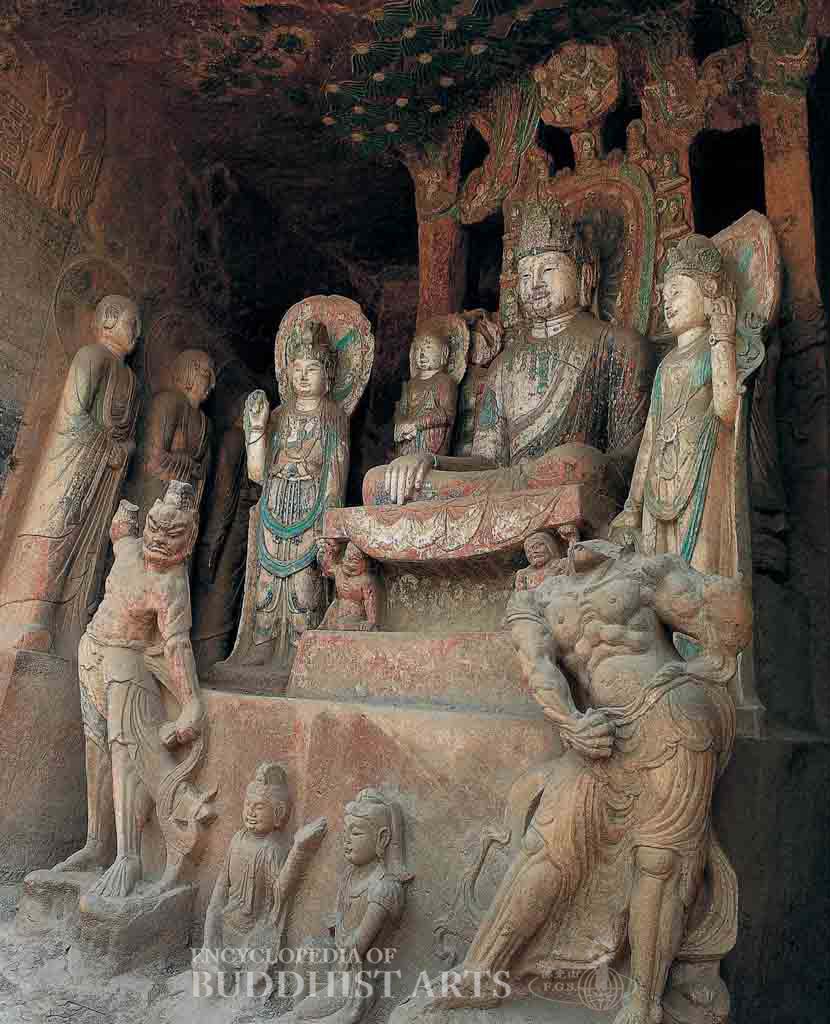
Guangyuan Thousand Buddha Cliff Rock Carvings Cave 366: Bodhi Figure
Stone
Guangyuan Thousand Buddha Cliff Rock Carvings Cave 366: Bodhi Figure
CHINA, Sichuan, Guangyuan; Tang dynasty
Located at the top of the Thousand Buddha Cliff, this niche is one of the largest at the site, and also one of the most exquisitely sculpted. It is a rectangular cave with a flat ceiling, and measures 3.55 m across at the front, 4.1 m across at the rear, 3.25 m in height, and 3.3 m in depth.
The focal point of the niche is an altar sculpted with a group of statues. The central Buddha sits in full lotus position on a raised throne, forming the bhumisparsa (earth-touching) mudra with the right hand. Clothed in a monastic robe, the Buddha wears a tall headdress, draped ornaments, and bangles. Behind the Buddha’s head is an oblong nimbus surrounded by eleven small seated Buddha reliefs. Flanking the Buddha are two disciples, two Bodhisattvas, and two warriors. Two small earth deities kneel beneath the Buddha’s throne, each with one arm raised as if supporting it. Two Bodhi trees are carved in openwork at the back of the niche; they rise up to the ceiling to form a canopy. The Thunder, Wind, and Rain Deities, among others, are sculpted on and around the Bodhi trees. There are carvings of the Ten Great Disciples and a group of musicians on the other three walls of the cave.
A stele on the north wall of the cave near the entrance states that the central carving is a Bodhi Figure, an image illustrating the auspicious signs during the Buddha’s enlightenment. It also identifies the sponsor of the cave as Bi Gong, a governor of Lizhou during the Tang dynasty. There was once more text written on the stele, but during a restoration in 968 sponsored by the Lady of Yue, most of the original writing was removed. The characters that are still visible appear to have been based on a description of the Buddha’s enlightenment in the Great Tang Records on the Western Regions authored by Master Xuanzang. This account describes the Buddha as wearing ornaments, a headdress, and bangles, displaying the bhumisparsa (earth-touching) mudra, and calling on two earth deities to act as witnesses, a scene that is mirrored by the central sculpture in the cave.
The Bodhi Figure was a popular theme in China ever since it was sketched by the Tang dynasty artist Song Fazhi when he accompanied an envoy on a trip to India. Both imperial temples in Chang’an and Luoyang, as well as Longmen Grotto 2050 (South Leigutai Grotto), contained sculptures of the figure. This particular example of the Bodhi Figure is considered precious, as many of the temple sculptures fromt he Tang dynasty were destroyed in later periods.
For more details, go to the Encyclopedia of Buddhist Arts: Caves R-L, page 404.
Cite this article:
author = Hsingyun and Youheng and Johnson, Peter and Mankuang and Huntington, Susan and Edson, Gary and Neather, Robert,
booktitle = {Encyclopedia of Buddhist Arts: Caves R-L},
pages = 404,
title = {{Guangyuan Thousand Buddha Cliff Rock Carvings Cave 366: Bodhi Figure}},
volume = 6,
year = {2016}}