
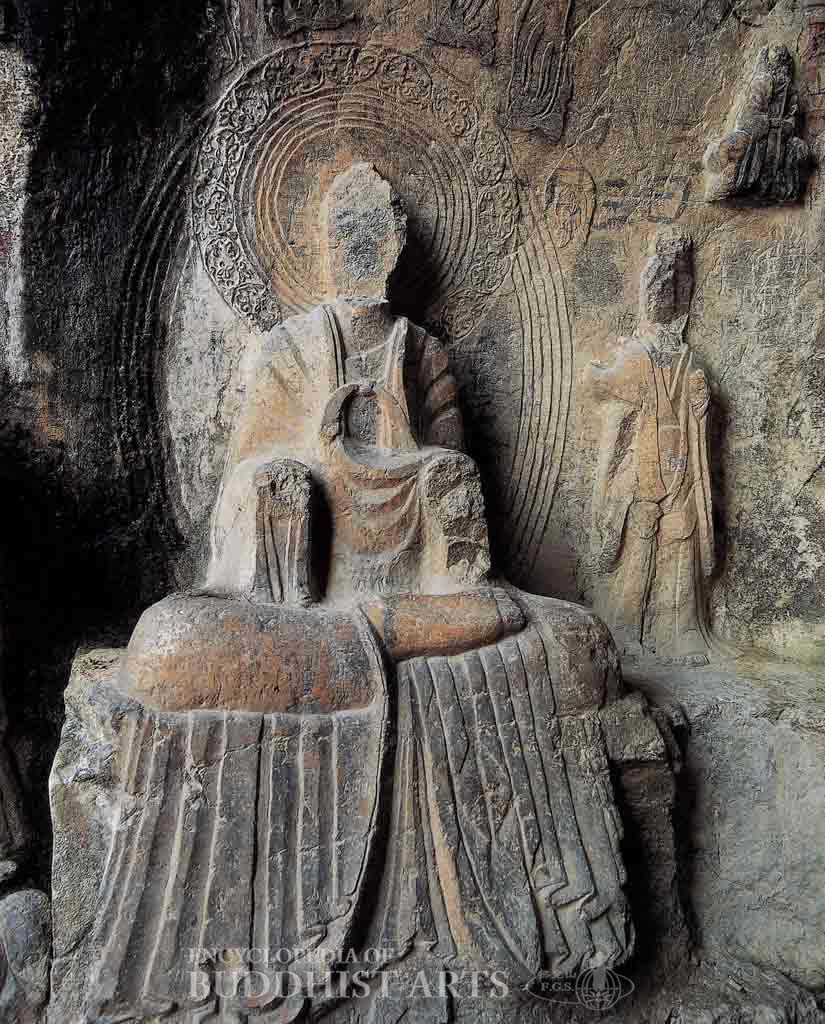
Huangshiya Rock Carvings: Cave 2 - Seated Buddha (east wall)

Huangshiya Rock Carvings: Cave 2 - Buddha Triad (west wall)
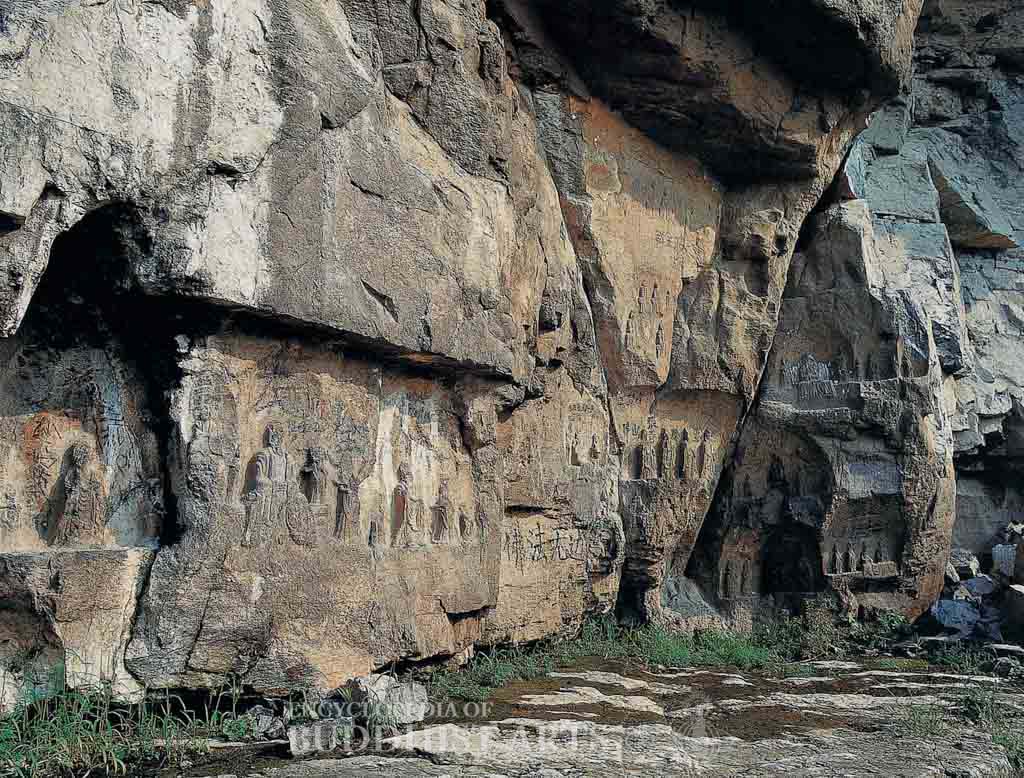
Huangshiya Rock Carvings
Huangshiya Rock Carvings
CHINA, Shandong, Jinan
Huangshiya stands for Yellowstone Cliff, and these carvings are located on a cliff wall to the west of the main peak of Luosiding in Jinan. To the northwest is Qianfoshan (Thousand Buddha Mountain) and to the east is Fohuishan (Buddha Wisdom Mountain). The cliff wall is 10 m high and 35 m wide, and contains a cave and 28 niches. They are considered the earliest Northern Dynasties (386–581) carvings in Shandong.
Cave 2, the only cave at the site, was created by expanding a natural crack in the cliff face. The carvings are distributed on the east and west walls. The east wall enshrines two Buddhas, one seated and one standing, flanked by Bodhisattvas. On the west wall are two standing Buddhas accompanied by two Bodhisattvas. The Buddhas measure 1.3 m to 1.5 m in height, and there are also over ten small seated Buddhas carved into the cliff walls. The inscriptions accompanying these carvings identify one of the figures as Sakaymuni Buddha, while the rest appear to depict Maitreya. This attests to the popularity of Maitreya during the late Northern Dynasties period. Among the carvings in this cave, the Buddha on the east wall is considered to be the most representative of the style and characteristics of carvings from the Northern Dynasties period. A honeysuckle-patterned nimbus and oval mandorla are engraved behind the Buddha, above which are depictions of apsaras. The Buddha sits in full lotus position on a lotus throne, wearing a draped monastic robe.
The other niches at the site are shallow and range from 0.27 to 1.4 m in height. The niches contain either one Buddha and two Bodhisattvas, a single Buddha or Bodhisattva, or several Buddhas seated or standing together. The earliest accompanying inscription dates to 523 during the Northern Wei dynasty. The latest is dated to 540 during the Eastern Wei dynasty. The sponsors of the sculptures, as identified in the inscriptions, were primarily monastics, ministers, and the general public.
For more details, go to the Encyclopedia of Buddhist Arts: Caves R-L, page 427.
Cite this article:
author = Hsingyun and Youheng and Johnson, Peter and Mankuang and Huntington, Susan and Edson, Gary and Neather, Robert,
booktitle = {Encyclopedia of Buddhist Arts: Caves R-L},
pages = 427,
title = {{Huangshiya Rock Carvings}},
volume = 6,
year = {2016}}