
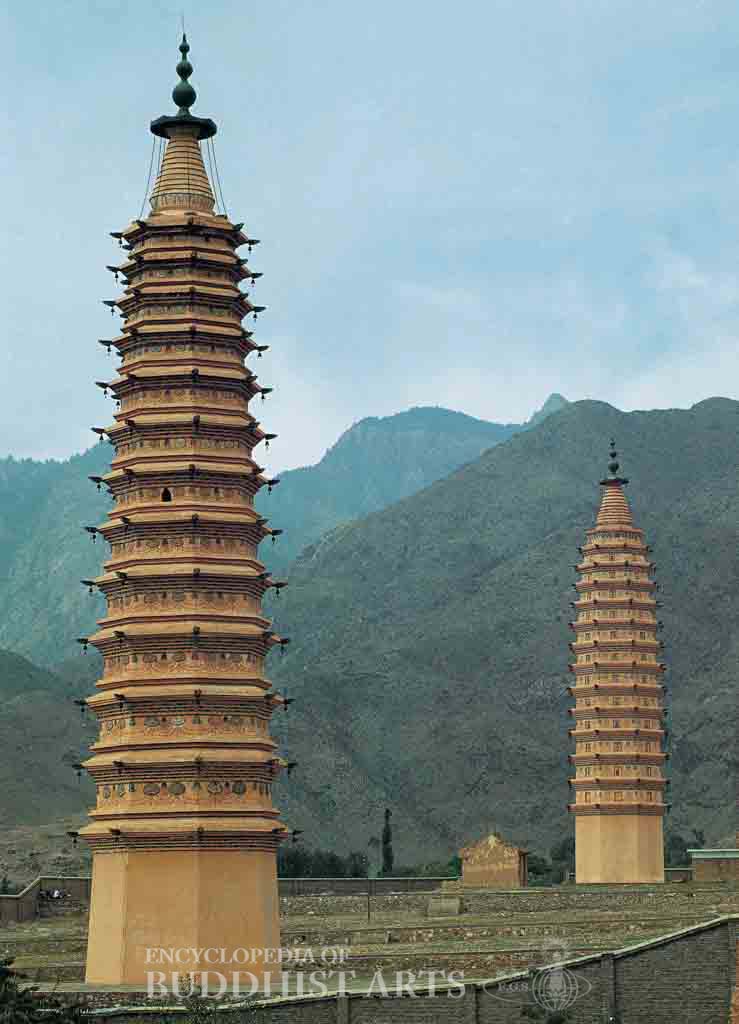
Baisikou Twin Pagodas
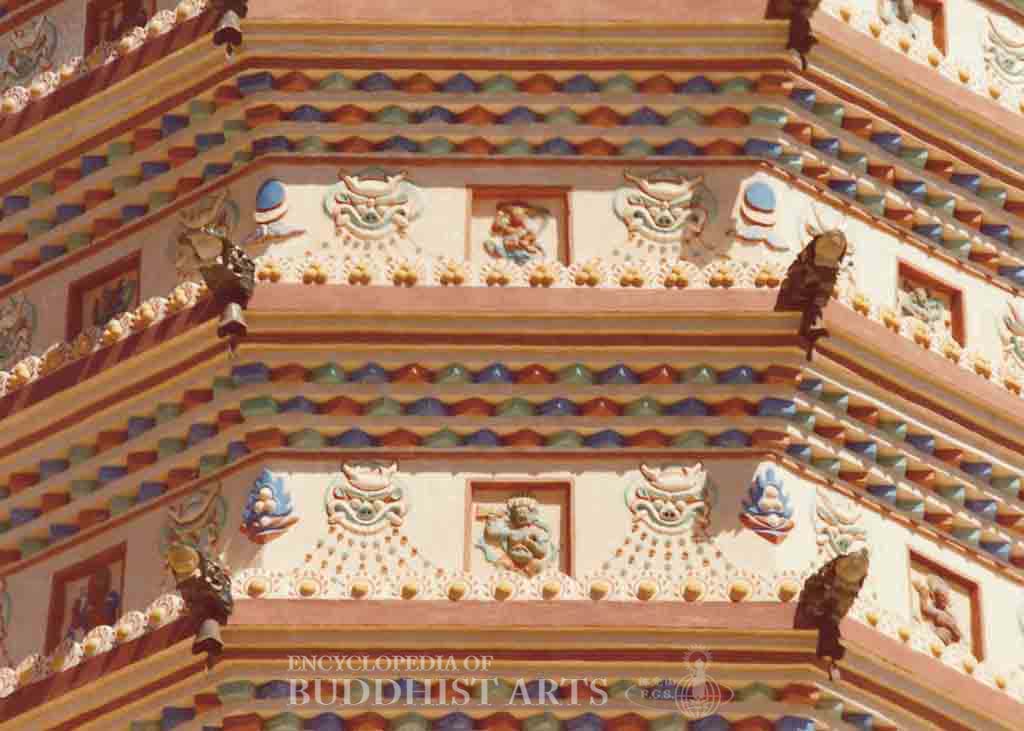
Baisikou Twin Pagodas (detail)
Baisikou Twin Pagodas
CHINA, Ningxia, Yinchuan
The pagodas are located more than 80 m apart and were originally on the grounds of a temple, which no longer exists. They were built during the late Western Xia period (1032–1227), and were colorfully decorated during the Yuan dynasty (1271–1368). In 1986 they were reinforced and renovated. Together they were listed as a National Cultural Heritage Site in 1988.
Both pagodas are hollow, octagonal, and built in a dense-eave style. They have 13 tiers and are constructed from brick. The pagodas are built on a low platform. The first tiers are high with arched doors on the south side, leading to a chamber. Harmikas are located at the top of the pagodas, followed by 13 stacked rings, a canopy, and three jewels.
The west pagoda is 41 m high, with the sides of the base measuring 3.1 m. It has a tapered curved shape. Starting from the second tier upwards, there is a small rectangular niche on every side. Painted images of Arhats, Wisdom Kings, and the seven jewels are placed in the niches. The roofs are decorated with corrugated tiles and tile caps with green glazed ridge decorations at each corner. There is a molded crouching warrior at each corner of the octagonal platform under the harmika.
The east pagoda is 39.2 m high and each side of the base measures 2.9 m. The first tier is plain, but from the second tier upwards, each side is decorated with two colorfully molded kirtimukhas. In between the heads there are square shallow niches containing various reliefs, including heavenly beings making offerings and Arhats. On the other sides there are decorations, such as the sun, moon, clouds, and flaming jewel. The eaves are in the form of colorfully painted dogtooth bricks.
Important artifacts were discovered in the harmika of the west pagoda, including inscriptions in Sanskrit and Tangut scripts, as well as Buddhist paintings on silk. They provided new information for the study of Buddhist art during the Western Xia and Yuan dynasties.
For more details, go to the Encyclopedia of Buddhist Arts: Architecture A-F, page 37.
Cite this article:
author = Hsingyun and Youheng and Johnson, Peter and Mankuang and Lancaster, Lewis,
booktitle = {Encyclopedia of Buddhist Arts: Architecture A-F},
pages = 37,
title = {{Baisikou Twin Pagodas}},
volume = 1,
year = {2016}}