
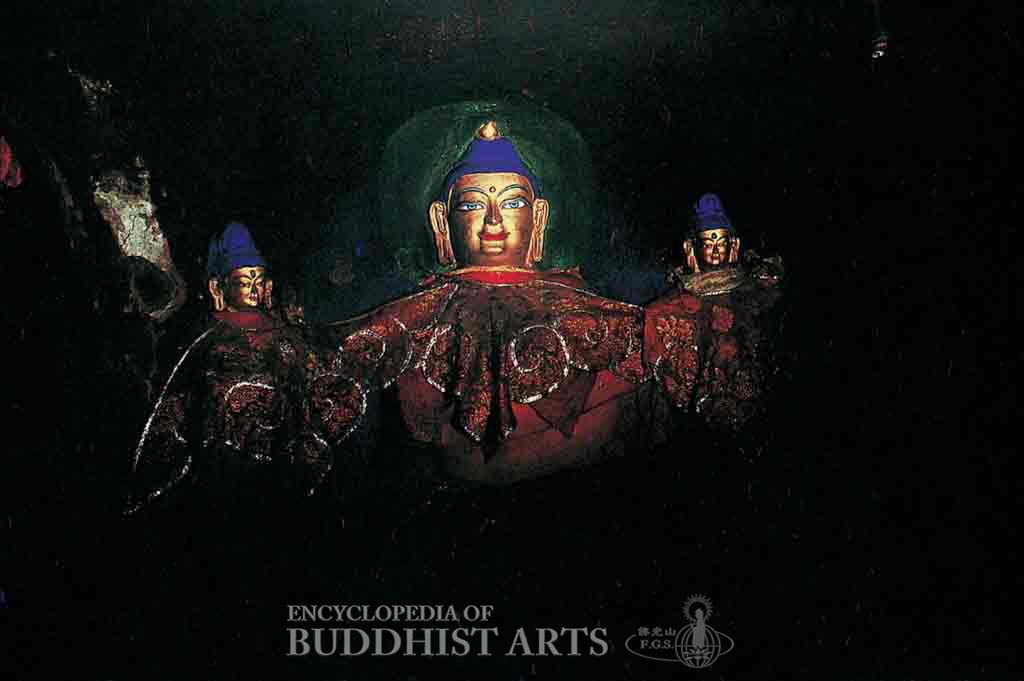
Drak Lhalupuk Cave: Sakyamuni Buddha
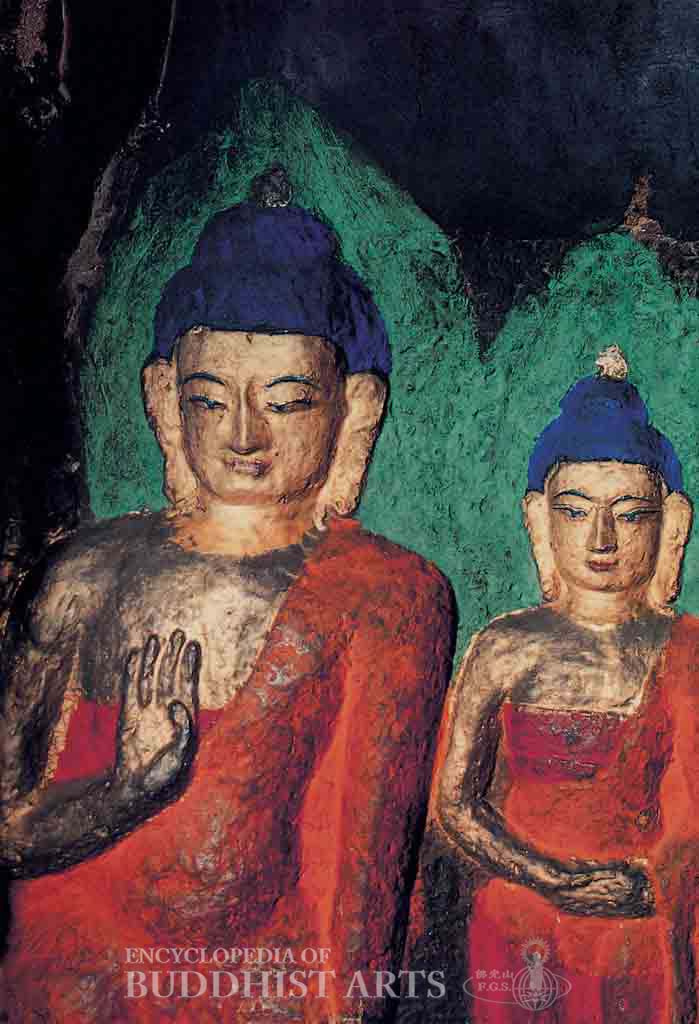
Drak Lhalupuk Cave: Standing Buddhas
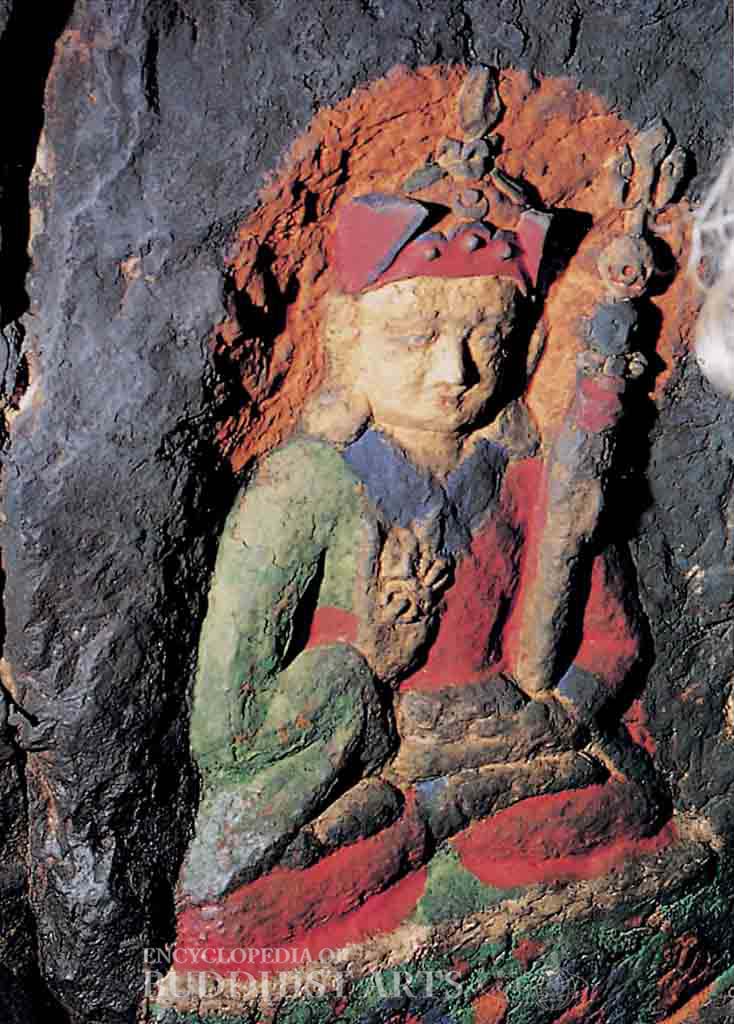
Drak Lhalupuk Cave: Padmasambhava
Drak Lhalupuk Cave
CHINA, Tibet, Lhasa
This cave is located on Chakpori Hill in Lhasa, 500 m west of the Potala Palace. Facing east, the cave is directly opposite and in close proximity to Johkang Temple. After it was constructed during the Tibetan Empire (circa 7th–9th century), locals named the cave Jokhang Chungmo (Small Shrine of Sakyamuni). It is said to have been the personal meditation cave of Songtsan Gampo (reigned 629–650), the first Buddhist ruler of Tibet. Within the cave, there are 69 stone sculptures and 2 clay sculptures. The cave has an irregular rectangle layout, measuring 4.45 m to 5.45 m wide, 2.56 m high, and 5.5 m deep. At the rear of the cave, there is a circumambulatory passageway with widths of 0.8 m to 1.3 m. The front section of the south wall has collapsed. In the Scholar’s Feast, it states that Ruyong sculpted Buddhist statues at Chakpori, completing them after 13 years. Ruyong was the clan name of one of the five wives of Songtsan Gampo. Numerous restorations of the sculptures, primarily by Nepalese artisans, resulted in a blend of Nepalese and Gandharan styles.
The cave houses sculptures of Buddhas and Bodhisattvas, revered masters such as Padmasambhava, Virupa, and Zurchen Shakya Jungne, and public figures such as Songtsan Gampo, his wives Princess Bhrkuti and Princess Wencheng, and minister Thonmi Sambhote.
The sculptures date from three different eras. The first began in 640, the year Buddhism was reintroduced to Tibet. This was the era in which the cave was excavated and the 14 statues on the central pillar were made, as well as the triad on the back (west) wall and the 16 sculptures on the north wall. The second era, between the 11th and 14th centuries, saw the creation of 17 statues on the upper south wall of the circumambulatory passageway, and the Bodhisattva and Padmasambhava statues on the back wall. In the third era, between the 14th and 16th centuries, was when the Sakyamuni statue in the circumambulatory passageway and the two Sakyamuni statues on the upper north wall were added.
For more details, go to the Encyclopedia of Buddhist Arts: Caves A-E, page 308.
Cite this article:
author = Hsingyun and Youheng and Johnson, Peter and Mankuang and Huntington, Susan and Edson, Gary and Neather, Robert,
booktitle = {Encyclopedia of Buddhist Arts: Caves A-E},
pages = 308,
title = {{Drak Lhalupuk Cave}},
volume = 5,
year = {2016}}