
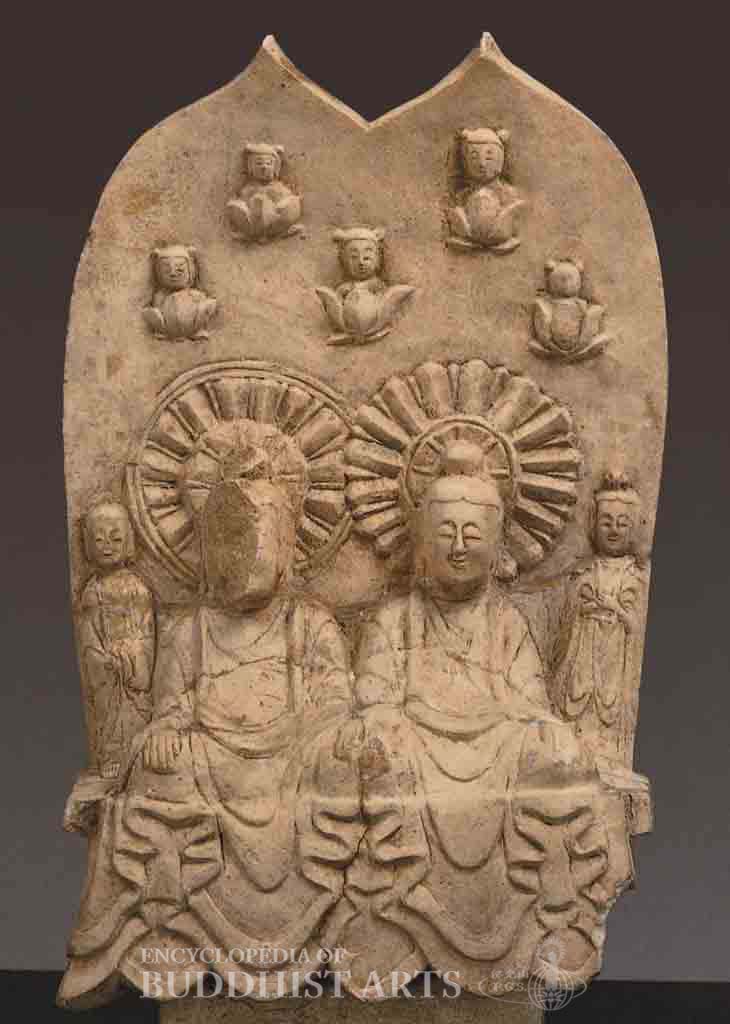
Banlacheng Temple 2: Sakyamuni and Prabhutaratna Buddhas
Tuff
Banlacheng Temple 2: Sakyamuni and Prabhutaratna Buddhas
CHINA, Jilin, Yanji; Balhae Kingdom
This sculpture was discovered during World War II (1939–1945) by a group of researchers from the University of Tokyo. They believed at first that it was made in the 6th century but other researchers have disputed this and assert it was created during the Balhae Kingdom (711–926).
The concept of the two Buddhas sitting together derives from the “Chapter on the Emergence of the Prabhutaratna Pagoda” in the Lotus Sutra. Sakyamuni and Prabhutaratna Buddhas sit cross-legged side by side on a bench with long robes hanging in ornamental folds. Nimbuses radiate out behind their heads. The attendant, standing on the right is a Bodhisattva while the one on the left is a monk, a rare combination. A combined mandorla with two separate peaks at the top is another rare feature. Five figures emerging from lotus buds appear in relief above the heads of the Buddhas.
For more details, go to the Encyclopedia of Buddhist Arts: Sculpture A-F, page 116.
Cite this article:
author = Hsingyun and Youheng and Lovelock, Yann and Chou, Yuan and Huntington, Susan and Edson, Gary and Neather, Robert,
booktitle = {Encyclopedia of Buddhist Arts: Sculpture A-F},
pages = 116,
title = {{Banlacheng Temple 2: Sakyamuni and Prabhutaratna Buddhas}},
volume = 10,
year = {2016}}