
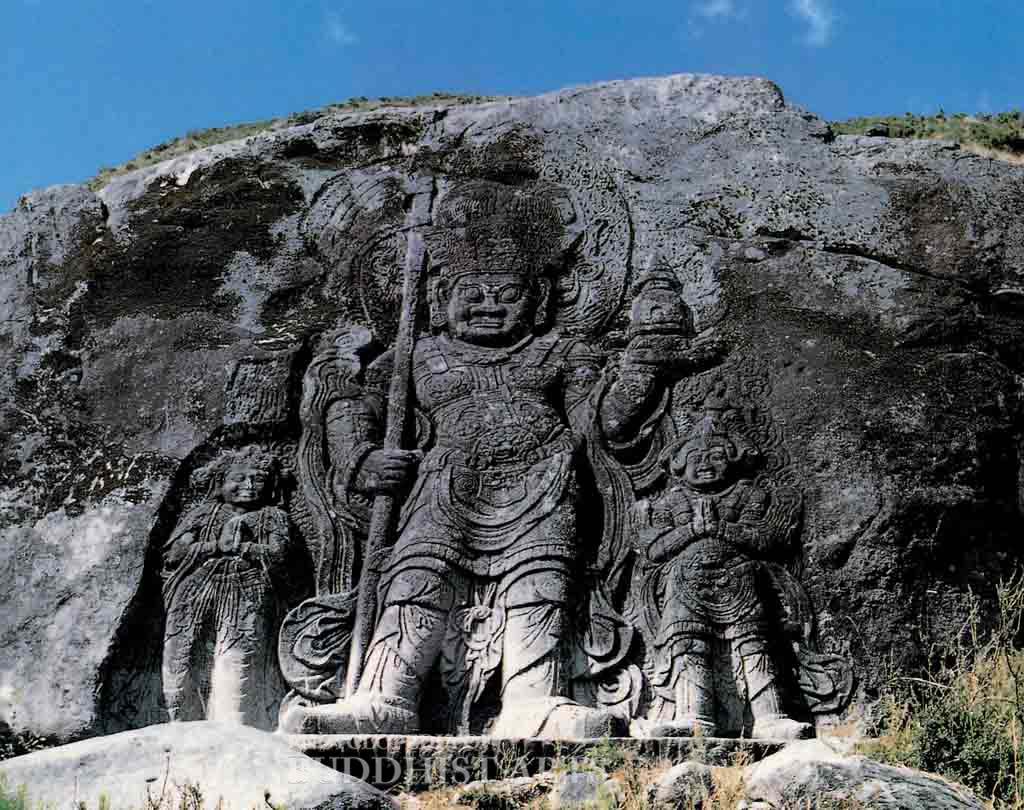
Jinhuashan: Vaisravana and Attendants
Stone
Jinhuashan: Vaisravana and Attendants
CHINA, Yunnan, Dali; Dali Kingdom
Located on Jinhuashan (Golden Flower Mountain) in Dali, this 10 m high relief was hewn from a cliffside during the Dali Kingdom (937–1253), and features Vaisravana as the main figure. The carving was listed as a Provincial Cultural Heritage Site in 1987.
Vaisravana, who measures 6 m in height, is clad with heavily ornamented armor and a number of flowing stoles. In his left hand, he supports a small pagoda, while his right hand clenches a halberd. His head is covered with a tall, intricately carved headdress, behind which is a flame-patterned nimbus. The figure is portrayed with an imposing and valiant countenance, with a strong build and wrathful eyes. Two attendants, measuring 2.2 m high each, are positioned on either side of Vaisravana with palms joined in reverence. The attendant on his left stands barefooted, wearing a crown adorned with flower garland. A stole sways about his arms and he wears beaded chest ornaments. The attendant on the left appears as a soldier wearing a cape, a stole, and a pair of boots. Behind each attendant is a background of decorative cloud patterns.
In Buddhist cosmology, Vaisravana is the Heavenly King of the North. A fierce Dharma protector, his figure was a popular object of devotion. Although Vaisravana is a Buddhist figure, obeisance to his image is also found in other forms of local idolatry and folk religion in China.
For more details, go to the Encyclopedia of Buddhist Arts: Caves R-L, page 437.
Cite this article:
author = Hsingyun and Youheng and Johnson, Peter and Mankuang and Huntington, Susan and Edson, Gary and Neather, Robert,
booktitle = {Encyclopedia of Buddhist Arts: Caves R-L},
pages = 437,
title = {{Jinhuashan: Vaisravana and Attendants}},
volume = 6,
year = {2016}}