
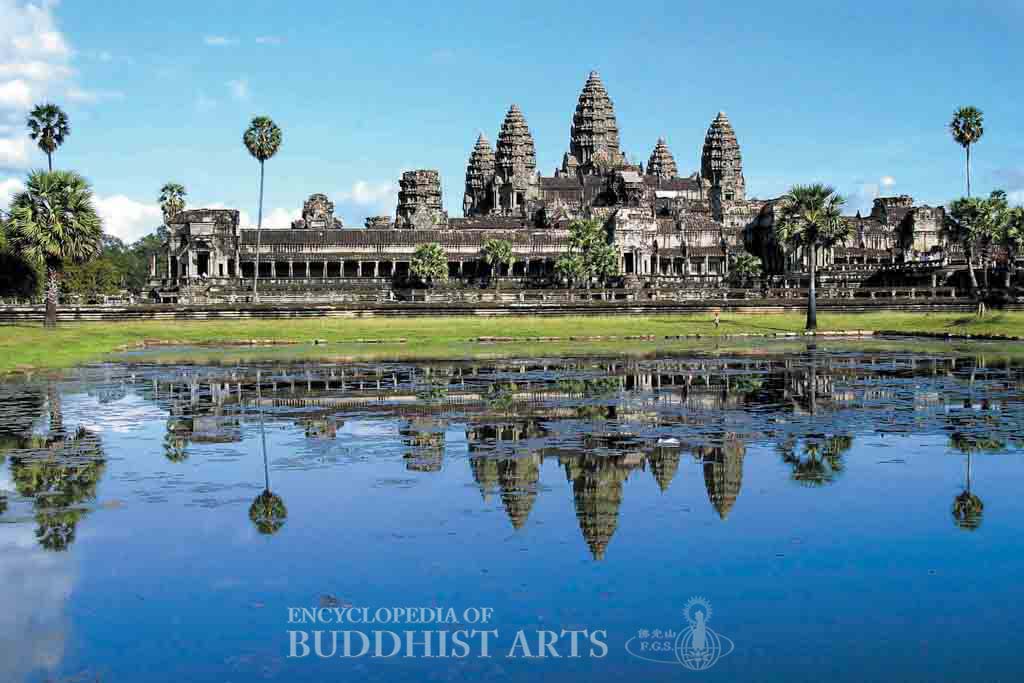
Angkor Wat
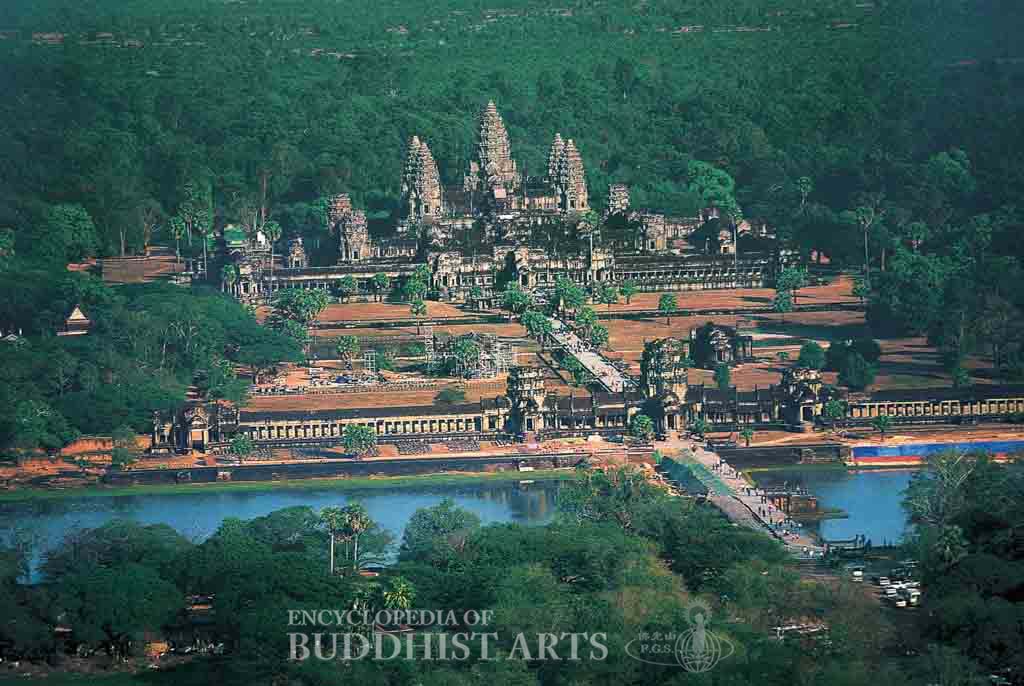
Angkor Wat (aerial view)
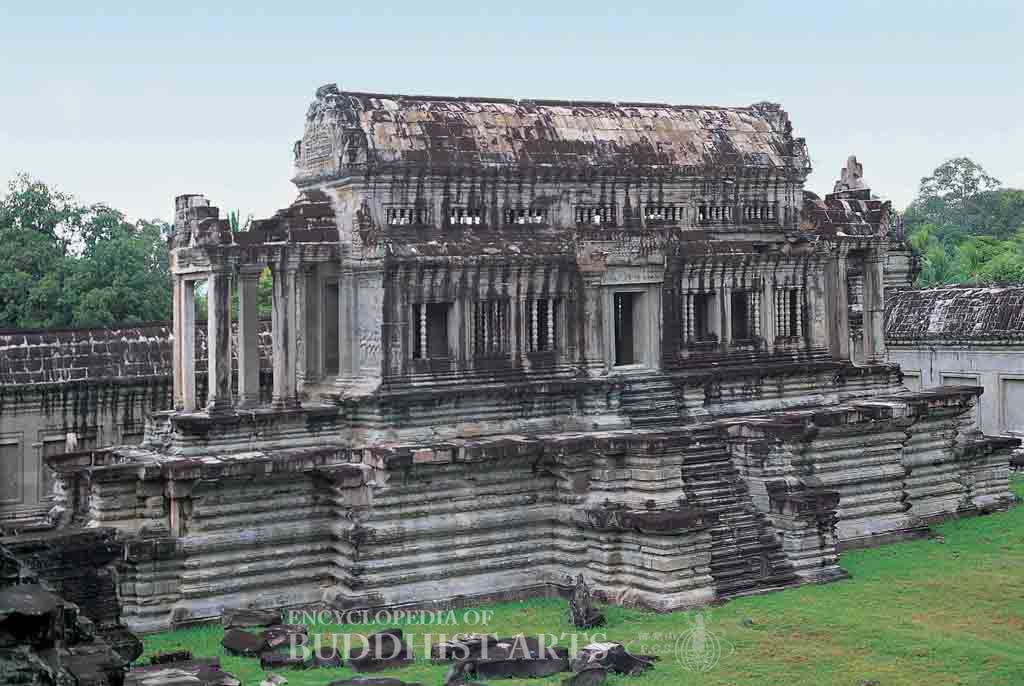
Angkor Wat: Sutra Repository
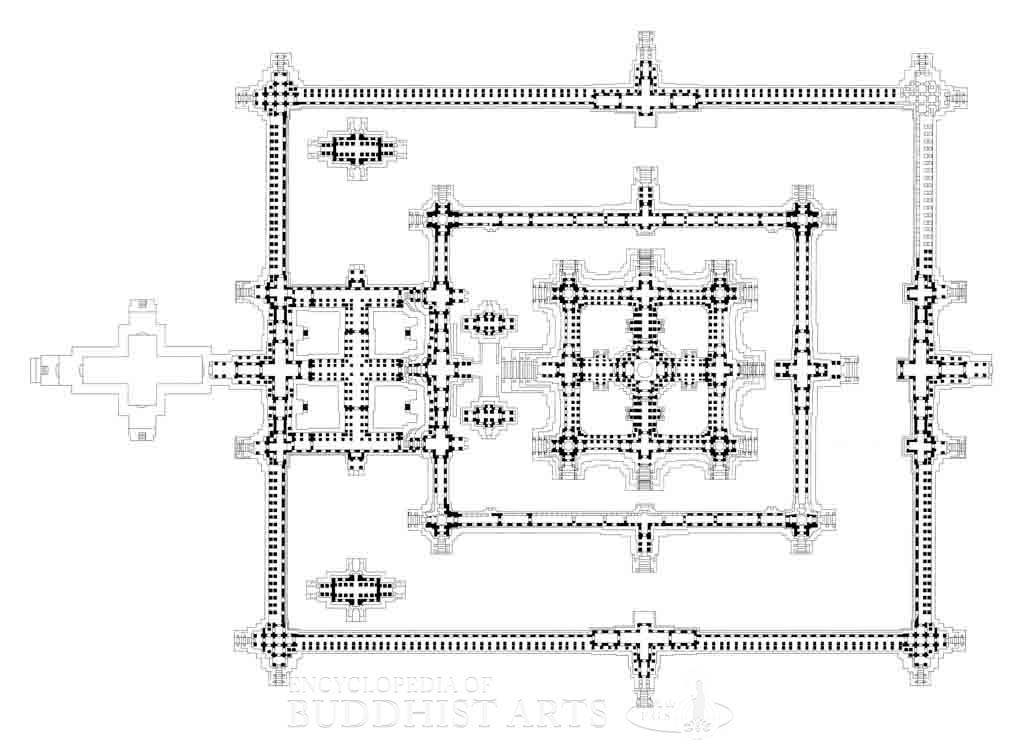
Angkor Wat (site layout)
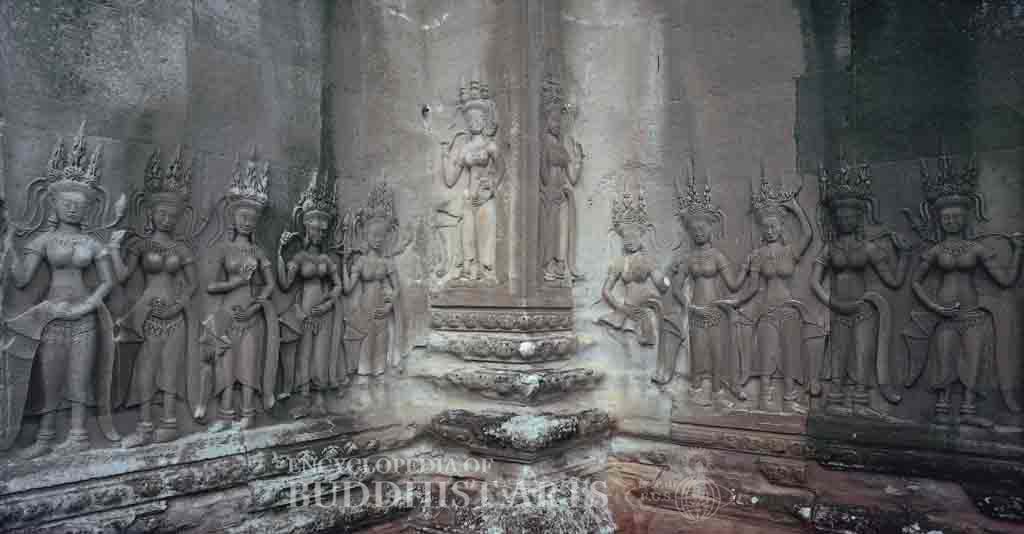
Angkor Wat: Reliefs
Angkor Wat
CAMBODIA, Siem Reap, Angkor
Angkor Wat means the City Temple. It was built by Khmer King Suryavarman II (reigned 1113–circa 1150) as a Hindu temple, but it later became a Buddhist temple. Over several centuries of successive expansion, it became a prominent landmark of the architectural and sculptural arts during the flourishing Angkor period (circa 9th–15th century). It was listed as a UNESCO World Heritage Site in 1992.
The temple faces west and is surrounded by a 190 m wide moat, with a perimeter of approximately 5.5 km. The whole complex is built from red sandstone blocks. The principal structures of the temple include four enclosures, main entrance gateway, corridors, sutra repositories, and the five central Khmer-style stupas.
The first enclosure is next to the moat. The second enclosure has a main entrance gateway in the form of a cross with two smaller cruciform structures on each side. Barrel-vaulted corridors extend from both sides of the main entrance gateway to form the enclosure. There is a small cruciform structure at each corner and a gateway at each cardinal point of this enclosure. Inside the main entrance gateway, the corridors subdivide the courtyard into four. On each side of this courtyard there is a sutra repository. A further corridor connects the third enclosure to the fourth enclosure via steps. The third and fourth enclosures have a gateway at each cardinal points and a stupa at each corner.
Within the fourth enclosure, there is the base platform of the five Khmer-style central stupas covering an area of 4 ha. The base has three levels: the two lower levels are rectangular and the third level is square. On the west side there are three steep stairways leading to the corridors on the uppermost level. There are four stupas, each located at one of the four corners of the corridors, surrounding the 65 m high central stupa. There are barrel-vaulted corridors projecting from the four sides of the central stupa. The five stupas form the center of the entire complex, creating a magnificent effect.
In addition to the architecture, the sculptural art at Angkor Wat is unique. The lintels, corridor walls, niches, and columns are elaborately carved with fine delicate reliefs, featuring the Five Dhyani Buddhas, Shiva, Vishnu, deities, and kings, which is a blend of Buddhism, Hinduism, and local beliefs. The subjects of the reliefs are especially numerous, including historical narratives, scenes from the Indian epics Mahabharata and Ramayana, images of heaven and hell, and the lives of the king and people of the time. The depiction of people, plants, and animals are lifelike and are evidence of a high level of craftsmanship and refined artistic techniques.
For more details, go to the Encyclopedia of Buddhist Arts: Architecture A-F, page 14.
Cite this article:
author = Hsingyun and Youheng and Johnson, Peter and Mankuang and Lancaster, Lewis,
booktitle = {Encyclopedia of Buddhist Arts: Architecture A-F},
pages = 14,
title = {{Angkor Wat}},
volume = 1,
year = {2016}}