
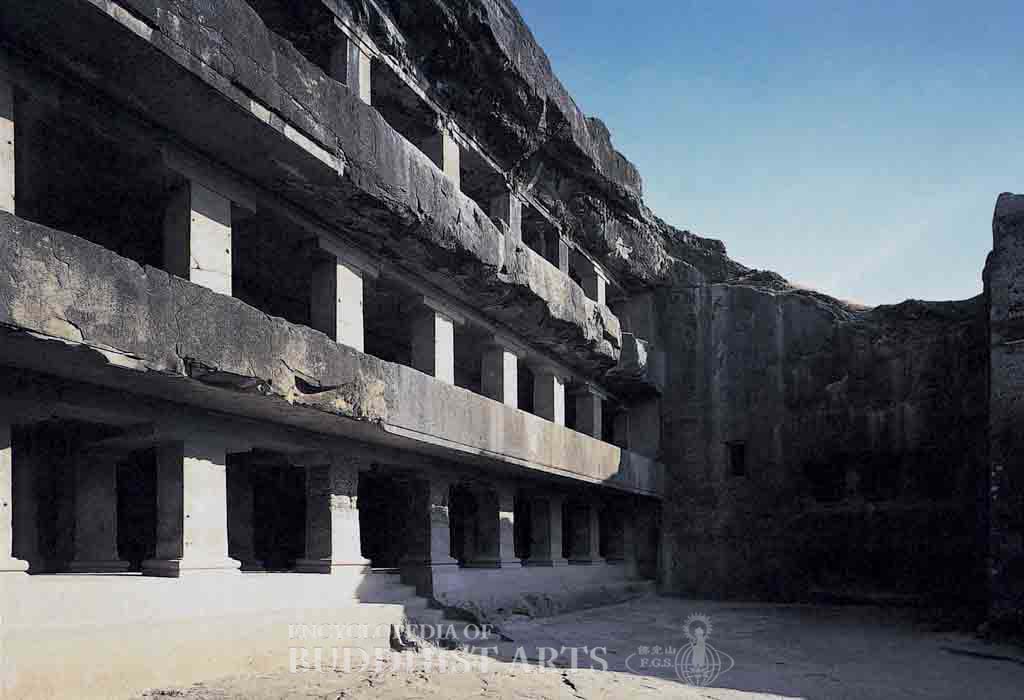
Ellora Cave 12
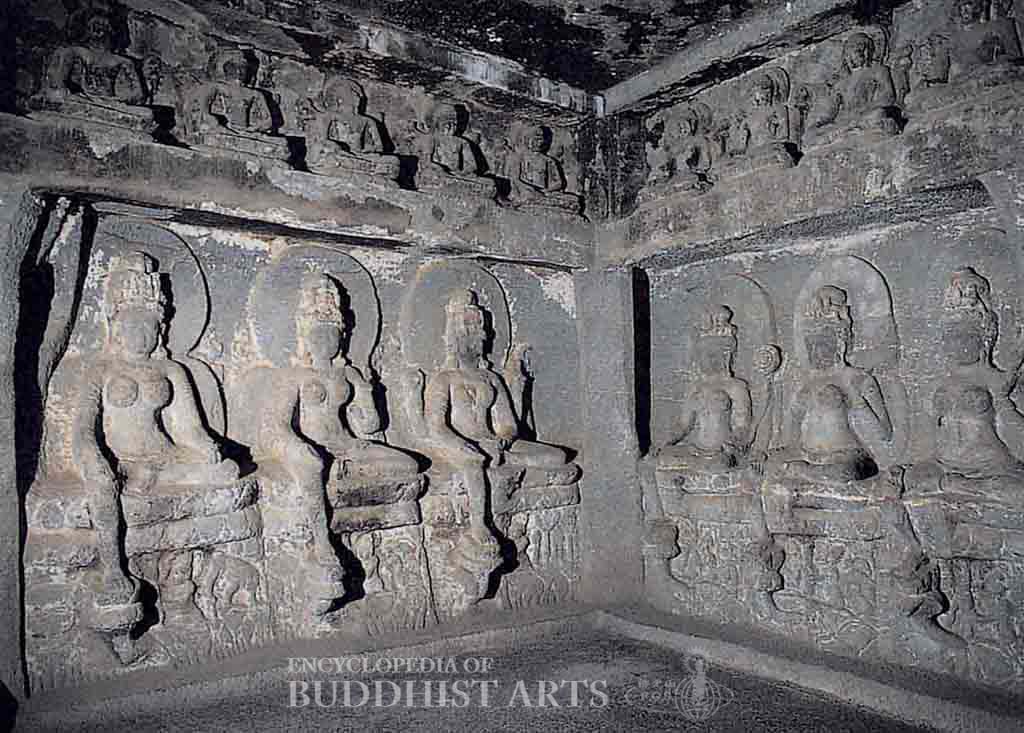
Ellora Cave 12: Antechamber - Female Deities (third story)
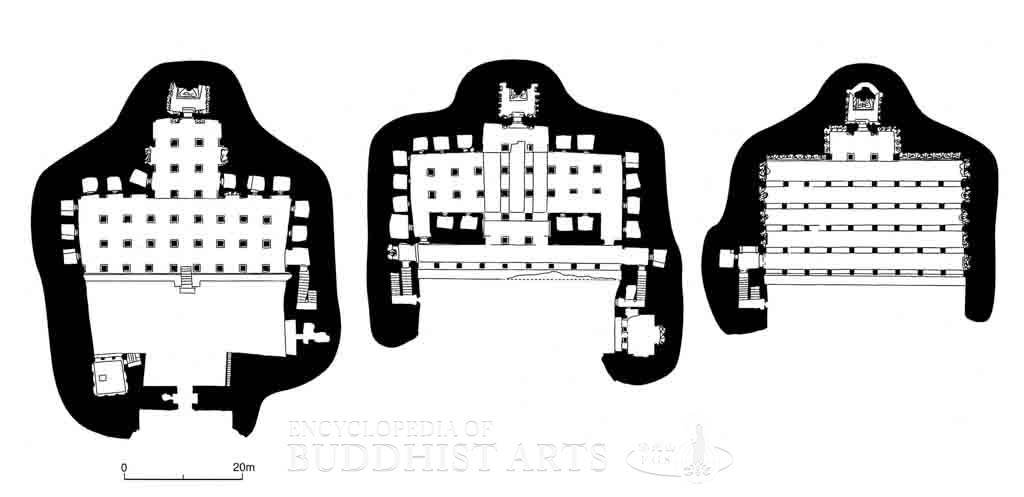
Ellora Cave 12 (plan)
Ellora Cave 12
INDIA, Maharashtra, Aurangabad
This cave was created in the 7th century and is noted for its impressive architectural design. It is thought to be one of the later Buddhist caves excavated at Ellora.
The cave consists of three stories, with colonnaded portico and walkways constructed outside of each. A shrine and its antechamber are located at the center of the back wall on each story. The main halls of each story contain square columns spaced at regular intervals throughout. There are residence cells along the three sides of the first and second stories. On the third story, these cells are replaced by niches housing reliefs with seven seated Buddhas on each side of the back wall and Buddha Triads on the side walls. Stone staircases connect the three stories.
The cave is filled with Vajrayana Buddhist figures, such as Vajrapani, Tara, Bhrkuti, Aparajita, and Cundi, showing an emphasis on the female as well as the male.
For more details, go to the Encyclopedia of Buddhist Arts: Caves A-E, page 345.
Cite this article:
author = Hsingyun and Youheng and Johnson, Peter and Mankuang and Huntington, Susan and Edson, Gary and Neather, Robert,
booktitle = {Encyclopedia of Buddhist Arts: Caves A-E},
pages = 345,
title = {{Ellora Cave 12}},
volume = 5,
year = {2016}}