
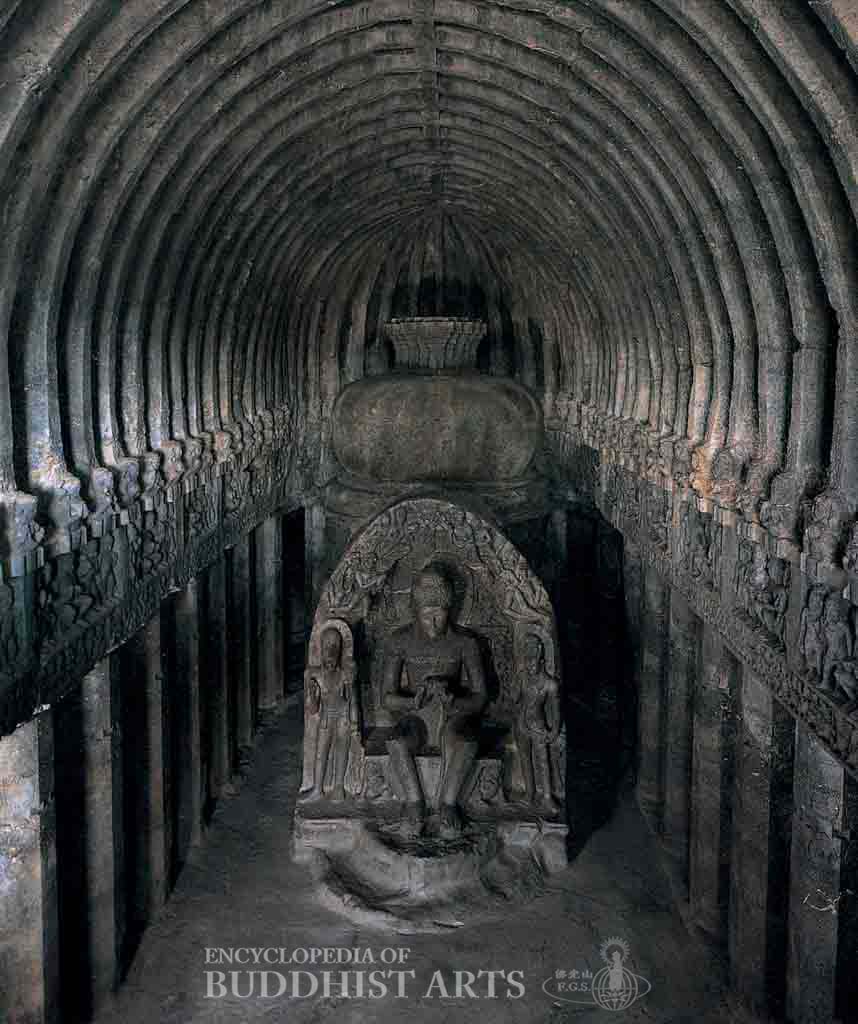
Ellora Cave 10: Main Hall
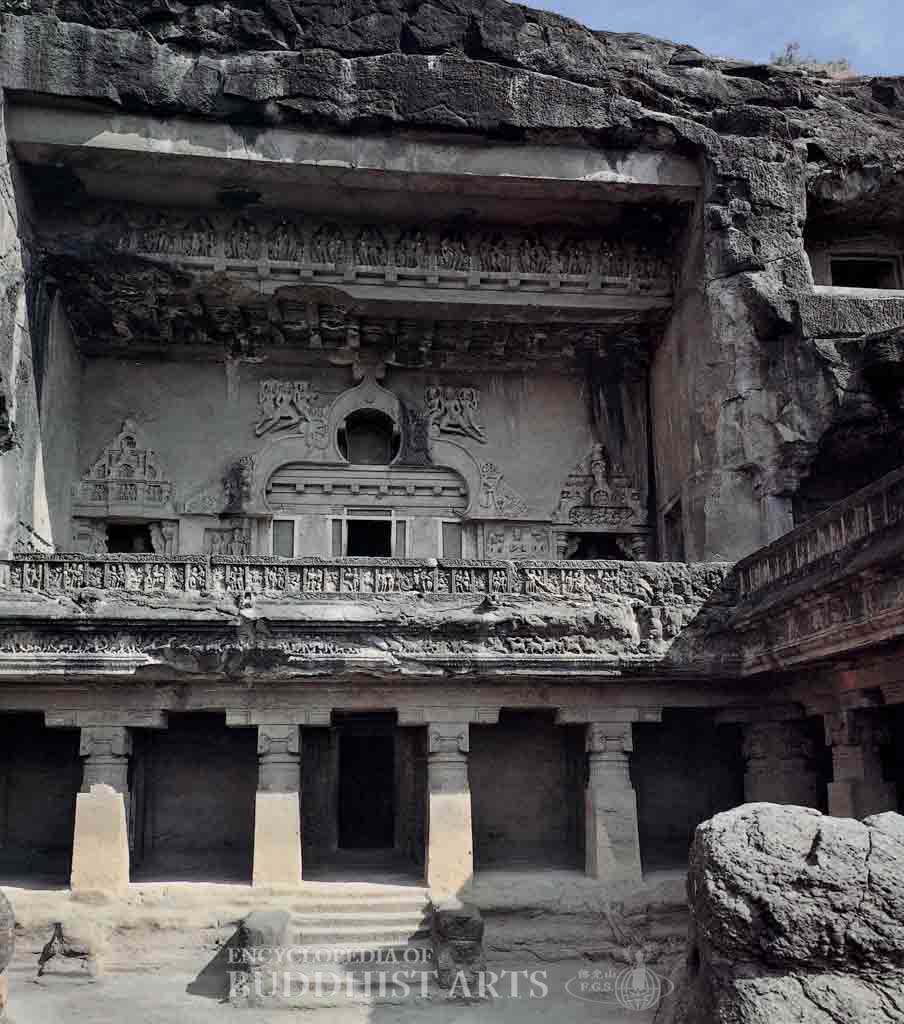
Ellora Cave 10
Ellora Cave 10
INDIA, Maharashtra, Aurangabad
This 7th century cave is the only caitya hall among the Buddhist caves at Ellora. It is widely known as the Viswakarma Cave due to its exquisite architecture. The two-story cave has a large courtyard with a three-sided cloister on the lower story and balconies on the upper story. The balconies are carved with balustrades. Both sides of the courtyard contain two stories of residence cells for monks.
There are imitation wooden beams and a caitya window above the doorway on the facade of the second story. Apsaras are carved in relief on each side of the window. Deep niches that house images of Manjusri Bodhisattva and Avalokitesvara Bodhisattva are found to the left and right of the doorway, respectively. The lintels of the niches are decorated with detailed miniature temple reliefs.
The interior of the cave has an apsidal layout and is 13.1 m wide, 10.4 m high, and 24.7 m deep. The vaulted ceiling is carved with imitation wooden beams. Twenty-eight plain octagonal columns, each 4.3 m high, form corridors around the hall. The frieze is decorated with a row of niches containing seated Buddhas with attendants.
An 8.2 m high stupa is located at the rear of the first story of the cave. The height of the stupa base is equal to that of the columns, and the body is in the shape of an inverted alms bowl. The harmika is slightly funnel shaped and lacks the usual stacked canopy finial. There is a sculpture of a Buddha accompanied by two Bodhisattvas in front of the stupa. The Buddha is seated with legs pendent and forms the Dharmacakra (Dharma wheel) mudra.
For more details, go to the Encyclopedia of Buddhist Arts: Caves A-E, page 344.
Cite this article:
author = Hsingyun and Youheng and Johnson, Peter and Mankuang and Huntington, Susan and Edson, Gary and Neather, Robert,
booktitle = {Encyclopedia of Buddhist Arts: Caves A-E},
pages = 344,
title = {{Ellora Cave 10}},
volume = 5,
year = {2016}}