
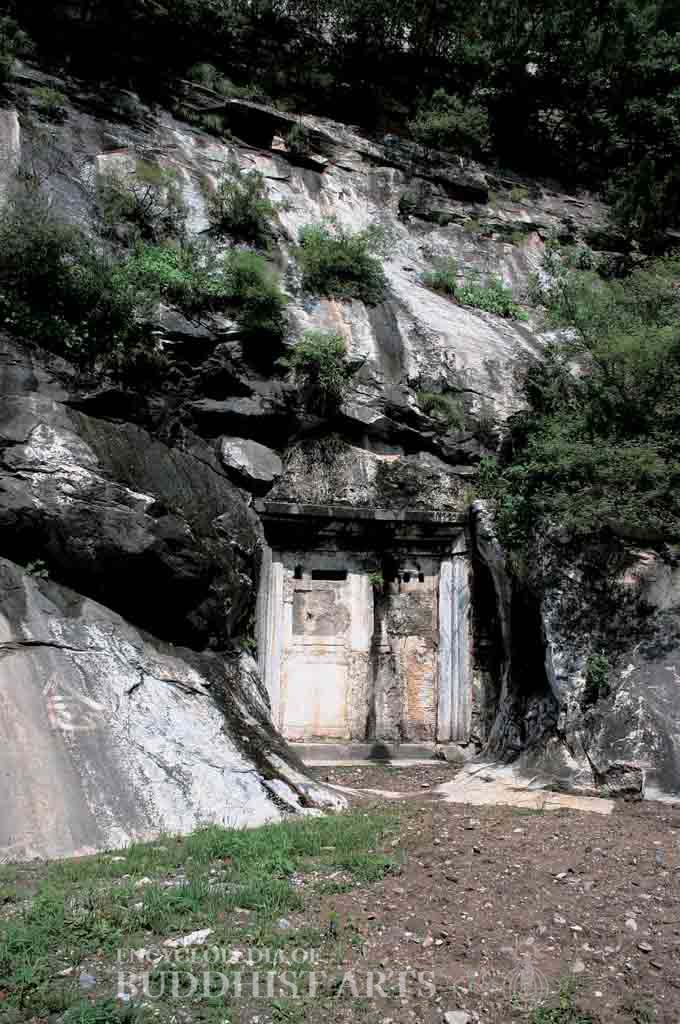
Yunju Temple Sutra Cave
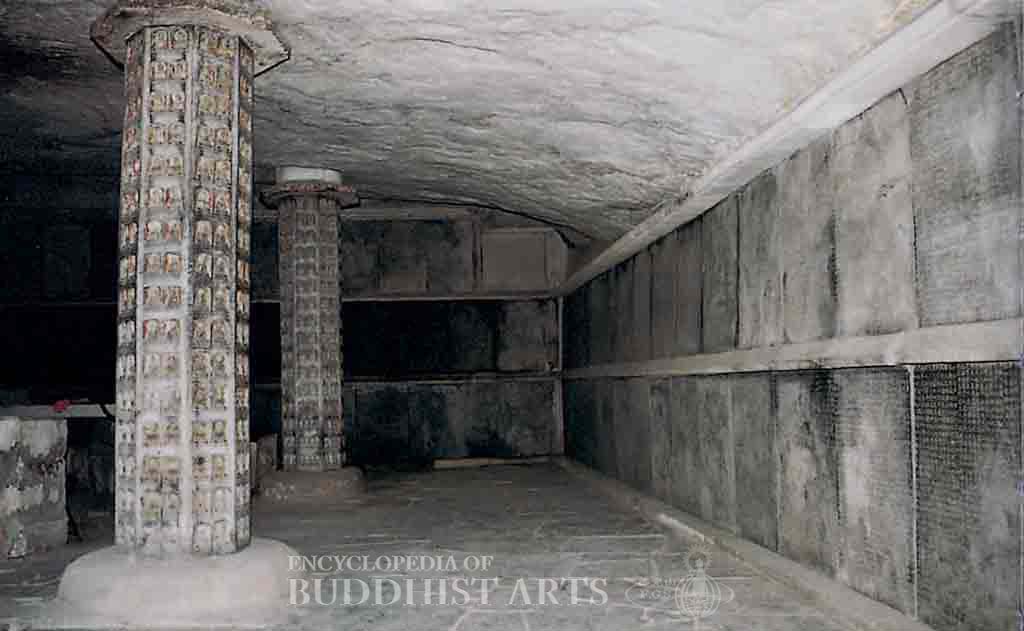
Yunju Temple Sutra Cave: Cave 5
Yunju Temple Sutra Cave
CHINA, Beijing
The Sutra Cave at Yunju Temple is also known as Fangshan Stone Cave. It is located on Baidaishan (White Ribbon Mountain), which is also called Shijinshan (Stone Sutra Mountain). During the rule of Emperor Yang (reigned 605–617) of the Sui dynasty, the monk Jingwan feared that future persecutions of Buddhism would lead to its destruction, so he vowed to engrave the Buddhist Tripitaka in stone, on the wishes of his master Huisi. According to the inscriptions, Jingwan’s goal in carving these stone scriptures was not for the propagation of Buddhism, but as a way of recording the sutras in the event that Buddhism might be extinguished. When Jingwan passed away in 639, his work was continued by his disciples.
This great endeavor was finally completed at the end of the Ming dynasty (1368–1644) with the production of more than 1,000 scriptures, spanning over 3,500 fascicles, on more than 14,000 sutra blocks. Among these, works from the High Tang period (712–756), Liao (907–1125) and Jin (1115–1234) dynasties are the most abundant and are stored within these caves, as well as beneath Yajing Pagoda. This is the largest collection of stone sutras in China. They provide important information for the study and research on the history of Chinese Buddhist scriptures and art.
Altogether there are nine caves within Shijingshan, separated into two levels. Only Cave 5, known as Leiyin (Thunder Sound) Cave, is open to the public, whereas the other caves were sealed off after they were filled with stone sutra blocks. Leiyin Cave was the first cave to be excavated and is the largest at 10 m deep and 3 m high. The four walls contain 146 sutra blocks, which were carved during Jingwan’s time. Four octagonal columns from the Sui dynasty support the ceiling. Altogether there are 1,056 Buddha images carved on the surface of the columns, earning them the name of Thousand Buddha Columns. In 1981 two relics of the Buddha were discovered within Leiyin Cave.
For more details, go to the Encyclopedia of Buddhist Arts: Caves T-Z, page 1743.
Cite this article:
author = Hsingyun and Youheng and Johnson, Peter and Mankuang and Huntington, Susan and Edson, Gary and Neather, Robert,
booktitle = {Encyclopedia of Buddhist Arts: Caves T-Z},
pages = 1743,
title = {{Yunju Temple Sutra Cave}},
volume = 9,
year = {2016}}