
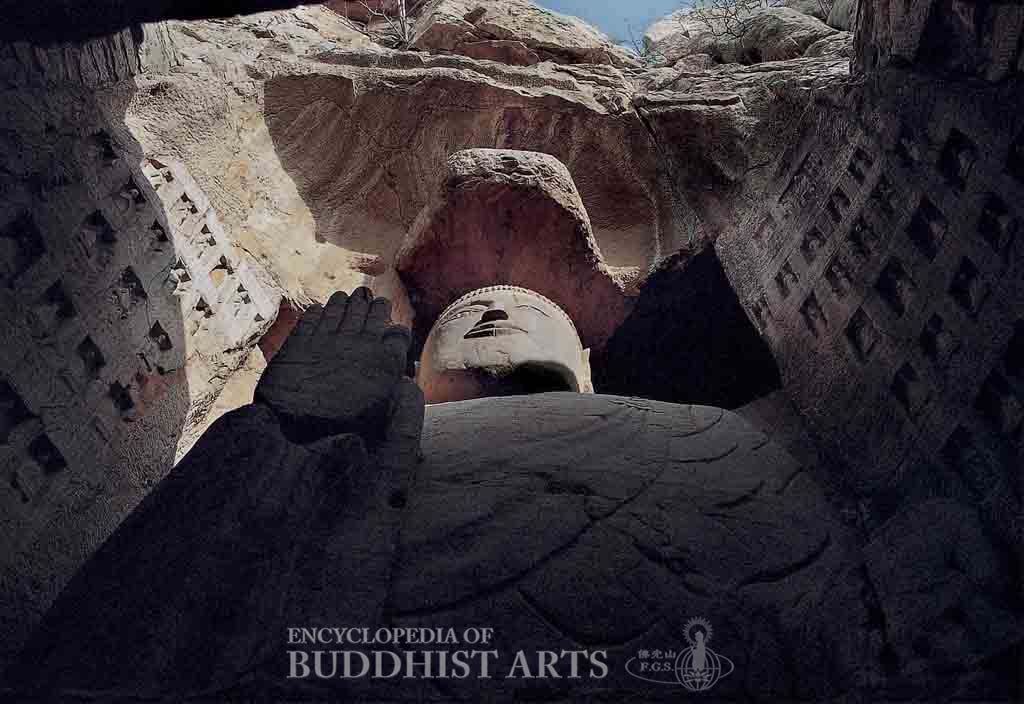
Baifoshan Caves: Cave 1 - Seated Buddha
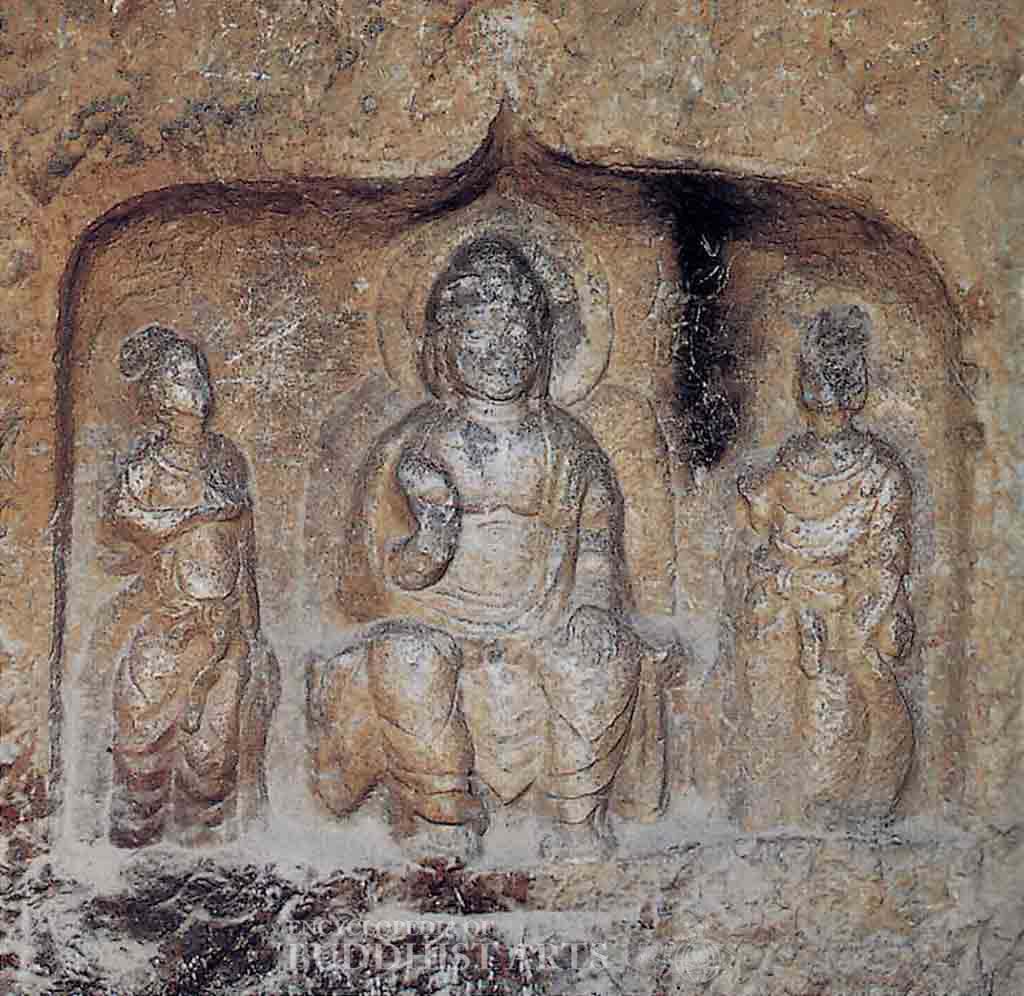
Baifoshan Caves: Cave 3 - Buddha Niche
Baifoshan Caves
CHINA, Shandong, Tai’an
These caves are located on the south side of Baifoshan (White Buddha Mountain), northwest of Dongping county in Tai’an. Four caves remain at the site, the oldest of which date to the Sui (581–618) and Tang (618–907) dynasties. The Baifoshan Caves were listed as a National Cultural Heritage Site in 2001.
Facing south, Cave 1 is 4.5 m in width, around 7.5 m in height, and 5 m in depth. Built by the enlargement of a natural cave, this great Buddha cave has an arched wall and a flat roof which has since collapsed. In the center of the cave is a 6.7 m high seated Buddha dressed in a monastic robe. The Buddha’s right hand forms the abhya (fearlessness) mudra, while the left hand rests upon the knee. The east and west walls of the cave are filled with small niches, enshrining one to three statues each. Beside each niche is an inscription stating the names of the statues. Approximately 106 of the niches have been preserved. On the lower section of the east wall, there is a rectangular niche which contains a reclining Buddha, while the lower section of the west wall has a niche enshrining a Buddha and disciples. Both sides of the entrance to the cave display inscriptions dating to the year 587. One inscription identifies the statue as Amitabha Buddha, with the year of carving as 590.
Like Cave 1, Cave 2 is an expansion of a natural cave and also faces south. Approximately 3 m in height, with an arched wall and flat roof, this cave houses three statues, roughly 2.4 m in height. The unique features of the images suggest that they were carved no later than the Tang dynasty.
Cave 3 is 1 m in width, 1.2 m in height, and 0.95 m in depth. This cave also contains carvings of three figures. On the west wall an inscription indicates that the statues were carved during the Tang dynasty.
The only west facing cave, Cave 4 measures 3 m in width, 2.4 m in height, and 3.5 m in depth. There are 12 statues housed within, as well as an inscription reading, “Wenyang town, Xucheng county in Yunzhou.” According to historical records, Xucheng county in Yunzhou was established sometime between the Five Dynasties (907–960) and the Song dynasty (960–1279). From the features of the statues, the cave is believed to have been carved somewhere between the late Five Dynasties and early Song dynasty period.
For more details, go to the Encyclopedia of Buddhist Arts: Caves A-E, page 96.
Cite this article:
author = Hsingyun and Youheng and Johnson, Peter and Mankuang and Huntington, Susan and Edson, Gary and Neather, Robert,
booktitle = {Encyclopedia of Buddhist Arts: Caves A-E},
pages = 96,
title = {{Baifoshan Caves}},
volume = 5,
year = {2016}}