
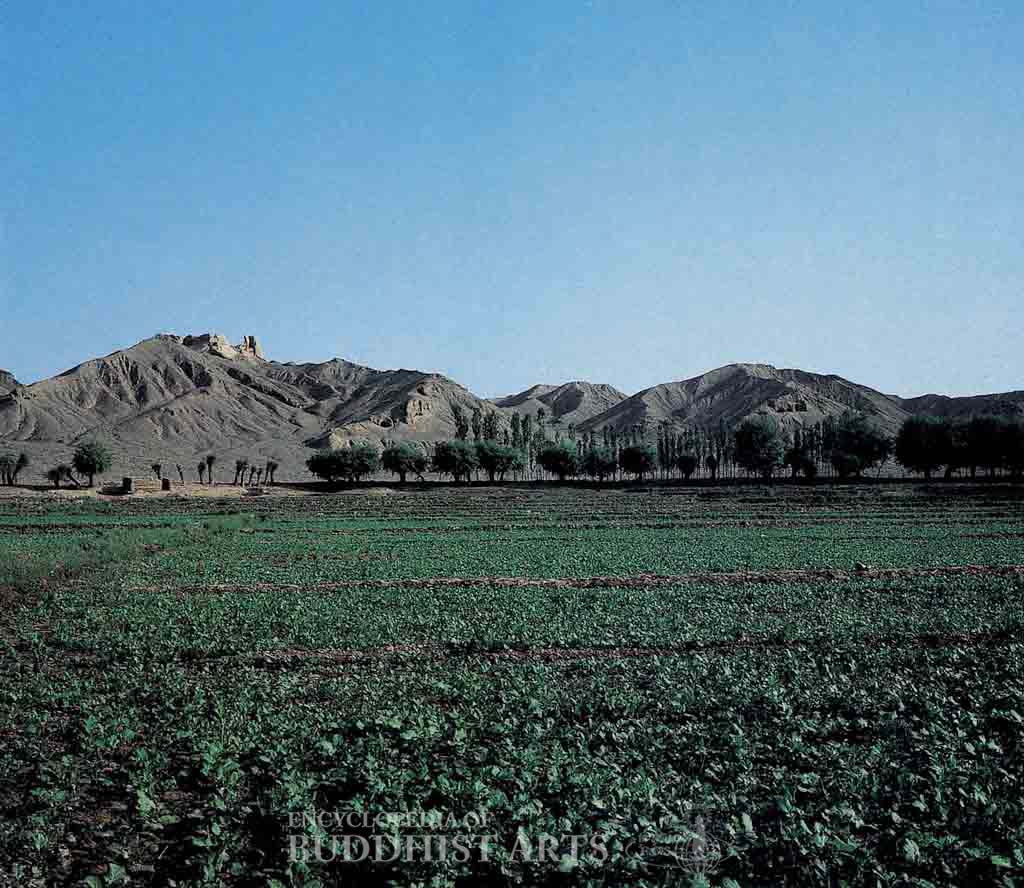
Taitai’er Caves
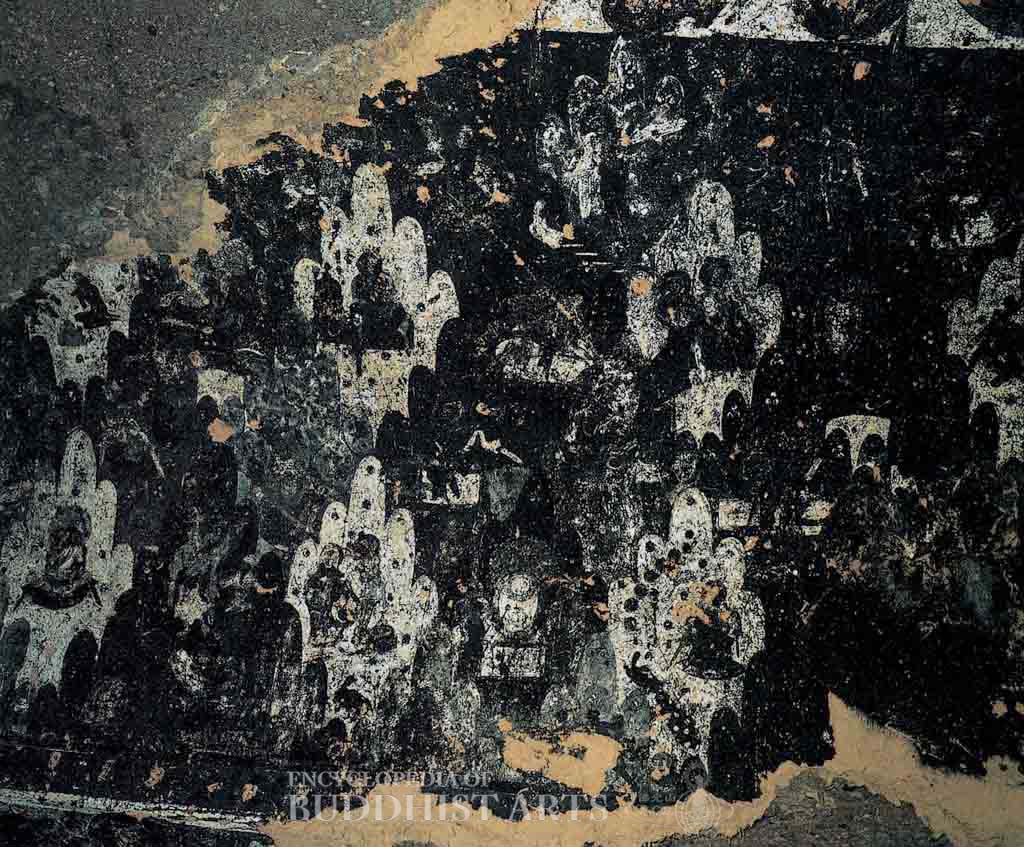
Taitai’er Caves: Cave 13 - Main Chamber - Ceiling (east slope)
Taitai’er Caves
CHINA, Xinjiang, Aksu
The Taitai’er Caves are located approximately 6 km northeast of Kizil village in Baicheng county, on the southern slope at the foothills of Ete’ershan, only 7 km from the Kizil Caves. These 18 caves were built from the 6th to 8th century. As part of the Kizil Caves, the Taitai’er Caves was listed as a National Cultural Heritage Site in 2006.
The types of caves include central pillar caves, vihara caves, and rectangular caves. Caves 5, 13, 16, and 17, are all central pillar caves, and contain well-preserved murals. The murals closely resemble the style from the late development period of the Kizil Caves, featuring many niches and images of Buddhas and Bodhisattvas. The influence of Mahayana Buddhism is evident.
The antechamber of Cave 13 has collapsed, but the main chamber and rear corridor still contain traces of murals, The diamond-shaped image on the east slope of the ceiling in the main chamber have suffered damage from incense smoke and therefore difficult to discern.
In Cave 16, the antechamber has collapsed. The main chamber and rear corridor each have flat ceilings and are different from other central pillar caves in the area. The outer walls on the east, west, and rear corridors are all painted with standing Buddha images, nine in total. A nimbus and aureole behind each Buddha is filled with small Buddha images.
The main chamber of Cave 17 has collapsed and the only murals preserved are in the rear corridor, displaying mountain landscapes. The mountains are arranged in rows of five or six, with a stupa on each mountain. Within each stupa is a seated Buddha. Monks and brahmins are painted on the arched ceiling. Unique to the caves of the area, paintings of imps are also found within.
For more details, go to the Encyclopedia of Buddhist Arts: Caves T-Z, page 1435.
Cite this article:
author = Hsingyun and Youheng and Johnson, Peter and Mankuang and Huntington, Susan and Edson, Gary and Neather, Robert,
booktitle = {Encyclopedia of Buddhist Arts: Caves T-Z},
pages = 1435,
title = {{Taitai’er Caves}},
volume = 9,
year = {2016}}