
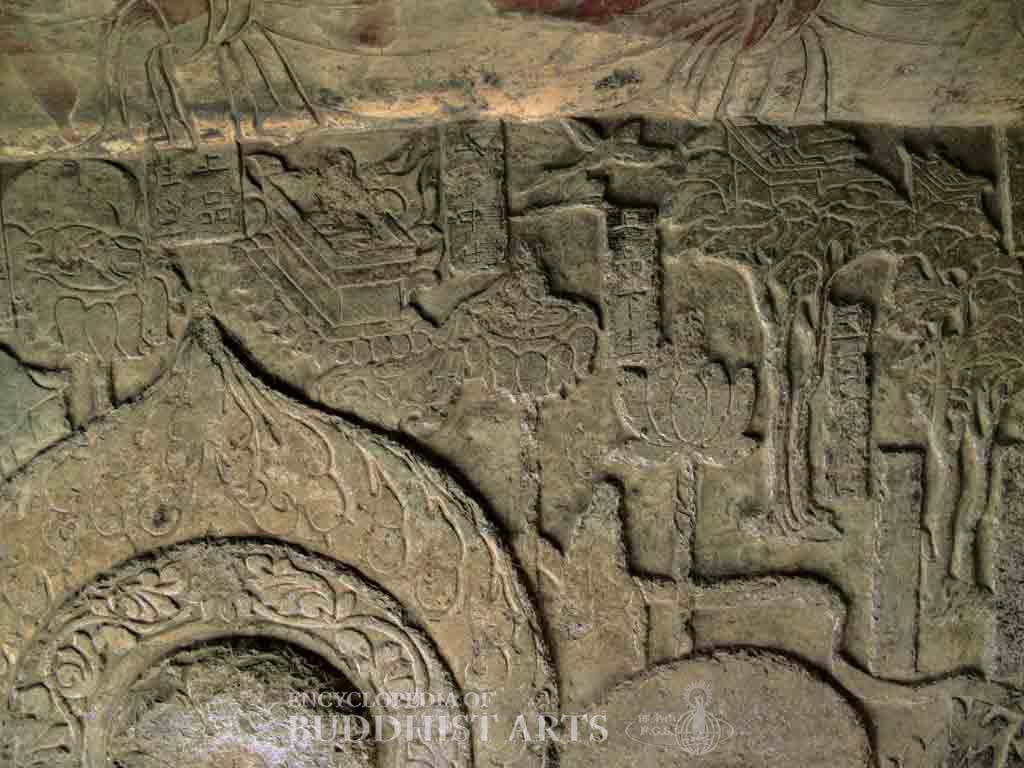
Xiaonanhai Caves: Illustration of the Amitayurdhyana Sutra - Sixteen Contemplations (detail) (Central Cave, west wall, right side)
Stone
Xiaonanhai Caves: Illustration of the Amitayurdhyana Sutra - Sixteen Contemplations
CHINA, Henan, Anyang; Northern Qi dynasty
This illustration can be found in the upper register of the west wall of both the Central and East Caves. The explanatory cartouches are only present in the Central Cave.
In the Central Cave, moving right from above the nimbus of the Buddha on the west wall, the cartouches read: “the highest grade of the highest class,” “the middle grade of the highest class,” “the lowest grade of the highest class,” “five hundred pavilions,” and “the trees of the seven treasures.” Moving to the left from the same spot, the cartouches in order read: “the highest grade of the middle class,” “the middle grade of the middle class,” “the lowest grade of the middle class,” “the waters of eight virtues,” and “the lowest class rebirth.” According to the Amitayurdhyana Sutra, the three classes of rebirth in the Pure Land are contemplations 14 to 16, and these classes are each broken up into three grades, resulting in nine grades in total. The trees of the seven treasures, the five hundred pavilions, and the waters of eight virtues represent contemplations 4 to 6.
Not only do the cartouches state the nine grades of rebirth, but there are also figures depicted on lotuses to represent them. Starting from the Buddha’s nimbus and spreading to the right, figures from the highest class of rebirth sit on lotuses that are either in full bloom or half bloom. Images representing the middle and lowest classes of rebirth are found to the left of the Buddha’s nimbus. The figures representing the middle class sit in lotuses that are about to bloom, while figures from the lowest class are seated in lotus buds that have yet to blossom.
The illustration of the Sixteen Contemplations on the west wall of the East Cave is simpler and lacks cartouches. Three figures sit on a square throne or hover on a cloud to the right of the Buddha’s nimbus in order to represent the highest class of rebirth. Two children on the left of the nimbus represent the middle class, and three other children wrapped in lotus buds that have yet to blossom represent the lowest class of rebirth.
For more details, go to the Encyclopedia of Buddhist Arts: Caves T-Z, page 1521.
Cite this article:
author = Hsingyun and Youheng and Johnson, Peter and Mankuang and Huntington, Susan and Edson, Gary and Neather, Robert,
booktitle = {Encyclopedia of Buddhist Arts: Caves T-Z},
pages = 1521,
title = {{Xiaonanhai Caves: Illustration of the Amitayurdhyana Sutra - Sixteen Contemplations}},
volume = 9,
year = {2016}}