
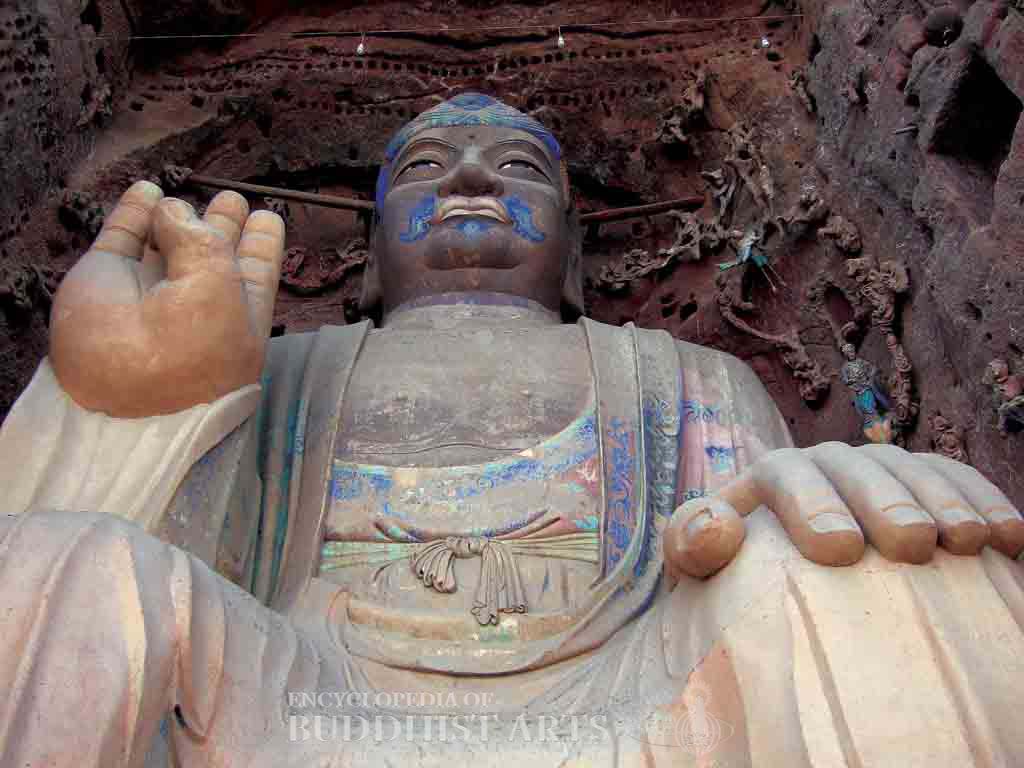
Daxiangshan Caves: Cave 6 - Seated Buddha (detail)
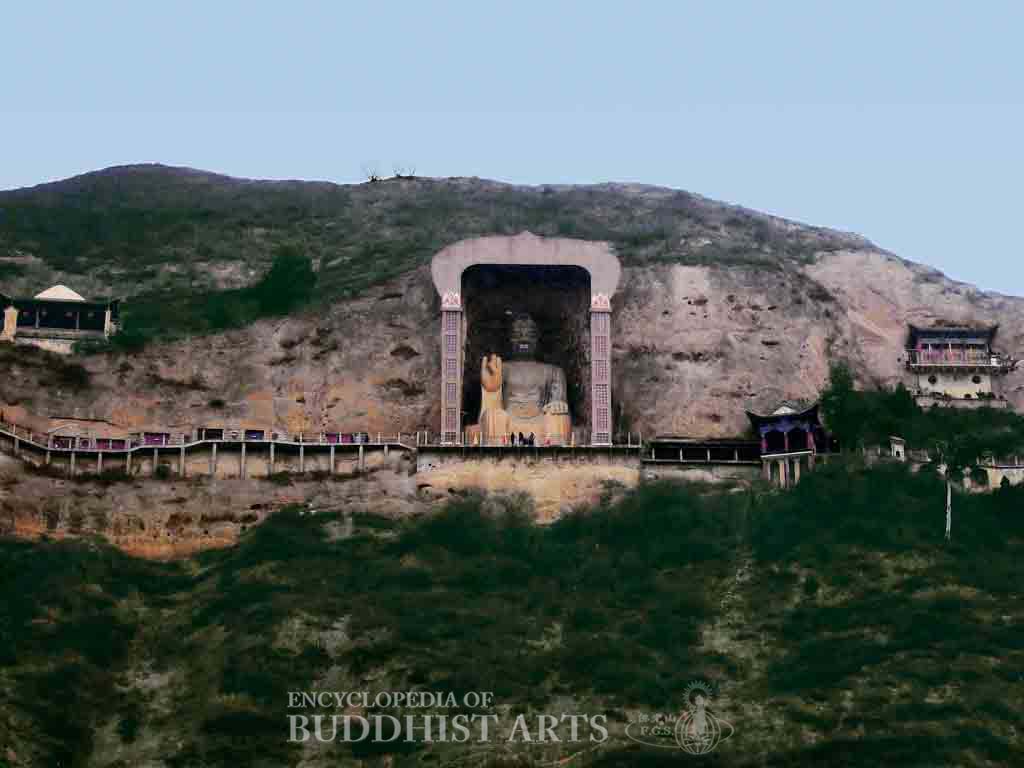
Daxiangshan Caves: Cave 6
Daxiangshan Caves
CHINA, Gansu, Tianshui
These caves are located on Wenqishan (Civil Flag Mountain), also known as Daxiangshan (Great Statue Mountain), 2.5 km west of Gangu county, Tianshui. Since the Northern Dynasties (386–581), there has been large scale construction at the site. During the Tang (618–907) and Song (960–1279) dynasties in particular, there was a flourish of Buddhist activities in the area. To date, there are 22 caves, the majority of which are meditation caves, with the notable exception of Daxiang Cave. The Daxiangshan Caves were listed as a National Cultural Heritage Site in 2001.
Cave 6 is Daxiang Cave, which is located on the side of the cliff at the top of the mountain. The eaves of the cave were originally made of wood and were built in three-story tower-style. Unfortunately, the original eaves have collapsed, and those now present at the site are a more recent construction. The interior of the cave is rectangular with an arched ceiling. It is 14 m wide, 34 m high, and 4.5 m deep, and contains a 23.3 m high Buddha, seated with legs pendent on a raised throne. The Buddha has a usnisa, curled hair, thin eyebrows, and an urna on the forehead. The inner and outer monastic robes covering the figure are carved with delicate folds. One hand forms the abhaya (fearlessness) mudra, while the other rests upon the knee. The Buddha’s bare feet are placed on lotus pedestals, and apsaras surround the Buddha. It is estimated that the Buddha was originally made during the High Tang period (712–756), and was later modified and repaired during the Song, Ming (1368–1644), and Qing (1644–1911) dynasties. More than 70 niches surround the Daxiang Cave, mostly containing miniature likenesses of the main statue.
The smaller surrounding caves have rectangular niches containing altars on the back walls. The east and west walls have monastic cells. A large number of surviving caves are meditation caves which were modified from the monastic cells. Due to the modifications, the murals which once decorated the walls no longer exist, making it hard to accurately date the creation of these caves.
For more details, go to the Encyclopedia of Buddhist Arts: Caves A-E, page 230.
Cite this article:
author = Hsingyun and Youheng and Johnson, Peter and Mankuang and Huntington, Susan and Edson, Gary and Neather, Robert,
booktitle = {Encyclopedia of Buddhist Arts: Caves A-E},
pages = 230,
title = {{Daxiangshan Caves}},
volume = 5,
year = {2016}}