
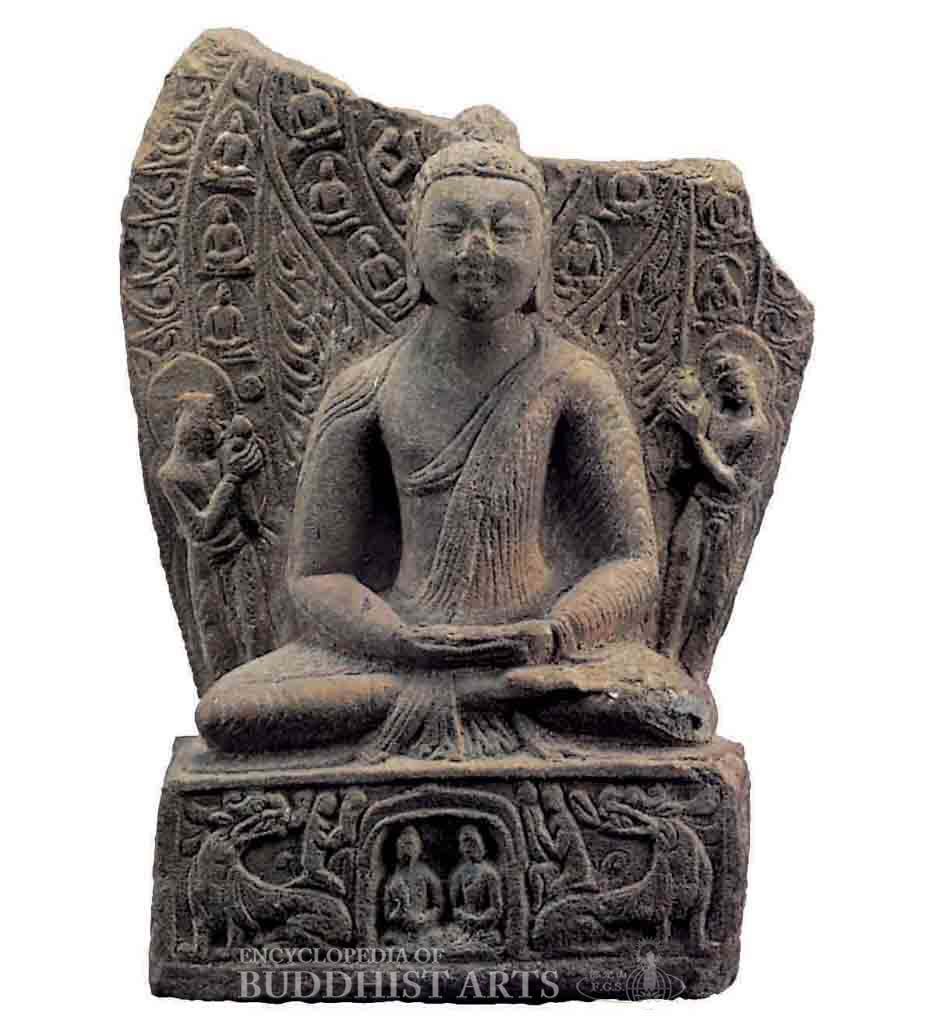
Buddha and Attendants
Sandstone
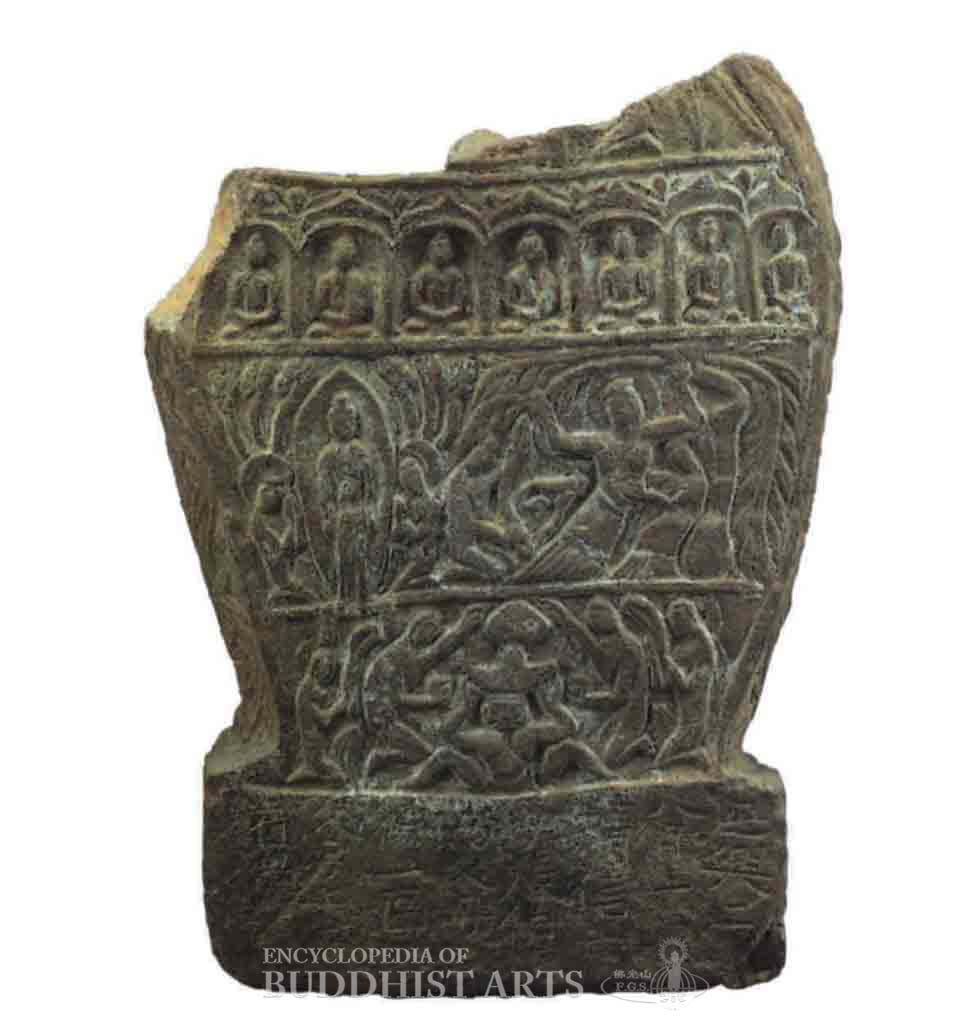
Buddha and Attendants (back)
Buddha and Attendants
CHINA; Northern Wei dynasty
The Buddha is seated in half lotus position on a low base with hands forming the dhyana (meditation) mudra. The figure has a prominent usnisa and a round face. A monastic robe covers both shoulders but the right side of the chest is bare. Only part of the mandorla remains and it is adorned with reliefs of seated Buddhas and flames. There is a Bodhisattva on either side of the Buddha holding an object.
The front of the throne has images of the Buddhas Sakyamuni and Prabhutaratna seated side by side. Donors accompanied by mythical creatures are located on either side with hands joined in reverence.
The reliefs on the back of the carving are divided into three registers. The top register depicts seven Buddhas. The middle register illustrates the birth of Prince Siddhartha, while the lowest register shows the nine nagas bathing the baby Prince. An inscription on the base dates the sculpture to 472.
For more details, go to the Encyclopedia of Buddhist Arts: Sculpture A-F, page 191.
Cite this article:
author = Hsingyun and Youheng and Lovelock, Yann and Chou, Yuan and Huntington, Susan and Edson, Gary and Neather, Robert,
booktitle = {Encyclopedia of Buddhist Arts: Sculpture A-F},
pages = 191,
title = {{Buddha and Attendants}},
volume = 10,
year = {2016}}