
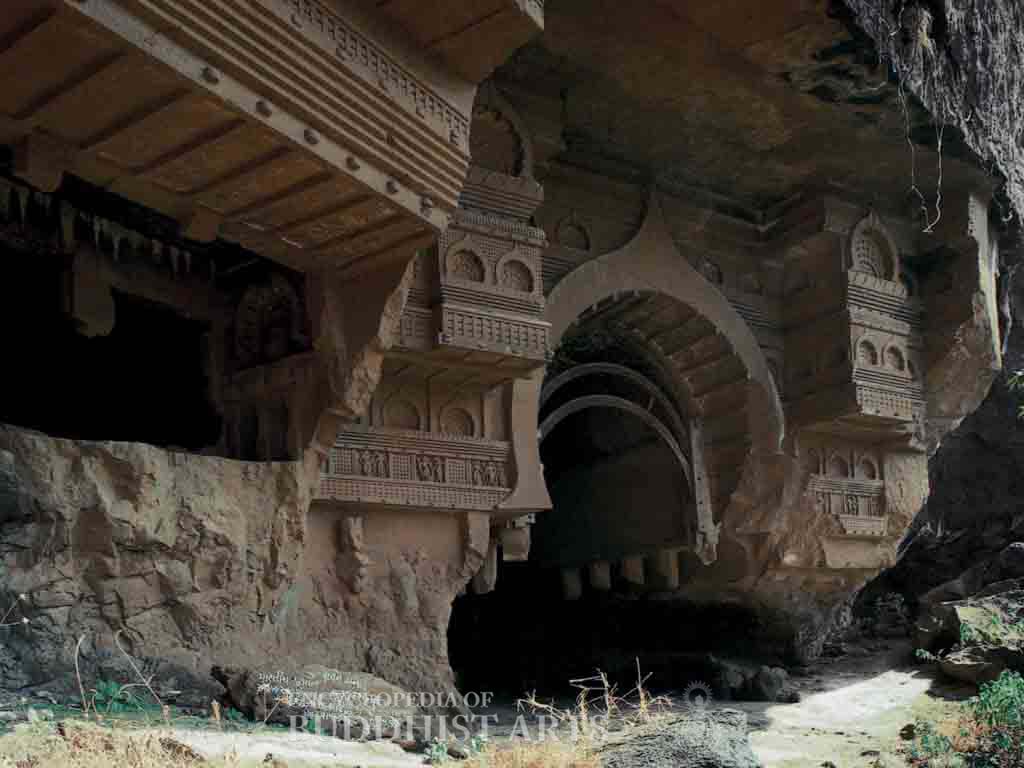
Kondane Caves: Cave 1

Kondane Caves: Cave 1 - Mithuna Couples (exterior wall)
Kondane Caves
INDIA, Maharashtra
Located approximately 80 km northwest of Pune, these caves are arranged in a line running from southwest to northeast and include a caitya cave, two vihara caves, and numerous cell groups. The caves are thought to have been created sometime between the late 2nd century BCE and early 1st century BCE.
Cave 1 is an apsidal caitya cave, measuring approximately 8.2 m in width, 20.4 m in depth, and 8.4 m in height. Wooden rafters originally framed the barrel-vaulted ceiling, but only small sections of the cave’s wooden structures remain; these are found around the large caitya window above the doorway. Remnants of a door guardian and an inscription dating to approximately the 1st century BCE are found on the lower left section of the exterior wall. Each side of the doorway features relief images of multi-story towers with caitya windows and balustrades. Thirty octagonal columns form a 1.2 m wide corridor around the main hall inside the cave. However, the majority of the columns are now damaged or lost, with only portions of their upper sections remaining. An additional two stone columns stand near the entrance. A stupa, located at the rear of the main cave, measures 2.9 m in diameter, and contains wooden canopies and a spire on top of its harmika. Mithuna couples in various postures embellish the walls of the cave, each positioned within individual compartments.
For more details, go to the Encyclopedia of Buddhist Arts: Caves R-L, page 600.
Cite this article:
author = Hsingyun and Youheng and Johnson, Peter and Mankuang and Huntington, Susan and Edson, Gary and Neather, Robert,
booktitle = {Encyclopedia of Buddhist Arts: Caves R-L},
pages = 600,
title = {{Kondane Caves}},
volume = 6,
year = {2016}}