
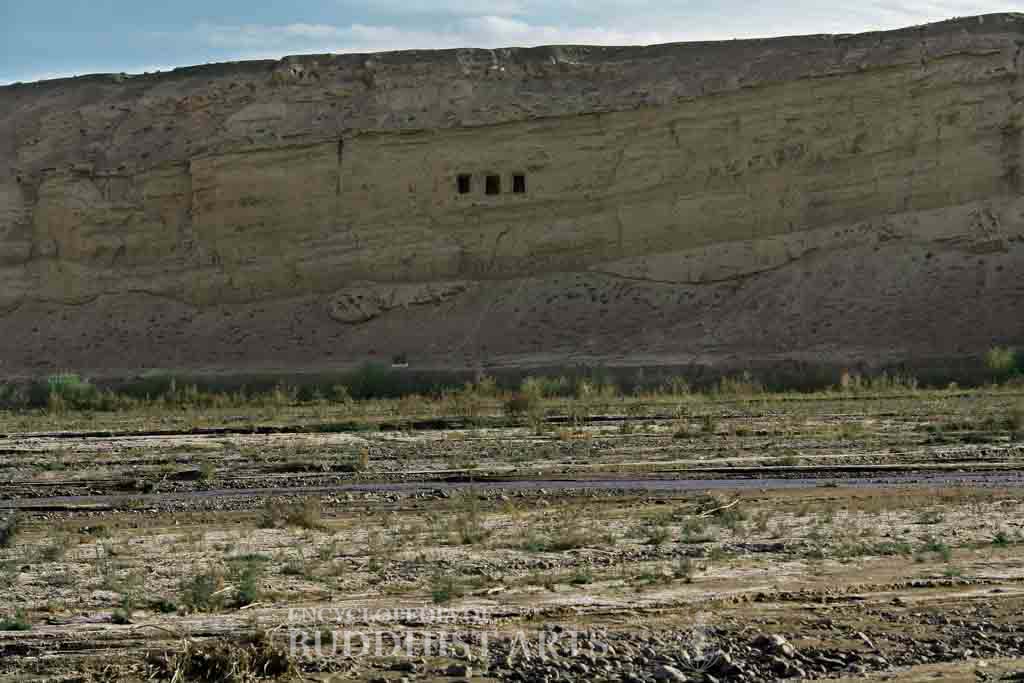
Sanxiandong Caves
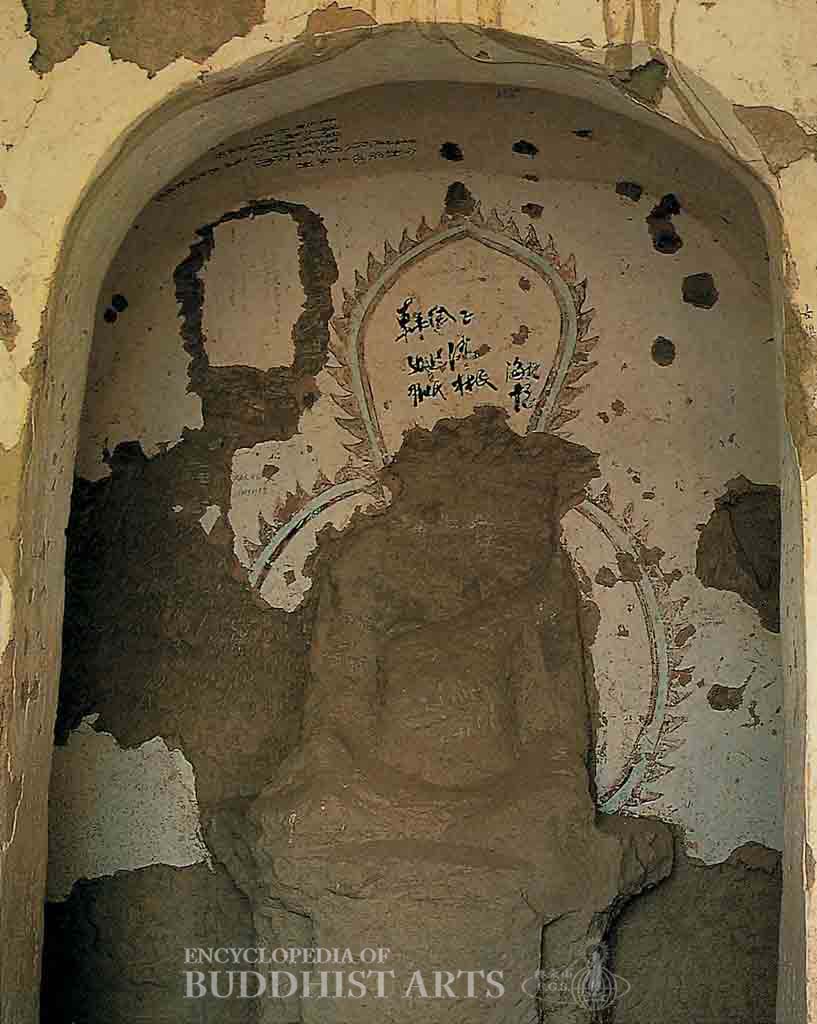
Sanxiandong Caves: Central Cave - Seated Buddha
Stone-core clay
Sanxiandong Caves
CHINA, Xinjiang, Kashgar
These three caves are located approximately 20 km north of Kashgar. The construction dates of the caves have not been determined; however, they are thought to have been built sometime between the 6th and 8th century. The caves are situated close together on an east-west axis, approximately 20 m above the ground on a cliff face, on the south bank of the Qiakmakh River. The three caves are similar in layout, each consisting of a front and rear chamber. The front chamber is almost square, while the smaller rear chamber is rectangular. Both chambers have barrel-vaulted ceilings. The caves were listed as a Provincial Cultural Heritage Site in 1957.
The murals in the east cave are in the best condition. Seven seated Buddhas, presumed to be the Seven Buddhas of the Past, are found above the cave entrance. The vaulted ceiling in the front chamber has astrological signs. The center of the painting is outlined by four rectangular frames, with a red moon at the center. The surface is painted gray around the red moon, and decorated with white dots. Portraits of seated and standing Buddhas are painted around these astrological signs. The ceiling and walls of the rear chamber display seated and standing Buddhas. Some of these Buddhas have canopies and wear the same clothes and display the same postures as those in the front chamber. All the Buddhas bare their chests while their lower bodies are covered with green, blue, and red garments painted in complex strokes. The west wall is unadorned, with neither mud surface nor traces of murals, indicating that construction was incomplete.
In all three caves, there are stone platforms present in front of the back wall of the rear chambers, indicating that at one time, they held statues. Only one of the platforms in the central cave retains a statue, but the head is missing. The seated Buddha is made from a stone core and then covered with clay. In this cave, the walls have been coated in white and repainted, beneath the surface of which are older murals. The style of the painting is different from the original murals.
For more details, go to the Encyclopedia of Buddhist Arts: Caves Mo-S, page 1344.
Cite this article:
author = Hsingyun and Youheng and Johnson, Peter and Mankuang and Huntington, Susan and Edson, Gary and Neather, Robert,
booktitle = {Encyclopedia of Buddhist Arts: Caves Mo-S},
pages = 1344,
title = {{Sanxiandong Caves}},
volume = 8,
year = {2016}}