
Karamar: Life of the Buddha
Schist
Karamar: Life of the Buddha
PAKISTAN, Khyber Pakhtunkhwa, Karamar
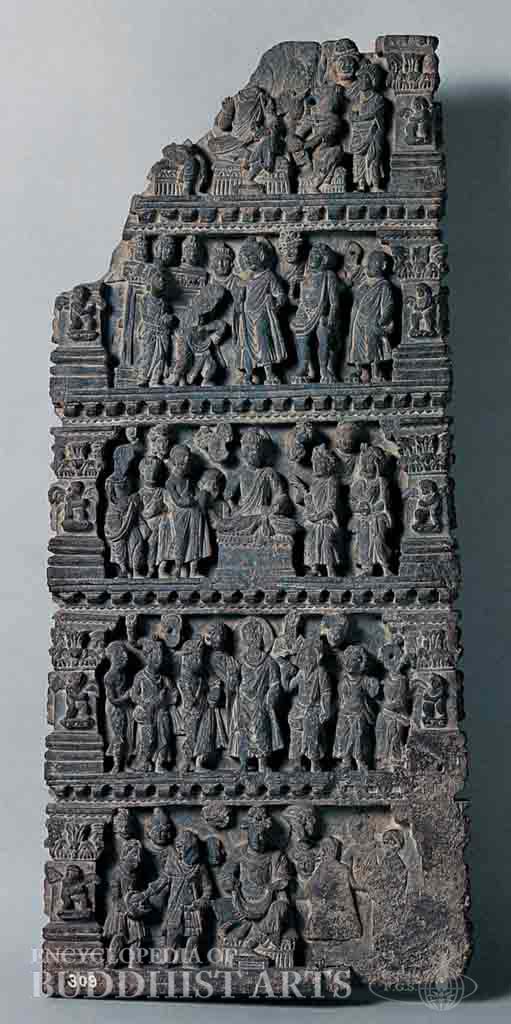
The relief was unearthed from Karamar and depicts different episodes of the Life of the Buddha divided between five registers. Each is separated by architectural elements such as rafters, architraves and Indo-Corinthian columns decorated with cherubs.
A part of the top register is damaged, rendering its content indecipherable. A figure surrounded by a mandorla is seated in the center, wearing a robe that covers the left shoulder and with his right hand raised. A number of figures surround him. Some historians speculate that the relief depicts Maitreya teaching the Dharma in Tusita Heaven.
The second register was taken from the Candraprabha Kumara Sutra and illustrates the story of Srigupta and his attempt on the Buddha’s life. Influenced by enemies of the Buddha, Srigupta made a fire pit at the entrance of the dwelling and poisoned the food he was offering. The Buddha transformed the pit into a lotus pond and neutralized the poison. In the relief, Srigupta is accompanied by his wife in welcoming the Buddha, who stands in the center. The Buddha, his Dharma protector, Vajradhara, and a monk are depicted with lotuses beneath their feet.
The third register depicts the Buddha’s aunt, Mahaprajapati, asking to become a nun. Initially her request was refused until Ananda pleaded on her behalf. Here, the Buddha sits on a lotus throne with his right arm raised to represent his eventual approval of an order of nuns. Ananda is to his immediate right, while the figure on his left holding a vase is Mahaprajapati.
The fourth register illustrates the Makandika Sutra. Makandika was an ascetic who, moved by the Buddha’s dignified appearance, believed him to be the only man worthy of his beautiful daughter, Anupama. When the Buddha rejected her, Anupama felt such humiliation that hate filled her heart. Eventually, she takes refuge in the Dharma and attains enlightenment. In the relief, Makandika, his wife, and Anupama are located on the right side. The other side is occupied by turbaned figures and a monk.
The right half of the lower register is worn. A throned Bodhisattva is at the center with an aristocratic figure standing directly to his right. Behind the noble there is a servant carrying a basket of offerings.
For more details, go to the Encyclopedia of Buddhist Arts: Sculpture G-M, page 525.
Cite this article:
author = Hsingyun and Youheng and Lovelock, Yann and Chou, Yuan and Huntington, Susan and Edson, Gary and Neather, Robert,
booktitle = {Encyclopedia of Buddhist Arts: Sculpture G-M},
pages = 525,
title = {{Karamar: Life of the Buddha}},
volume = 11,
year = {2016}}