

Kiyomizudera Temple: Main Hall

Kiyomizudera Temple: Gate of Benevolent Kings
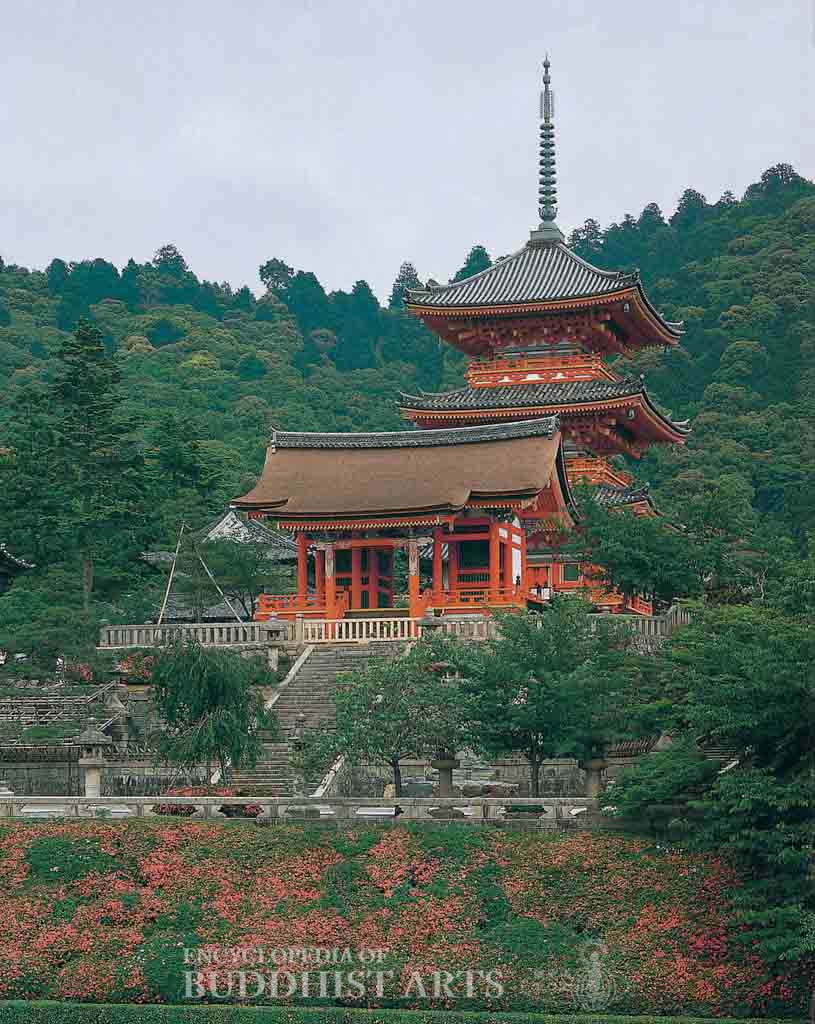
Kiyomizudera Temple: Three-Story Pagoda
Kiyomizudera Temple
JAPAN, Kyoto
Kiyomizudera, meaning Clear Water Temple, is the head temple of the Northern Hosso school of Japanese Buddhism and is the 16th of the 33 Avalokitesvara temples of the Saigoku Kannon Pilgrimage of southern-central Japan. It was built in 798 during the Nara period, and derived its name from the nearby mountain spring. In 805 Emperor Kammu (reigned 781–806) designated it as a temple for the use of the imperial family. It was attacked and damaged several times as a result of doctrinal differences but was rebuilt with imperial support. As part of the historical buildings of Kyoto, it was listed as a UNESCO World Heritage Site in 1994.
The temple occupies 13 ha and consists of the Gate of Benevolent Kings, main hall, sutra repository, founder’s hall, Amitabha Hall, Sakyamuni Buddha Hall, Ksitigarbha Hall, three-story pagoda, and the west gate. The three-bay Gate of Benevolent Kings is the main temple gate. It has two stories and a hip-and-gable roof covered in cypress bark. Within the central bay there is a statue of a benevolent king on either side.
The main hall was reconstructed in 1633 and is built on the side of a hill. It has a single-eave hip roof covered in cypress bark. In front of the hall, at either end of the main roof, there are protruding hip-and-gable roofs. At the front there is an extended area for worship surrounded by balustrades, an area known as the Kiyomizu stage. The building is supported by 139 columns without the use of a single nail. The hall is 36 m wide, 30 m deep, and 18 m high. The interior consists of a main hall and a ceremonial hall. A statue of the Eleven-Headed, Thousand-Armed Avalokitesvara is enshrined within the main hall.
The wooden three-story pagoda is 30 m high and built in the style of the early Edo period (1615–1868). On the first story there is a seated Vairocana Buddha statue surrounded by Vajrayana Buddhist paintings and motifs of apsaras and nagas.
For more details, go to the Encyclopedia of Buddhist Arts: Architecture G-L, page 608.
Cite this article:
author = Hsingyun and Youheng and Johnson, Peter and Mankuang and Lancaster, Lewis,
booktitle = {Encyclopedia of Buddhist Arts: Architecture G-L},
pages = 608,
title = {{Kiyomizudera Temple}},
volume = 2,
year = {2016}}