
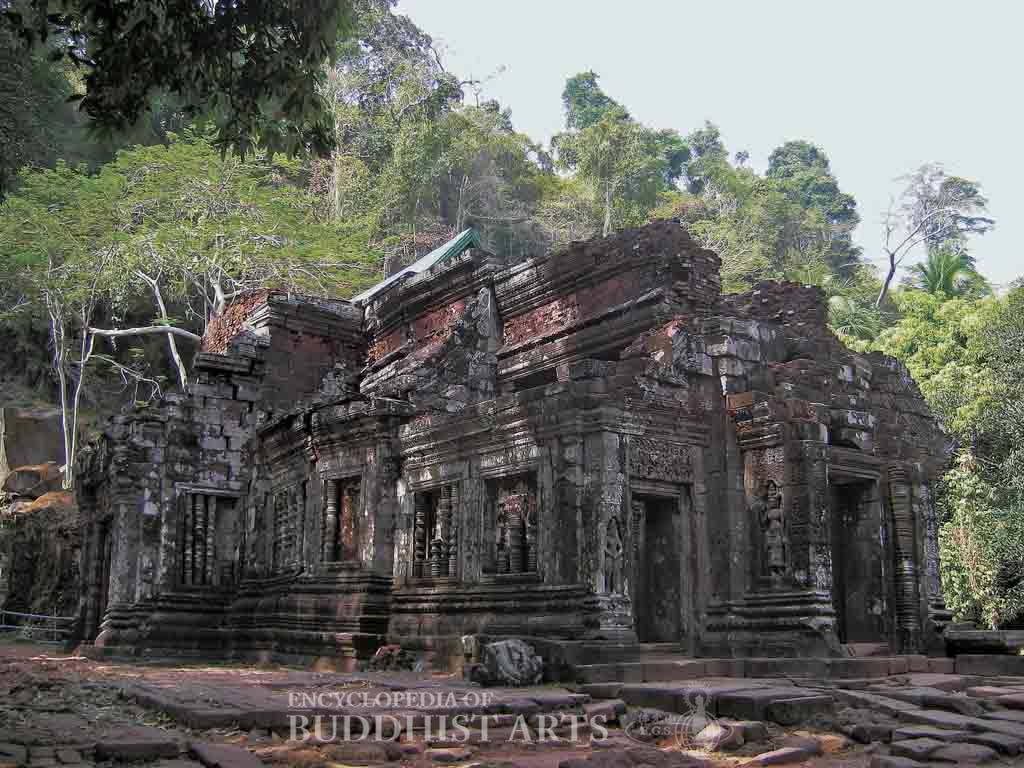
Wat Phou: Main Shrine
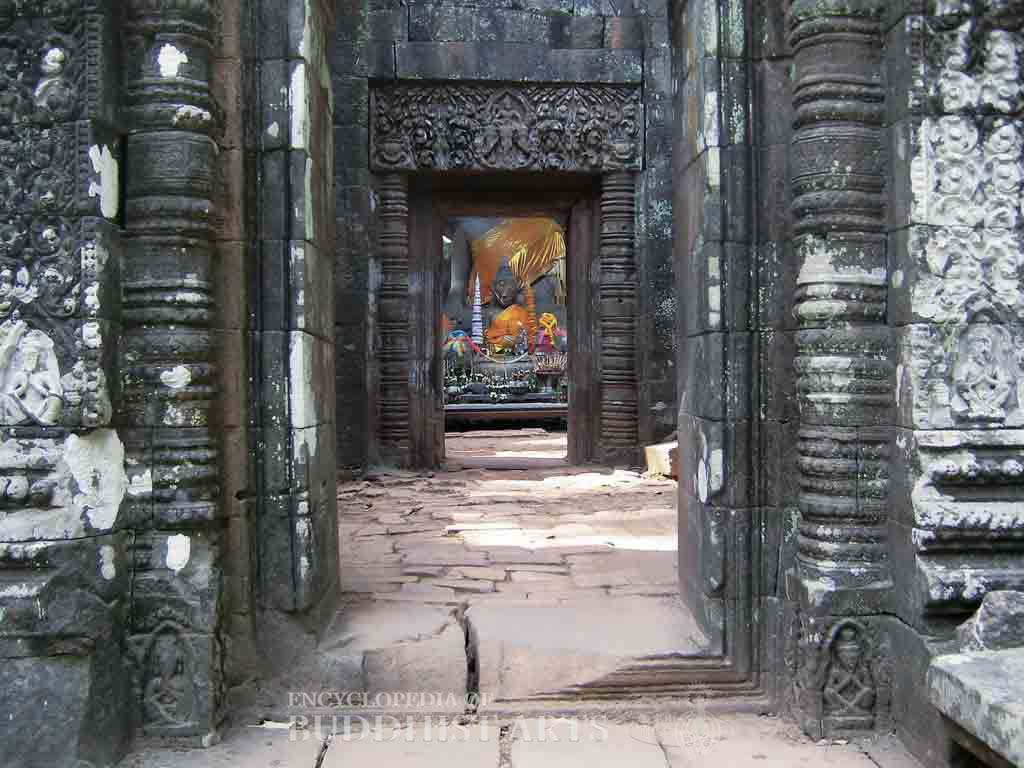
Wat Phou: Main Shrine
Wat Phou
LAOS, Champasak
Wat Phou means Temple on the Mountain and it is situated at the foot of Phou Khao Khouay (Buffalo Horn Mountain), 50 km from Pakse. Its origins can be traced back to the 5th century. The temple underwent major development between the 7th and 14th centuries during the Khmer Empire (circa 9th–15th century). It was originally built as a Hindu temple but was converted to a Theravada Buddhist temple in the 13th century. The temple was designated a National Heritage Site in 1993 and it was listed as a UNESCO World Heritage Site in 2001.
The temple complex stretches 1.4 km from east to west. The major buildings are distributed over several terraces on the slope of the mountain. The existing structures include two rectangular buildings with courtyards, the Nandin Shrine, main shrine, sutra repository, and other smaller shrines.
There is a 280 m long path lined with posts and paved in stone leading up to the first terrace. The path is flanked by two artificial lakes. At the end of the path there are two rectangular structures on each side facing the path. They are made of sandstone and laterite, and each contains an inner courtyard. The structures are intricately carved, with large tympana above the doorways, as well as barred windows lining the walls.
The rest of the terraces are connected by a central walkway and staircases. The Nandin Shrine and other smaller shrines are located along the upper terraces. The main shrine, made of brick and stone, is located on the highest terrace and built against a cliff. Except for the collapsed roof, the shrine is well preserved. The front of the building has three doorways with delicately carved reliefs on the lintels. The exterior walls have bricked-up windows fronted by a row of slender round columns. This shrine was dedicated to Shiva and the reliefs and sculptures mostly depict Hindu themes. Following the conversion of the temple into a Buddhist one, it now houses Buddha statues. The temple still plays an important role in local religious life and remains a sacred place today.
For more details, go to the Encyclopedia of Buddhist Arts: Architecture T-Z, page 1217.
Cite this article:
author = Hsingyun and Youheng and Johnson, Peter and Mankuang and Lancaster, Lewis,
booktitle = {Encyclopedia of Buddhist Arts: Architecture T-Z},
pages = 1217,
title = {{Wat Phou}},
volume = 4,
year = {2016}}