
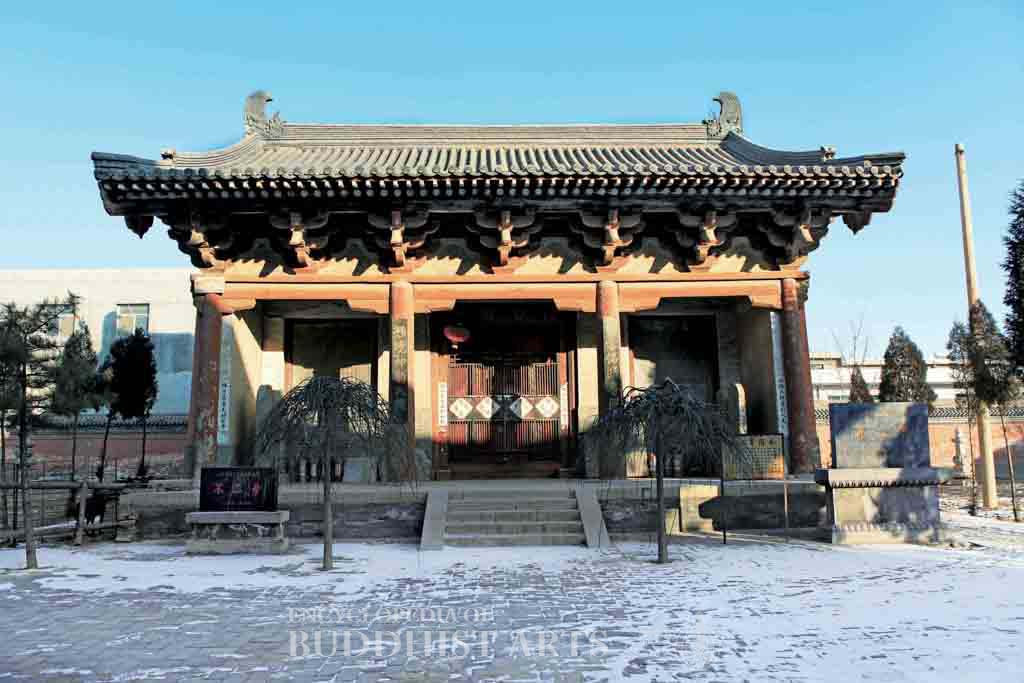
Bu’er Temple: Great Hero Hall
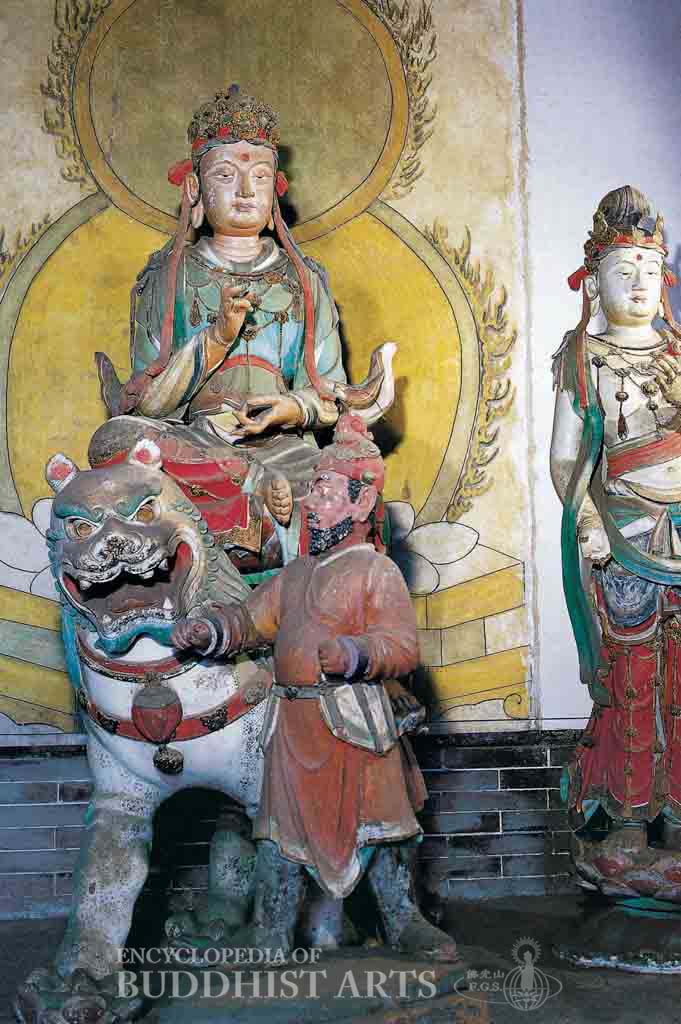
Bu’er Temple: Great Hero Hall - Manjusri Bodhisattva
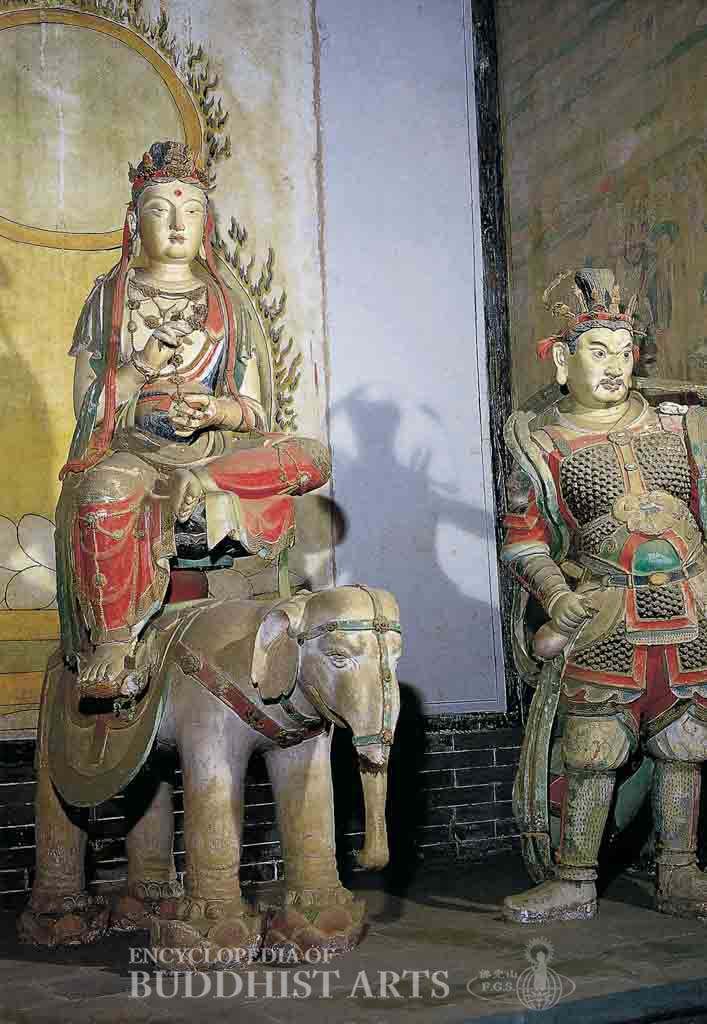
Bu’er Temple: Great Hero Hall - Samantabhadra Bodhisattva
Bu’er Temple
CHINA, Shanxi, Taiyuan
Bu’er means Non-duality. According to an inscription, the temple was built in 956 during the Northern Han Kingdom and has been repaired a number of times. It was originally located in Yangqu county; however, due to long term damage by nature and humans, the only extant buildings are the Great Hero Hall and two funerary pagodas. The Great Hero Hall was relocated to its current position in 1989. The temple was listed as a National Cultural Heritage Site in 2006.
The Great Hero Hall was rebuilt in 1195 during the Jin dynasty. It faces south and occupies 148 sq m. It is a three-by-three bay structure with a single-eave overhanging gable roof. The roof is covered with cylindrical tiles and the gradient of the roof is gentle. It is supported by two-tier bracket sets with a single projecting bracket arm and downward-pointing cantilevers. Inside, the roof frame is exposed. Clay statues of Sakyamuni Buddha, Manjusri, and Samantabhadra Bodhisattvas are enshrined at the center. They were probably created during the Ming dynasty (1368–1644) and are perfectly preserved. There are about 80 sq m of murals on the gables. They are divided into three registers connected by clouds, which add a sense of unity to the artwork.
For more details, go to the Encyclopedia of Buddhist Arts: Architecture A-F, page 102.
Cite this article:
author = Hsingyun and Youheng and Johnson, Peter and Mankuang and Lancaster, Lewis,
booktitle = {Encyclopedia of Buddhist Arts: Architecture A-F},
pages = 102,
title = {{Bu’er Temple}},
volume = 1,
year = {2016}}