
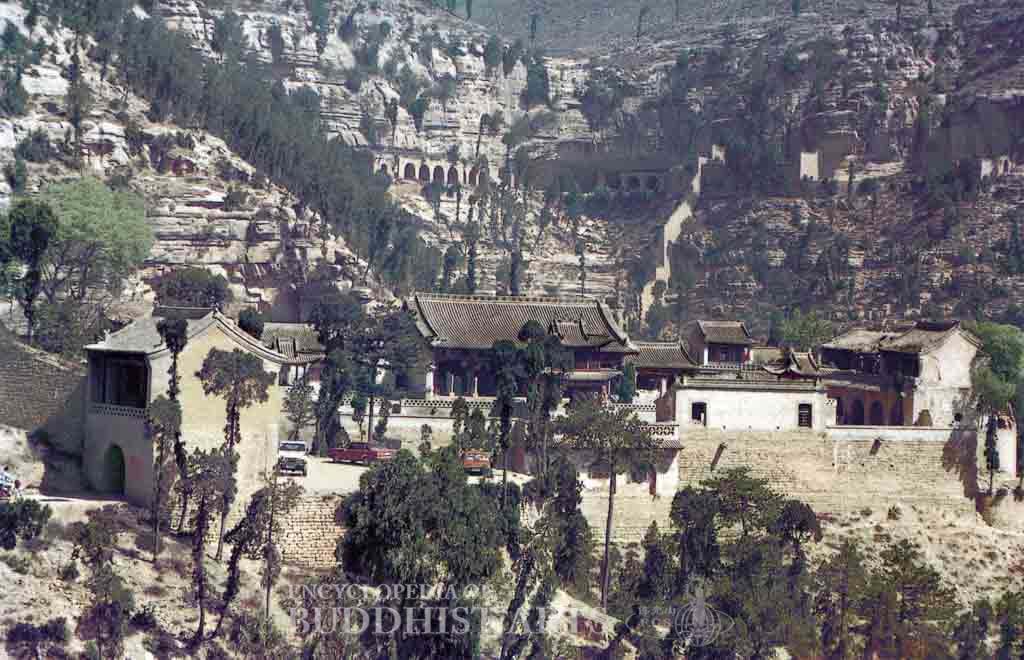
Anguo Temple
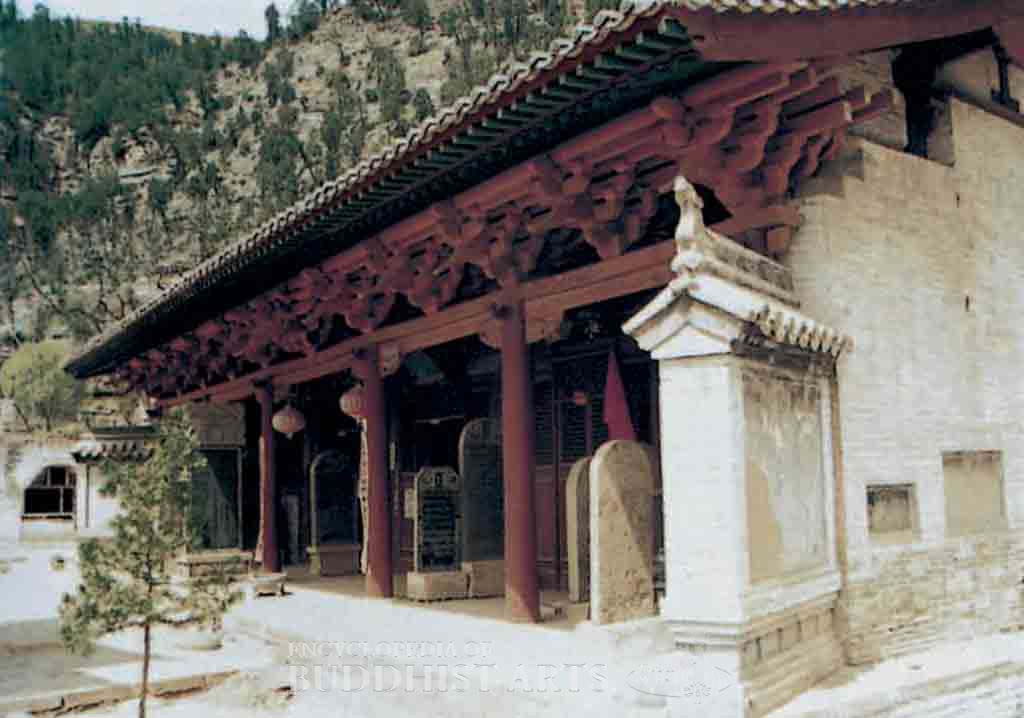
Anguo Temple: Great Hero Hall
Anguo Temple
CHINA, Shanxi, Luliang
Anguo means National Peace. The temple was built in 637 during the Tang dynasty. It was repaired during subsequent dynasties and most of the surviving buildings date to the Ming (1368–1644) or Qing (1644–1911) dynasties. It was listed as a National Cultural Heritage Site in 2001.
The temple faces south and is built according to the shape of the hill. The main buildings include the Great Hero Hall, Bronze Pagoda Tower, bell and drum towers, Hall of the Ten Kings, Lord Guan Pavilion, Avalokitesvara Pavilion, Ancestral Temple of Yu Qingduan, Study House of Yu Chenglong, and a brick pagoda. The five-by-three bay Great Hero Hall has a single-eave overhanging gable roof. The hall contains the Buddhas of the past, present, and future, which are 4.8 m high. The walls are decorated with murals from the Qing dynasty depicting the Life of the Buddha. The eight-tier octagonal brick pagoda has a Sumeru base with carvings in the concave section. The pagoda body was constructed with smooth, solid bricks to imitate a timber structure.
For more details, go to the Encyclopedia of Buddhist Arts: Architecture A-F, page 17.
Cite this article:
author = Hsingyun and Youheng and Johnson, Peter and Mankuang and Lancaster, Lewis,
booktitle = {Encyclopedia of Buddhist Arts: Architecture A-F},
pages = 17,
title = {{Anguo Temple}},
volume = 1,
year = {2016}}