
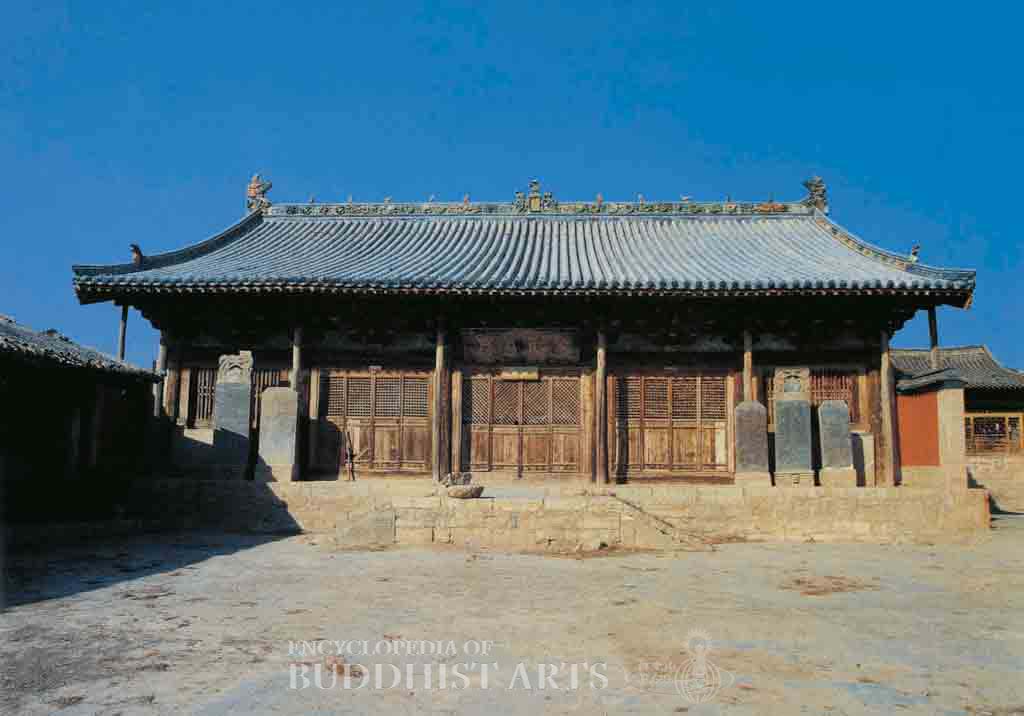
Hongfu Temple: Great Hero Hall
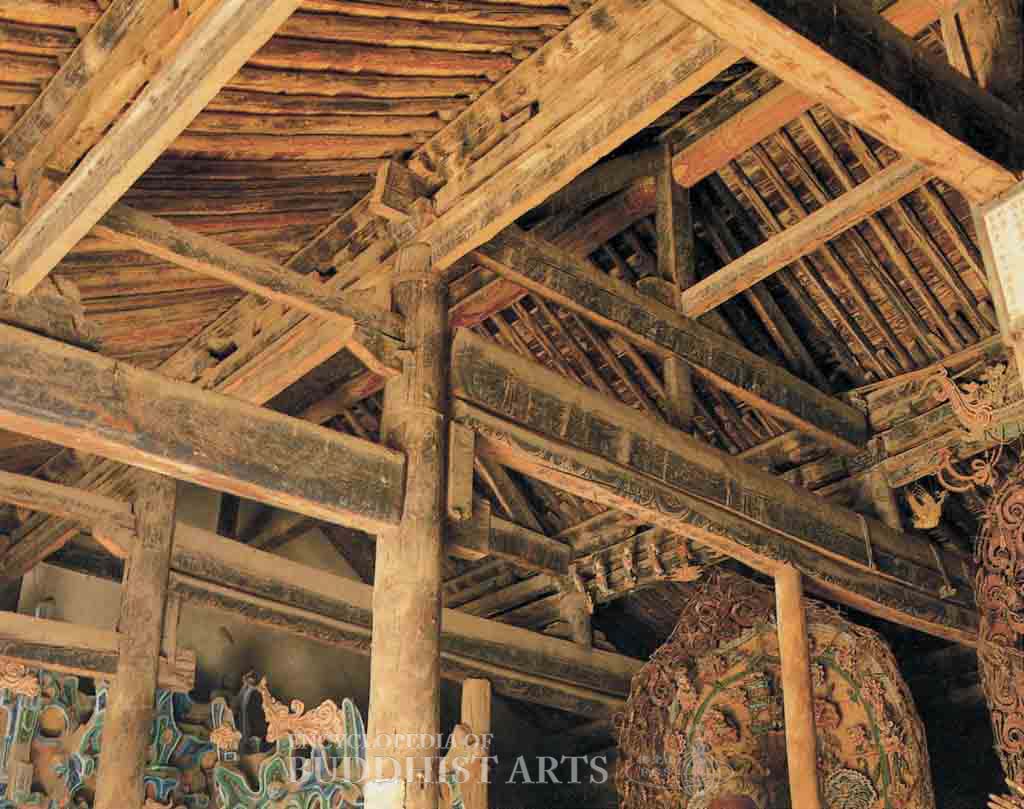
Hongfu Temple: Great Hero Hall (interior)
Hongfu Temple
CHINA, Shanxi, Xinzhou
Hongfu stands for Immense Blessing. The temple has no known construction date but according to the records it already existed by the Northern Song dynasty (960–1127). The temple was repaired during subsequent dynasties, so the Great Hero Hall dates back to the Jin dynasty (1115–1234), whereas the side halls were built in the Qing dynasty (1644–1911). The temple was listed as a National Cultural Heritage Site in 2001.
Facing south and occupying 3,300 sq m, the whole complex is constructed upon a 7 m high earthen platform. The only existing buildings are the Great Hero Hall, the bell and drum towers and the side halls. The complex is enclosed by a low wall with a perimeter of about 400 m. The five-by-three bay Great Hero Hall has a single-eave overhanging gable roof covered with cylindrical clay tiles. Glazed decorations shaped like mythical creatures are well-preserved and can be found on the ridge and rafters. The central bay and the two side bays have sliding lattice doors. Apart from the bracket sets found above the pillar capitals, there is also one intercolumnar bracket set between each pillar. All transverse bracket arms have angled brackets protruding from both sides, a typical feature found in Jin architecture. Inside the Great Hero Hall the roof frame is exposed. Nine statues dating back to the Ming dynasty (1368–1644) are enshrined upon the Buddha altar, including those of Sakyamuni Buddha, Manjusri Bodhisattva, and Samantabhadra Bodhisattva.
For more details, go to the Encyclopedia of Buddhist Arts: Architecture G-L, page 449.
Cite this article:
author = Hsingyun and Youheng and Johnson, Peter and Mankuang and Lancaster, Lewis,
booktitle = {Encyclopedia of Buddhist Arts: Architecture G-L},
pages = 449,
title = {{Hongfu Temple}},
volume = 2,
year = {2016}}