
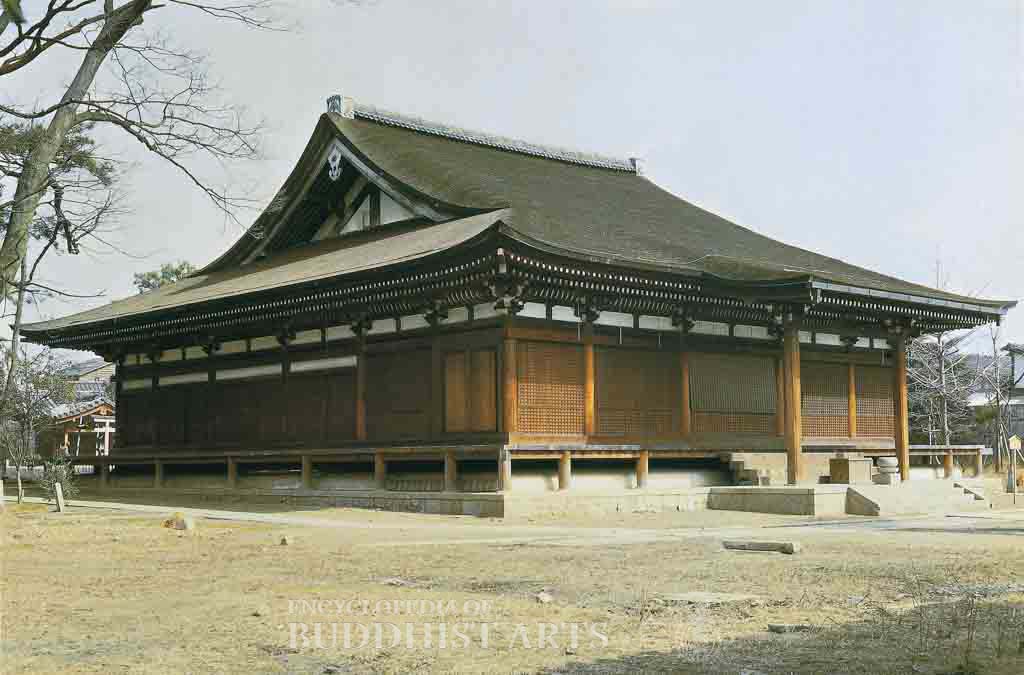
Daihoonji Temple Main Hall
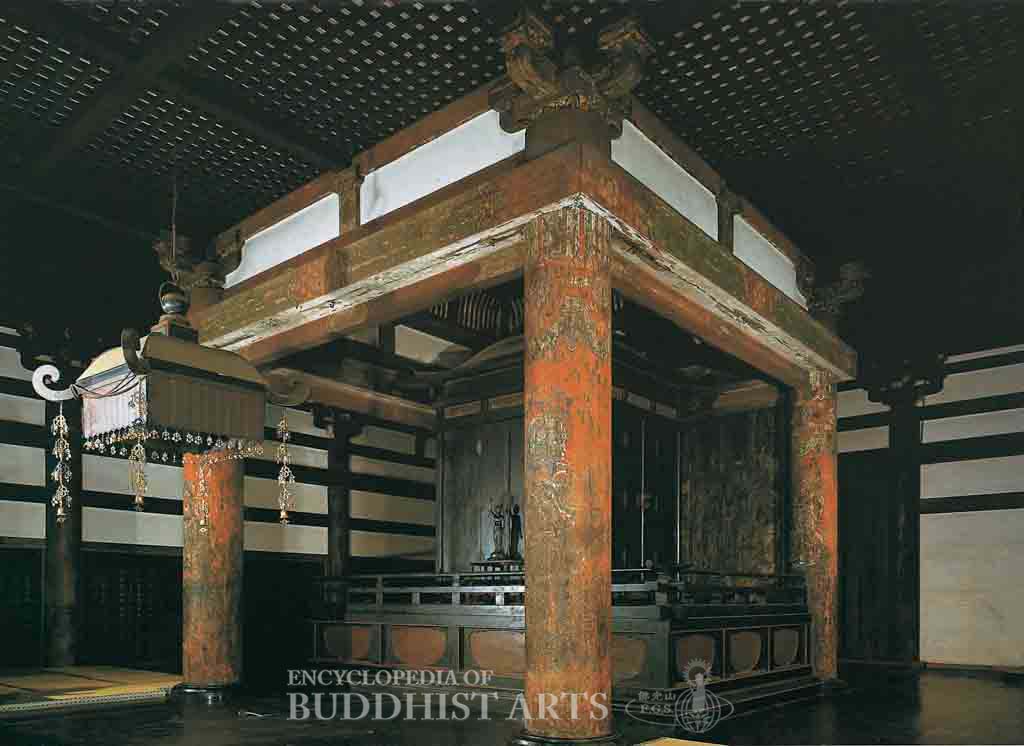
Daihoonji Temple Main Hall (interior)
Daihoonji Temple Main Hall
JAPAN, Kyoto
The main hall is one of the oldest wooden structures in Kyoto. It was constructed in 1227 during the Kamakura period to serve as a hall for chanting the Sakyamuni Buddha’s name. The hall is also known as the Thousand Sakyamuni Buddha Hall. It was listed as a National Treasure in 1952.
Though the hall was destroyed many times during wartime, it retains its original appearance. The five-by-six bay structure is 19.5 m wide and 23.2 m deep. The single-eave hip-and-gable roof is covered with cypress bark. In the front there is a portico and a veranda surrounds the entire hall. The structure has many mullioned windows, paneled doors, as well as sliding doors. The floor is laid out with wooden boards. There is a bowl-shaped plafond in the center of the lattice ceiling. The hall is built in the wayo style from the Kamakura period (1185–1333) and appears simple and elegant. The hall houses a statue of seated Sakyamuni Buddha sculpted by Gyokai, statues of the Ten Great Disciples of the Buddha carved by Kukei, as well as Jukei’s six standing statues of Avalokitevara, all of which are Important Cultural Properties.
For more details, go to the Encyclopedia of Buddhist Arts: Architecture A-F, page 197.
Cite this article:
author = Hsingyun and Youheng and Johnson, Peter and Mankuang and Lancaster, Lewis,
booktitle = {Encyclopedia of Buddhist Arts: Architecture A-F},
pages = 197,
title = {{Daihoonji Temple Main Hall}},
volume = 1,
year = {2016}}