
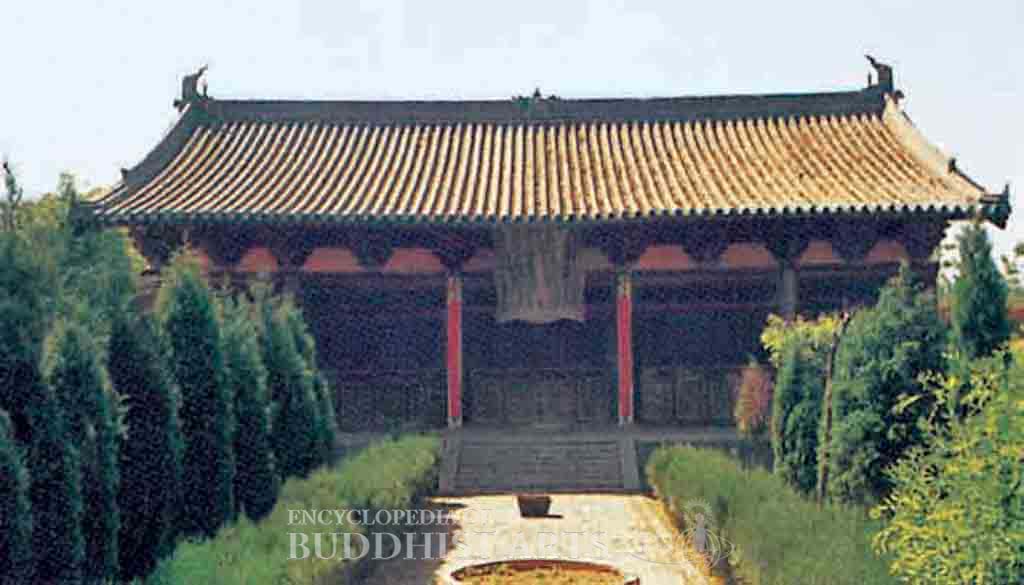
Taiyin Temple: South Hall
Taiyin Temple
CHINA, Shanxi, Yuncheng
Taiyin means Very Shady. The temple was built during the Northern Wei dynasty (386–534) and expanded in 652 during the Tang dynasty. The south hall was rebuilt in 1170 during the Jin dynasty. It was listed as a National Cultural Heritage Site in 2001.
The temple faces north and occupies 8,700 sq m with dimensions of 108 m x 81 m. Along the central axis there are the main temple gate, the north hall, which is also named Avalokitesvara Pavilion, and the south hall. Only the timber structure of the South Hall is original from the Jin dynasty (1115–1234), which makes it of considerable architectural value.
The five-bay by six-rafter south hall has a single-eave overhanging gable roof. The eaves are supported by three-tier bracket sets with a single projecting bracket arm and two cantilevers, with intercolumnar bracket sets between the columns. Inside the hall, there is a wooden niche with a 4 m long and 1.5 m high Reclining Buddha from 1170 of the Jin dynasty. The walls within the niche depict the disciples mourning the parinirvana of the Buddha. These images are believed to have been painted in 1372 during the Ming dynasty.
For more details, go to the Encyclopedia of Buddhist Arts: Architecture T-Z, page 1084.
Cite this article:
author = Hsingyun and Youheng and Johnson, Peter and Mankuang and Lancaster, Lewis,
booktitle = {Encyclopedia of Buddhist Arts: Architecture T-Z},
pages = 1084,
title = {{Taiyin Temple}},
volume = 4,
year = {2016}}