
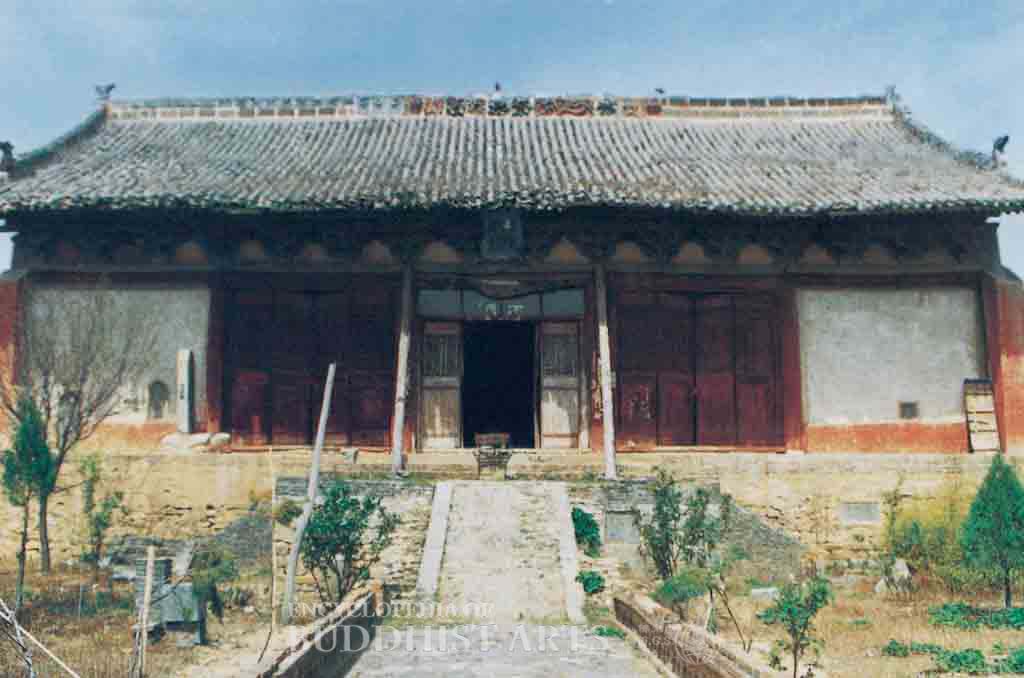
Qingliang Temple: Great Hero Hall
Qingliang Temple
CHINA, Shanxi, Yuncheng
Qingliang stands for Clear and Cool. The temple records state that it was built in 1303 during the Yuan dynasty and repaired a few times throughout the Ming (1368–1644) and Qing (1644–1911) dynasties. In 1993 the framework of the Great Hero Hall sank slightly and had to be renovated. The temple was listed as a National Cultural Heritage Site in 2001.
The temple faces south and occupies 2,500 sq m, measuring 62 m long and 41 m wide. The Great Hero Hall, in its original form from the Yuan dynasty (1271–1368), is the only remaining building within the temple. The five-by-three bay hall has an overhanging gable roof covered with cylindrical tiles. The central bay and the two bays on either side have lattice doors. The eaves are supported by two-tier bracket sets with two sets of downward-pointing cantilevers, while each bay contains two intercolumnar bracket sets. The hall was constructed using the column omitting technique. The roof frame is completely exposed. Since the central bay and the side bays have different frameworks, the columns sometimes seem not to be aligned and appear to be positioned rather haphazardly. This design makes the hall very unique.
For more details, go to the Encyclopedia of Buddhist Arts: Architecture M-S, page 876.
Cite this article:
author = Hsingyun and Youheng and Johnson, Peter and Mankuang and Lancaster, Lewis,
booktitle = {Encyclopedia of Buddhist Arts: Architecture M-S},
pages = 876,
title = {{Qingliang Temple}},
volume = 3,
year = {2016}}