
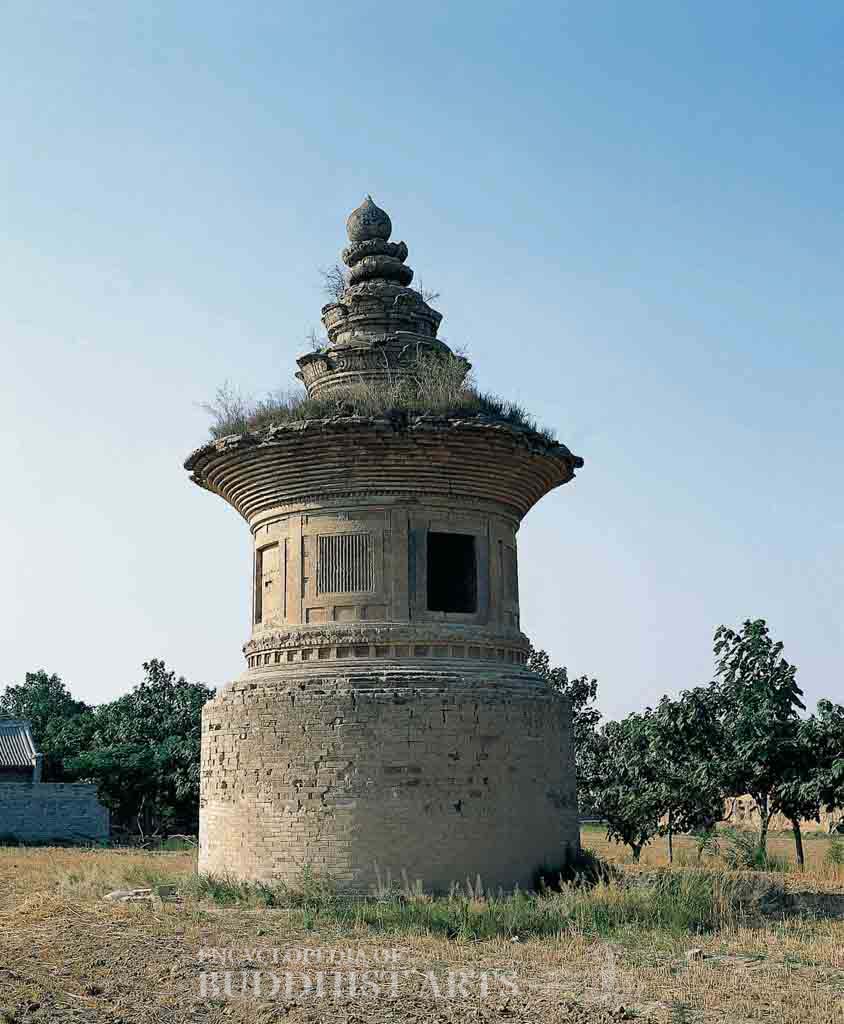
Fanzhou Pagoda
Fanzhou Pagoda
CHINA, Shanxi, Yuncheng
This pagoda is located within the ruins of Baoguo (Repay the Nation) Temple. This may be the only example of a round pagoda from the Tang dynasty (618–907). It was built in 793 and is the funerary pagoda of Chan Master Fanzhou, who renounced in 759 and passed away in 793 at the age of 54. The pagoda was listed as a National Cultural Heritage Site in 2001.
The pagoda is 10 m high with a diameter of 5.7 m. Most of the pagoda is built in brick, although there are some stone parts in the body and roof. Structurally it consists of three parts: base, body, and roof in almost equal proportions. The base is cylindrical and formed from 30 layers of brick, tapering slightly at the top. The pagoda body is hollow with a hexagonal chamber. The entrance is located on the south side with the door frame constructed from stone, while on either side there are timber imitations of vertical bar windows. On one side of the pagoda body there is an inscription relating to Chan Master Fanzhou. The eaves are in the form of brick corbeling. In the center of the roof there is base of the spire, consisting of two layers of plantain leaf patterns. They support an inverted bowl, a suspended lotus, an upright lotus, and a canopy. The finial is in the shape of a jewel.
For more details, go to the Encyclopedia of Buddhist Arts: Architecture A-F, page 290.
Cite this article:
author = Hsingyun and Youheng and Johnson, Peter and Mankuang and Lancaster, Lewis,
booktitle = {Encyclopedia of Buddhist Arts: Architecture A-F},
pages = 290,
title = {{Fanzhou Pagoda}},
volume = 1,
year = {2016}}