
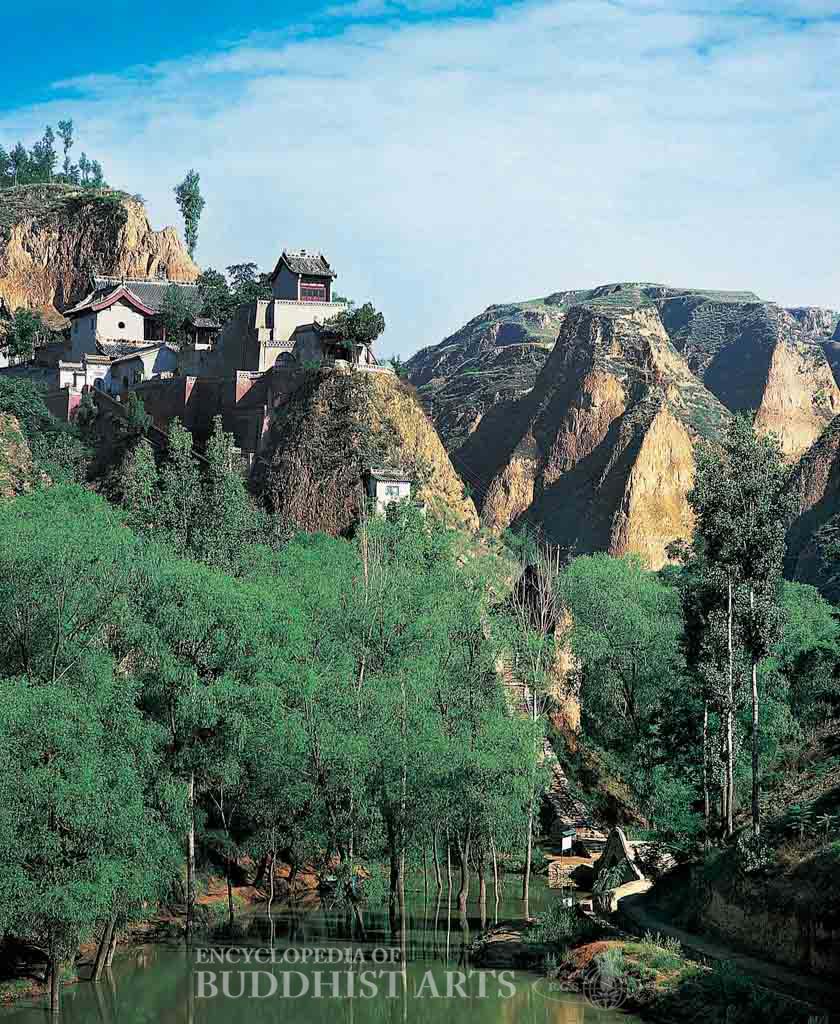
Qianfo Hermitage
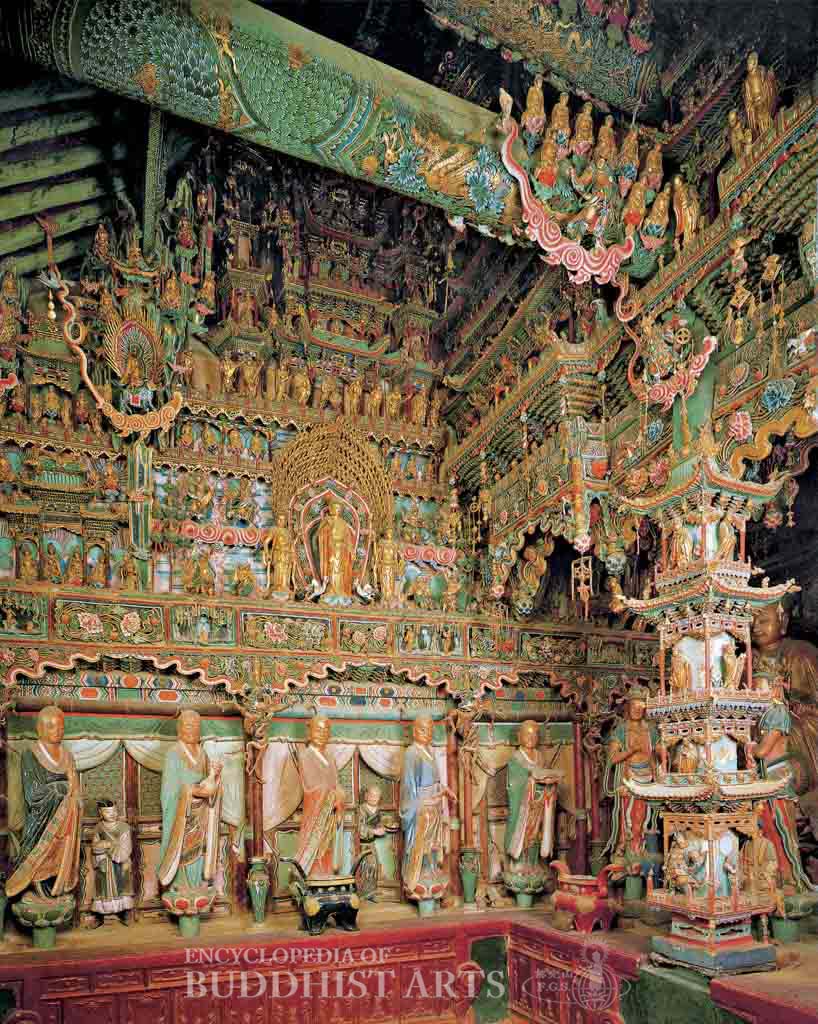
Qianfo Hermitage: Great Hero Hall (interior)
Qianfo Hermitage
CHINA, Shanxi, Linfen
Qianfo means Thousand Buddhas, although the hermitage is also known as Xiao Xitian (Small Western Pure Land). It was constructed in 1634 during the Ming dynasty under the supervision of Chan Master Dongming. It was listed as a National Cultural Heritage Site in 1996.
The layout of the temple was built to blend in with the landscape and faces east. It is divided into upper and lower courtyards. The Great Hero Hall is located in the center of the upper courtyard, with the Samantabhadra Hall and Manjusri Hall located to its north and south. The lower courtyard consists of the Infinity Hall, Skanda Hall and subsidiary buildings.
The five-by-four bay Great Hero Hall has a single-eave overhanging gable roof. Five Buddha niches are featured on the back wall, each containing a Buddha flanked by two attendants. Starting from the north there is Maitreya, then Vairocana, Sakyamuni, Amitabha, and finally Medicine Buddha. The north and south walls are filled with images. The upper register on the south wall has depictions of the Western Pure Land, while the opposite wall has scenes of Vairocana Buddha teaching the Dharma at nine assemblies in seven different places. The lower registers of both walls contain images of the Ten Great Disciples and youth figures. The ceiling is covered with colored molded sculptures, while the beams are painted with lotuses and other floral patterns. The statue of Skanda within the Skanda Hall has been carved from a single block of phoebe wood, which is unusual and rarely seen.
For more details, go to the Encyclopedia of Buddhist Arts: Architecture M-S, page 865.
Cite this article:
author = Hsingyun and Youheng and Johnson, Peter and Mankuang and Lancaster, Lewis,
booktitle = {Encyclopedia of Buddhist Arts: Architecture M-S},
pages = 865,
title = {{Qianfo Hermitage}},
volume = 3,
year = {2016}}