
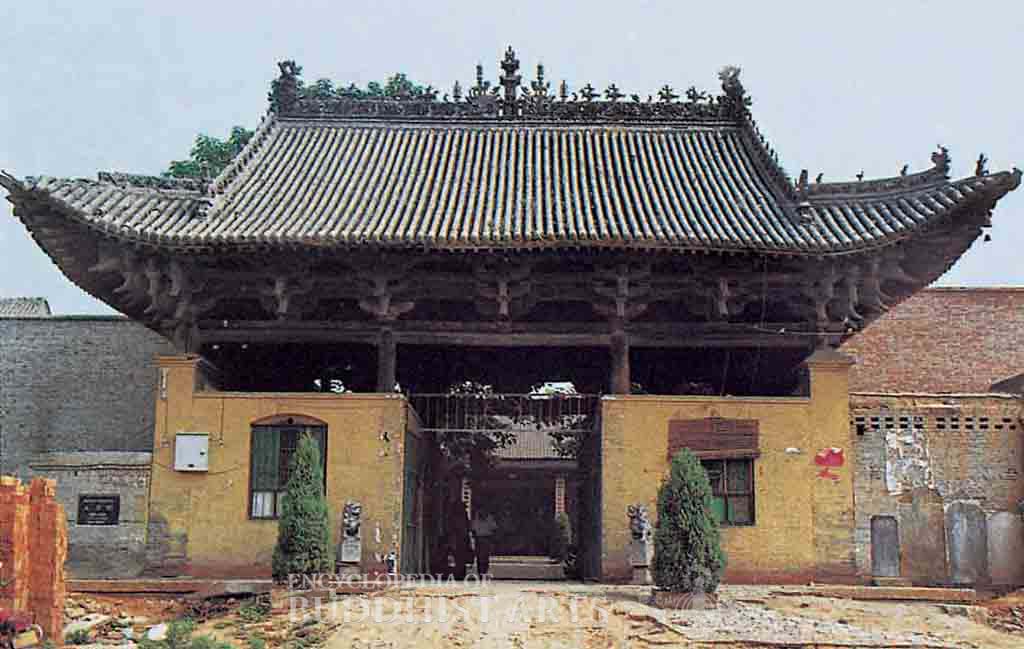
Dabei Yuan Temple: Contribution Hall
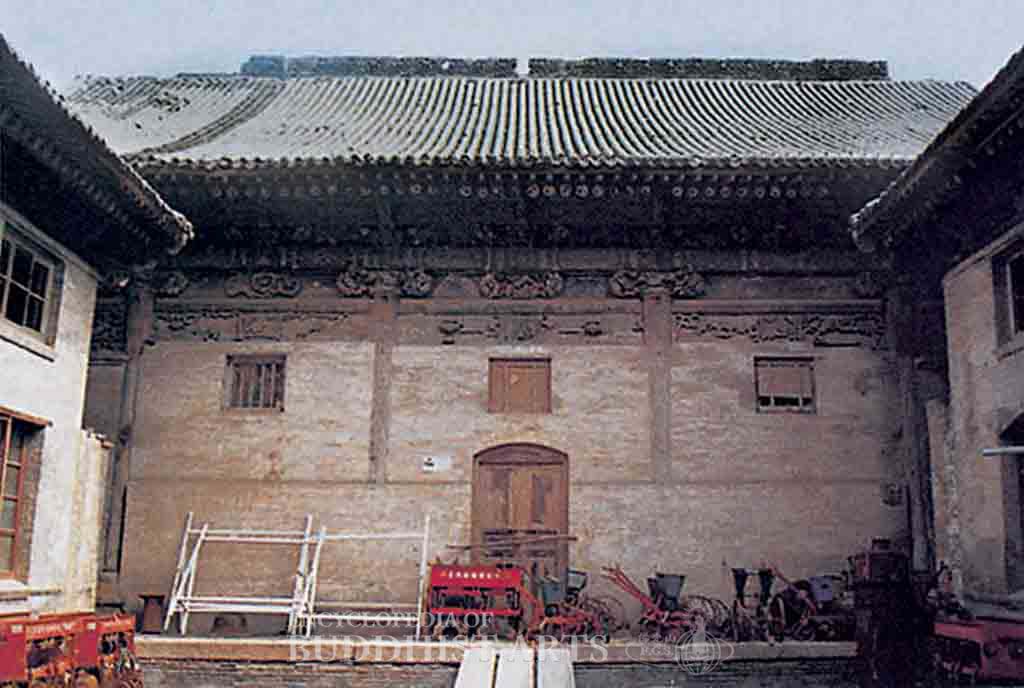
Dabei Yuan Temple: Heavenly King Hall
Dabei Yuan Temple
CHINA, Shanxi, Linfen
Dabei means Great Compassion. Constructed in 827 during the Tang dynasty, the temple was renovated in 1067 during the Northern Song, in 1180 during the Jin, and in 1758 during the Qing dynasties. The temple was listed as a National Cultural Heritage Site in 2001.
The temple faces south and occupies 4,000 sq m. Extant buildings include the Contribution Hall, intermediate hall, Heavenly King Hall, and side chambers. Apart from the Contribution Hall, which is the original Jin dynasty (1115–1234) construction and the only building left standing after the 1303 Pingyang Earthquake, all the other buildings are from the Qing dynasty (1644–1911).
The three-by-three bay Contribution Hall has a single-eave hip-and-gable roof covered in cylindrical tiles. The framework within the hall is exposed, showing perfectly preserved architectural elements, such as the inverted V-shape braces, supporting inclined struts, and camel-hump braces. The intercolumnar bracket sets and the bracket sets on the capitals are in two tiers with two sets of downward-pointing cantilevers.
The five bays wide Heavenly King Hall has a single-eave flushed gable roof covered in cylindrical tiles. The capital blocks located above the columns or in between them are decorated with carvings of peonies, while the architraves feature Heavenly Kings and intertwining flowery motifs. The upper architraves are painted with round floral patterns. All these are distinct features of Qing architecture.
For more details, go to the Encyclopedia of Buddhist Arts: Architecture A-F, page 182.
Cite this article:
author = Hsingyun and Youheng and Johnson, Peter and Mankuang and Lancaster, Lewis,
booktitle = {Encyclopedia of Buddhist Arts: Architecture A-F},
pages = 182,
title = {{Dabei Yuan Temple}},
volume = 1,
year = {2016}}