
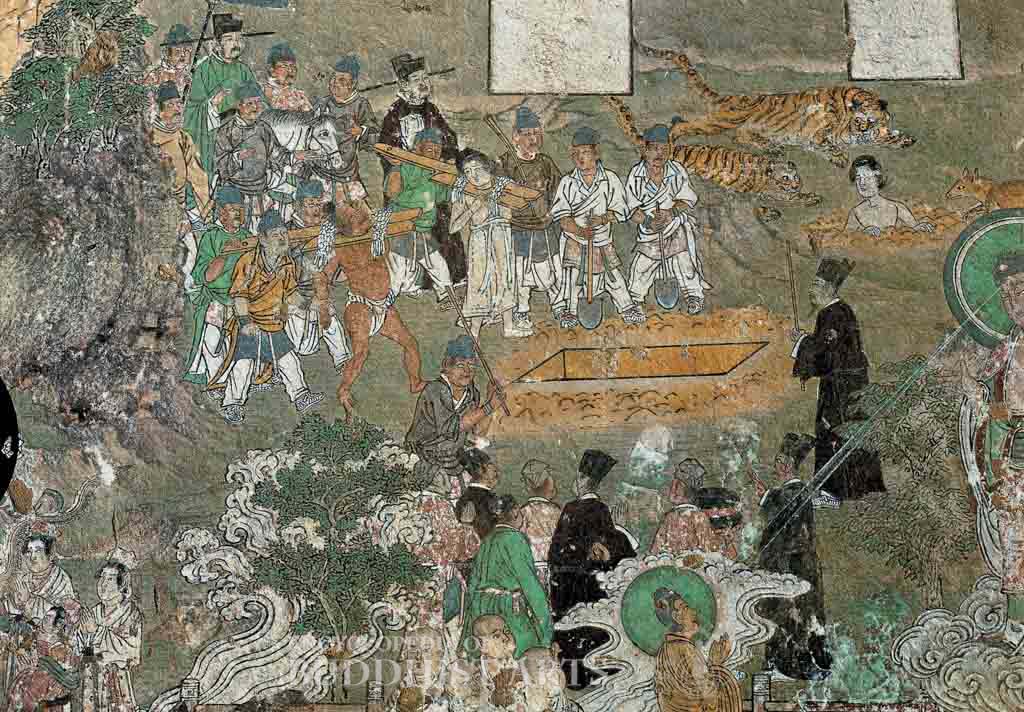
Kaihua Temple Great Hero Hall: Illustration of the Returning Favors Sutra - Chapter on Kindness
Kaihua Temple Great Hero Hall: Illustration of the Returning Favors Sutra - Chapter on Kindness
CHINA, Shanxi, Jincheng; Northern Song dynasty
Located on the west wall of the Great Hero Hall, this segment of a mural is painted with scenes from the story of Utpalavarna, who suffered abuse and met with misfortune all her life before becoming a Buddhist nun. According to the “Chapter on Kindness” in the Returning Favors Sutra, when Utpalavarna was pregnant, local custom required that she return to her parent’s home to give birth. While traveling to her hometown with her husband and young child, she gave birth to the new baby. Soon after, her husband was bitten by a poisonous snake and died, one of her children was swallowed by a hungry tiger, and the other drowned in a river. Later, Utpalavarna was told that her parents had died in a fire at their home. After so many misfortunes in succession, she was then kidnapped by a thief and forced to become his wife. When the thief was arrested by the government and sentenced to death, Utpalavarna was buried alive with him, only to be set free by grave robbers. The chief of the grave robbers forced her to marry him, but soon after he was sentenced to be buried alive for robbing the grave, and Utpalavarna was buried with him. However, tigers and wolves dug up the grave and she escaped. Soon after, Utpalavarna heard the Dharma of Sakyamuni Buddha and felt inner peace for the first time in her life. With this happiness in her heart, she decided to become a Buddhist nun.
The mural shows an execution site. The prisoner, stripped of his clothes, is restrained in a cangue and escorted by guards. Wearing a green robe and riding a tall horse, a government officer follows behind the guards. Utpalavarna, also restrained in a cangue, walks forward with a hopeless expression. Executioners wait beside the burial pit with shovels. Onlookers are shown at the bottom of the picture. In the top right corner of the image, Utpalavarna is shown emerging from the ground, surrounded by two tigers and a wolf.
For more details, go to the Encyclopedia of Buddhist Arts: Painting I-O, page 405.
Cite this article:
author = Hsingyun and Youheng and Youlu and Wilson, Graham and Manho and Mankuang and Huntington, Susan,
booktitle = {Encyclopedia of Buddhist Arts: Painting I-O},
pages = 405,
title = {{Kaihua Temple Great Hero Hall: Illustration of the Returning Favors Sutra - Chapter on Kindness}},
volume = 15,
year = {2016}}