
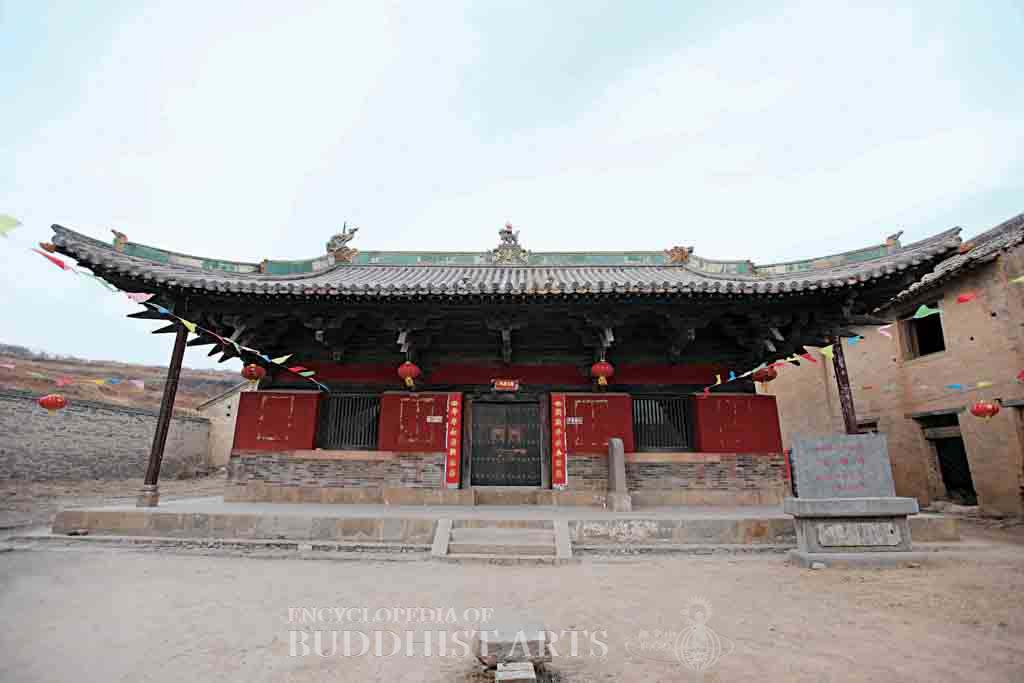
Chongming Temple: Middle Hall

Chongming Temple: Middle Hall - Duanliang
Chongming Temple
CHINA, Shanxi, Jincheng
Chongming stands for Esteemed Brilliance. Built between 968 and 976 during the Northern Song dynasty, it was expanded during the Yuan dynasty (1271–1368), then renovated in 1591 during the Ming and 1826 during the Qing dynasties. It was listed as a National Cultural Heritage Site in 2001.
The temple faces south and consists of two courtyards. The surviving buildings include the main temple gate, bell and drum towers, middle hall, rear hall, as well as side halls.
The middle hall, built in Tang dynasty (618–907) style, has a single-eave hip-and-gable roof and a three-bay by six-rafter structure. The gradient of the roof is gentle. The eaves are noticeably extended, with the corners curved upwards and supported by two projecting bracket arms and double downward-pointing cantilever. The roof constitutes almost half of the building’s height. Within the hall, the roof frame is exposed, clearly showing two corner tie beams laid at a 45 degree angle upon the corner beams. Where the two corner tie beams meet, they crossover like bowknots, otherwise known as duanliang (broken beam). This particular feature is unique and is found nowhere else in Chinese architecture.
For more details, go to the Encyclopedia of Buddhist Arts: Architecture A-F, page 160.
Cite this article:
author = Hsingyun and Youheng and Johnson, Peter and Mankuang and Lancaster, Lewis,
booktitle = {Encyclopedia of Buddhist Arts: Architecture A-F},
pages = 160,
title = {{Chongming Temple}},
volume = 1,
year = {2016}}