
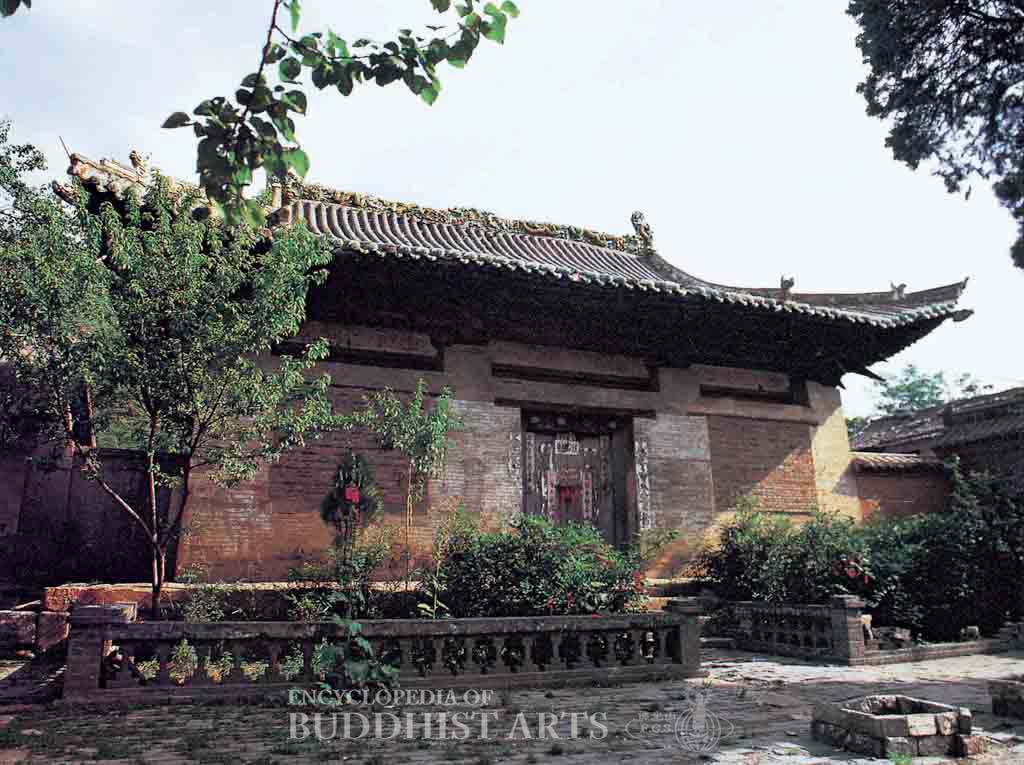
Chongqing Temple: Hall of the Three Great Bodhisattvas
Chongqing Temple
CHINA, Shanxi, Changzhi
Chongqing means Esteemed Celebration. This temple was built in 1016 during the Northern Song dynasty, although the statues were not enshrined until 1079. Various renovations and expansions were conducted during the Ming (1368–1644) and Qing (1644–1911) dynasties, but the layout and some buildings have been preserved in their original forms. It was listed as a National Cultural Heritage Site in 1996.
The temple faces south and consists of two courtyards. The buildings located along the central axis include the Heavenly King Hall and Thousand Buddha Hall, with the Reclining Buddha Hall and Hall of the Three Great Bodhisattvas located on either side. The Ksitigarbha Hall is located in the northwest corner, while the abbot’s quarters are in the northeast.
The Thousand Buddha Hall is the main hall of the temple and has a three-bay by six-rafter structure. The Hall of the Three Great Bodhisattvas contains the Three Great Bodhisattvas, as well as the Eighteen Arhats. Within the Ksitigarbha Hall there are statues of Ksitigarbha Bodhisattva and the Ten Kings of Hell.
For more details, go to the Encyclopedia of Buddhist Arts: Architecture A-F, page 161.
Cite this article:
author = Hsingyun and Youheng and Johnson, Peter and Mankuang and Lancaster, Lewis,
booktitle = {Encyclopedia of Buddhist Arts: Architecture A-F},
pages = 161,
title = {{Chongqing Temple}},
volume = 1,
year = {2016}}