
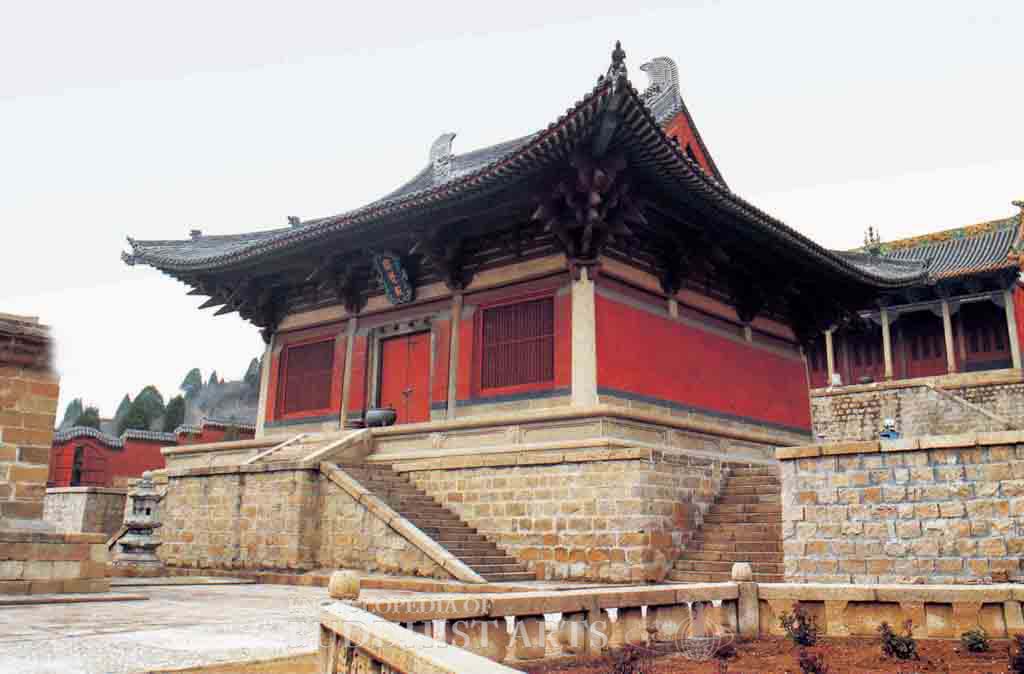
Faxing Temple: Perfect Enlightenment Hall
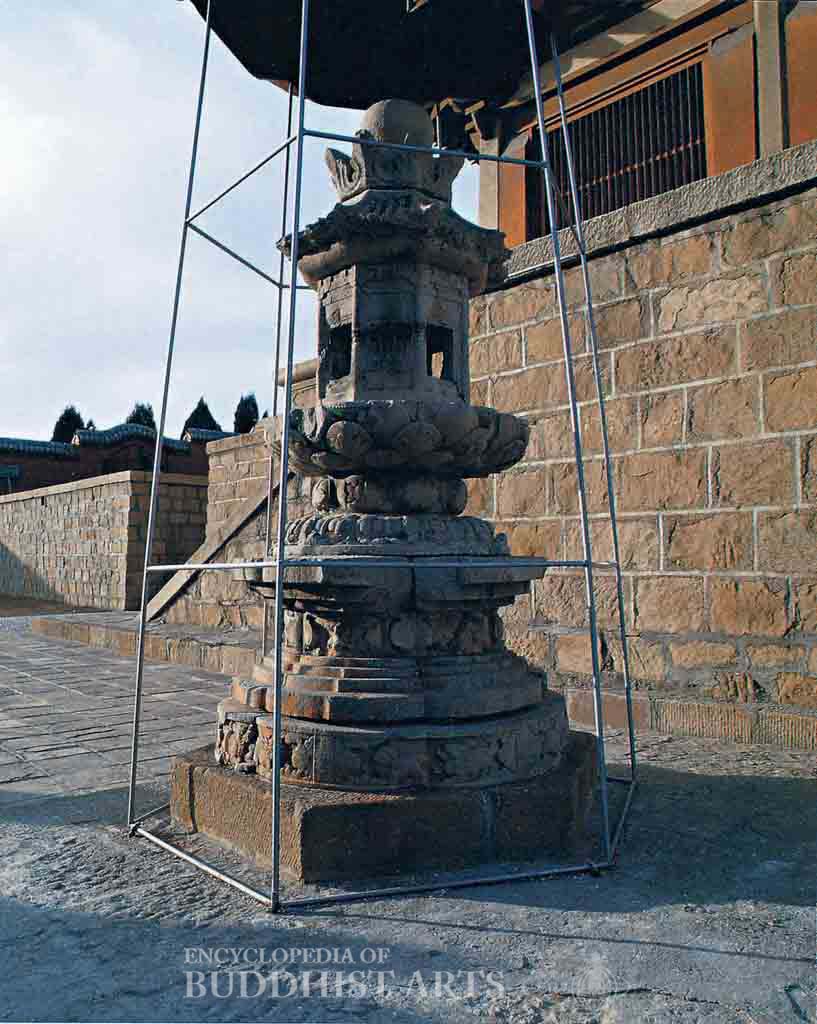
Faxing Temple: Lantern Pagoda
Faxing Temple
CHINA, Shanxi, Changzhi
Faxing means Dharma Prosperity. It was built in 400 during the Later Liang Kingdom. It underwent expansion between 670 and 674 during the Tang dynasty. The temple was forced to relocate to Cuiyunshan (Blue Cloud Mountain) in 1984 when the ground cracked and collapsed due to mining. The temple was listed as a National Cultural Heritage Site in 1988.
Facing south, the temple was built along the mountain slope. The buildings along the central axis are the main temple gate, Relic Pagoda, Lantern Pagoda, Perfect Enlightenment Hall, Bodhisattva Hall, with two side buildings called Lord Guan Hall and Sangharama Hall, and a stele passageway.
The Lantern Pagoda is 2.3 m high and constructed from limestone. Above the octagonal base there are two layers of Sumeru bases. The very top layer of the Sumeru base is shaped like a lotus while the concaved waist section has half-blossomed lotuses. The lantern body itself is hollow with images of doors carved onto the walls facing the four cardinal directions. The remaining walls are carved with false vertical bar windows. On the pyramidal roof, a ring of plantain leaves support a jewel-like spire.
Built in 945 during the Later Jin dynasty, the Perfect Enlightenment Hall was considered to be the most important building of the temple. It was later rebuilt in 1080 during the Northern Song dynasty. The roof is covered in cylindrical tiles and has glazed greenish-yellow tiles bordering the sides, which were most likely added later. It has a three-by-three bay structure which sits on a platform base constructed from slabs of stone. The concaved waist section of the Sumeru base is interspersed with simple flower motifs, a rather unique design seen in no other Tang or Song Buddhist buildings. All the wooden columns were replaced with stone columns including the framework of the roof, a feature that became popular during the Song dynasty. A U-shaped altar is located in front of the partitioned wall. Statues of Sakyamuni Buddha, immediately flanked by Mahakasyapa and Ananda, then Manjusri and Samantabhadra Bodhisattvas, are enshrined on the altar. Before them there is a pair of warriors. Twelve Perfect Enlightenment Bodhisattvas line the walls, six on each side.
For more details, go to the Encyclopedia of Buddhist Arts: Architecture A-F, page 292.
Cite this article:
author = Hsingyun and Youheng and Johnson, Peter and Mankuang and Lancaster, Lewis,
booktitle = {Encyclopedia of Buddhist Arts: Architecture A-F},
pages = 292,
title = {{Faxing Temple}},
volume = 1,
year = {2016}}