
Quhui Temple Mound of Stone Carvings
Quhui Temple Mound of Stone Carvings
CHINA, Shanxi, Datong
The carvings are located in Quhui Temple village. According to the records, the temple was built by Chan Master Huigan in 733 during the Tang dynasty by imperial order. It was actually the lower temple of Qingliang Temple. The temple was repaired a few times before it was destroyed by fire in 1973.
A total of 306 mounds were built by imperial order in 751 during the Tang dynasty. These structures covered an area of approximately 20 sq km. Underneath the mounds there are stone carvings. Forty-three mounds have been confirmed to be part of the original 306. They are located behind the temple village in Jiulonggang (Nine Dragon Hill) and Qiyeshan (Banner Leaf Mountain). The site was listed as a National Cultural Heritage Site in 2001.
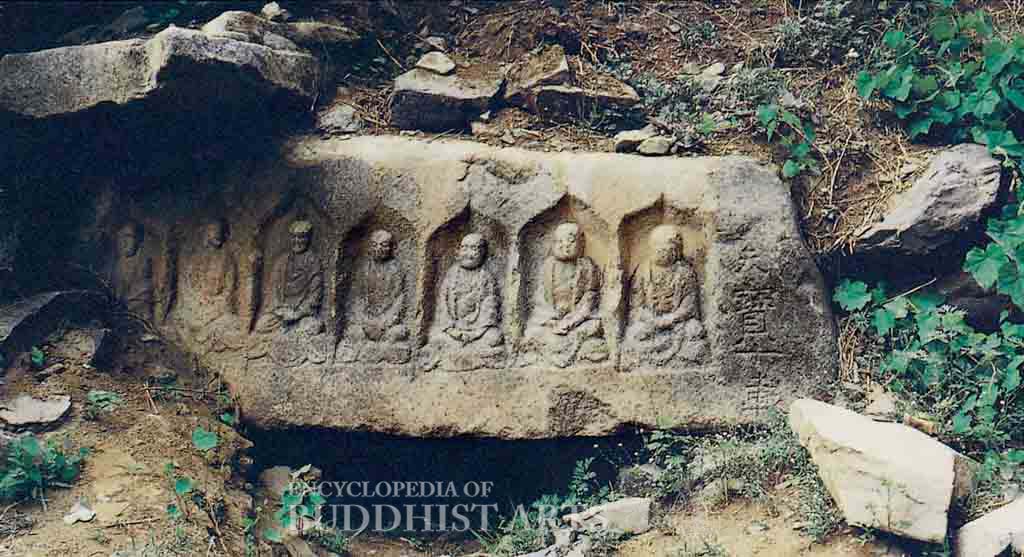
The stone carvings resemble grave mounds constructed with stone slabs. Their sizes vary but they are usually 3 m to 4 m high with a circumference of approximately 30 m. On the stone doors sealing the tombs there are relief images of the monks that the pagodas are entombing, with their Dharma name inscribed above the images. Various stone carvings are lined up neatly within each mound cave. The number of carvings varies from mound to mound but at most they contain 30 carvings, and while the largest measure 150 cm, the smallest are barely 30 cm high. The carvings depict Buddhas, Bodhisattvas, and donors. This group of structures is the only existing example in China with this scale and sheer number of mounds.
For more details, go to the Encyclopedia of Buddhist Arts: Architecture M-S, page 890.
Cite this article:
author = Hsingyun and Youheng and Johnson, Peter and Mankuang and Lancaster, Lewis,
booktitle = {Encyclopedia of Buddhist Arts: Architecture M-S},
pages = 890,
title = {{Quhui Temple Mound of Stone Carvings}},
volume = 3,
year = {2016}}